
THEY SEEMED NEITHER, AND YET BOTH
Elle Hendrickson’s They seemed neither, and yet both, on view at the Quonset Hut
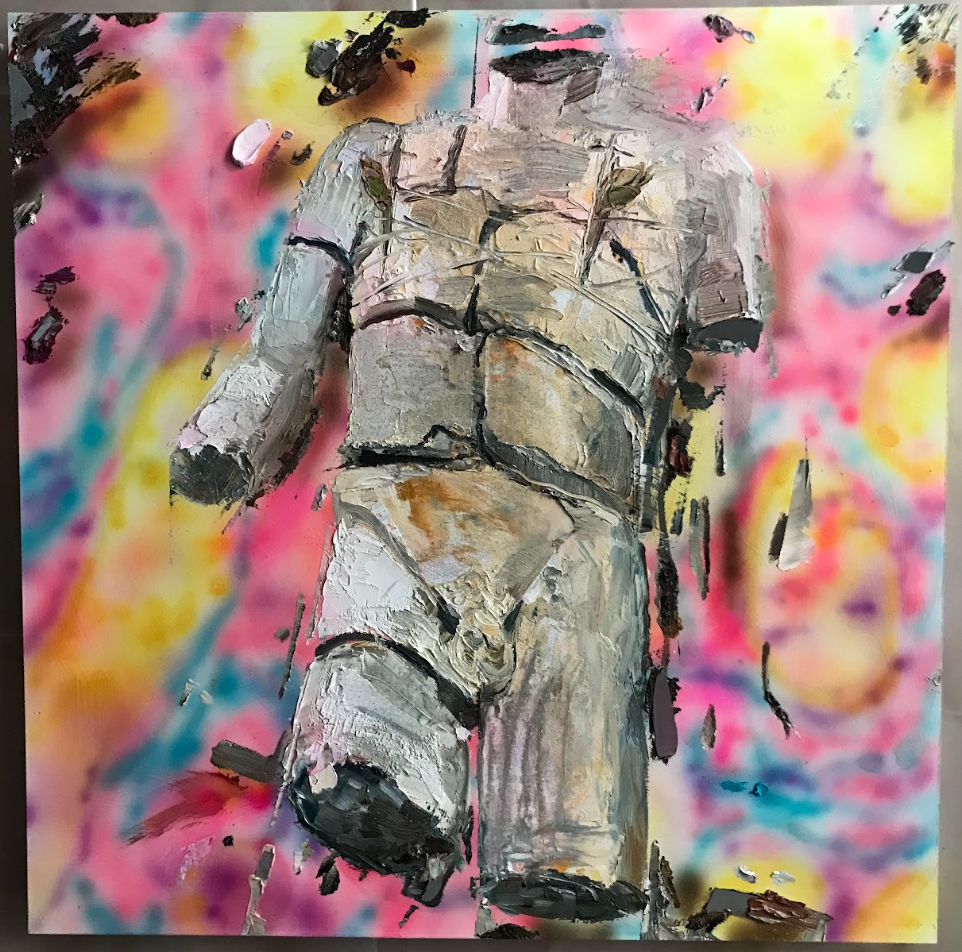
Elle, Hendrickson, Querelle, oil and acrylic on panel, 2026, photos via Elle Hendrickson and Quonset Hut
They seemed neither, and yet both, Elle Hendrickson's solo exhibition at Quonset Hut takes its title from Ovid’s Metamorphoses. Hermaphroditus, born son of Hermes and Aphrodite, goes for a dip in the natural spring waters of the nymph Salmacis. Her effeminate, gushing fount is so powerful that Hermaphroditus fuses with Salmacis. They transition to become one integrated, gender-fluid, androgynous being.
Hendrickson expresses and affirms their gender-expansive experience by locating this mythology as they see it in nature, particularly in the kinship they feel with co-sexual, hermaphroditic trees, like the gender-bending Ginkgo and Tulip Poplar. The imagery of tree merging with body and body being cut like tree draw parallels between the horticultural technique of grafting with gender-affirming medical practices like hormone therapy, sex change operations, and plastic surgery.
In Querelle (2026), limbs have gone under the axe, and a scarred torso-stump is extracted foreground atop bright, neon-pastel airbrush that resembles cell division under a microscope. The work conveys the state of liminality and vulnerability that exists after violence, violation, or extraction to the body. The bright colors of the background lighten the mood. A picture of a friend awakening from top-surgery comes to mind. Most evident in this picture is relief. A great weight has been lifted. Our scars can be battle wounds and badges of honor both.
In Resting Hermaphroditus (2026), the energy of liminality shifts to whimsical repose. Here is a form that is not afraid to take up space. The same bright, airbrushed backdrop is now set against a robust, round vessel that we might imagine is filled to the brim with the alchemized fluids of a fully realized, fully fused, hormonally balanced Hermaphroditus.
Founding Feathers (2026) re-imagines John James Audubon's Carolina Parakeet with unleashed whimsy. The painting depicts thickly-textured, green-bodied, extinct birds whose quarter-sized heads are American founding fathers. Hendrickson’s work leads these parakeets to the fountain of femininity, where they may drink the patriarchy into extinction.
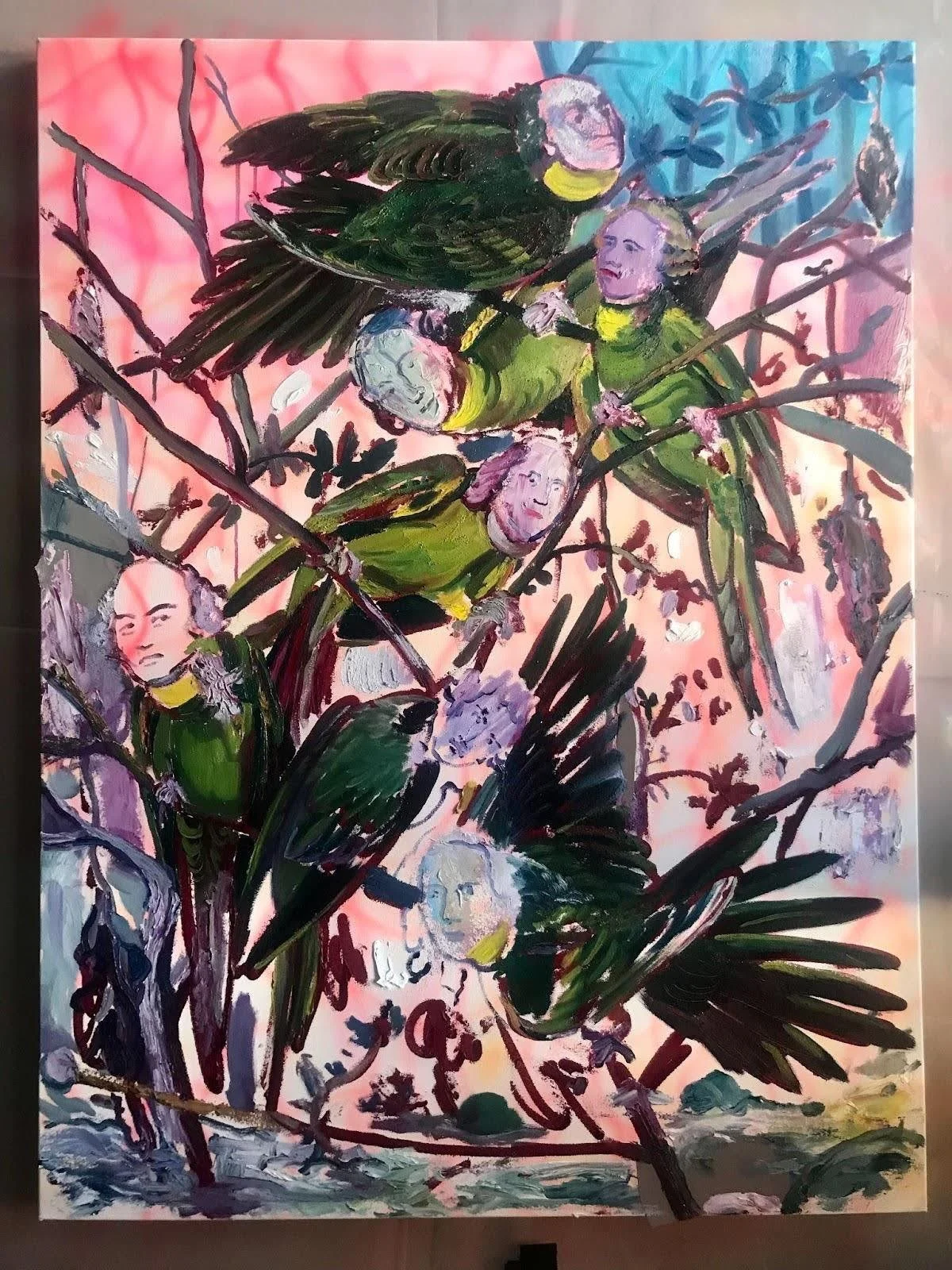
Elle, Hendrickson, Founding Feathers (After J.J. Audubon's Carolina Parakeets), oil and acrylic on canvas, 2026
The motif of the vessel continues. Olympian (2026) depicts an amphora, a two-handed, narrow-necked, ancient Roman trophy-goblet, symbolizing “unity of virtues of mind and body.” Hendrickson’s vessel is fixed with the fading face of a boyish youth. It seems like Hendrickson’s inner child or Hermaphroditis pre-transition. Behind the face, we glimpse a worn pharmaceutical logo of 5mg estradiol. I’ve been Hendrickson’s partner before and after they started hormone therapy, so I can personally attest to estradiol as MVP in their battle against gender dysphoria and its associates: anxiety and depression. To me, Olympian champions Elle’s bravery in coming out as trans/non-binary and undergoing legal name change. Gender-affirming healthcare, like this trophy, signal the attainment of “unity of virtues of mind and body.”
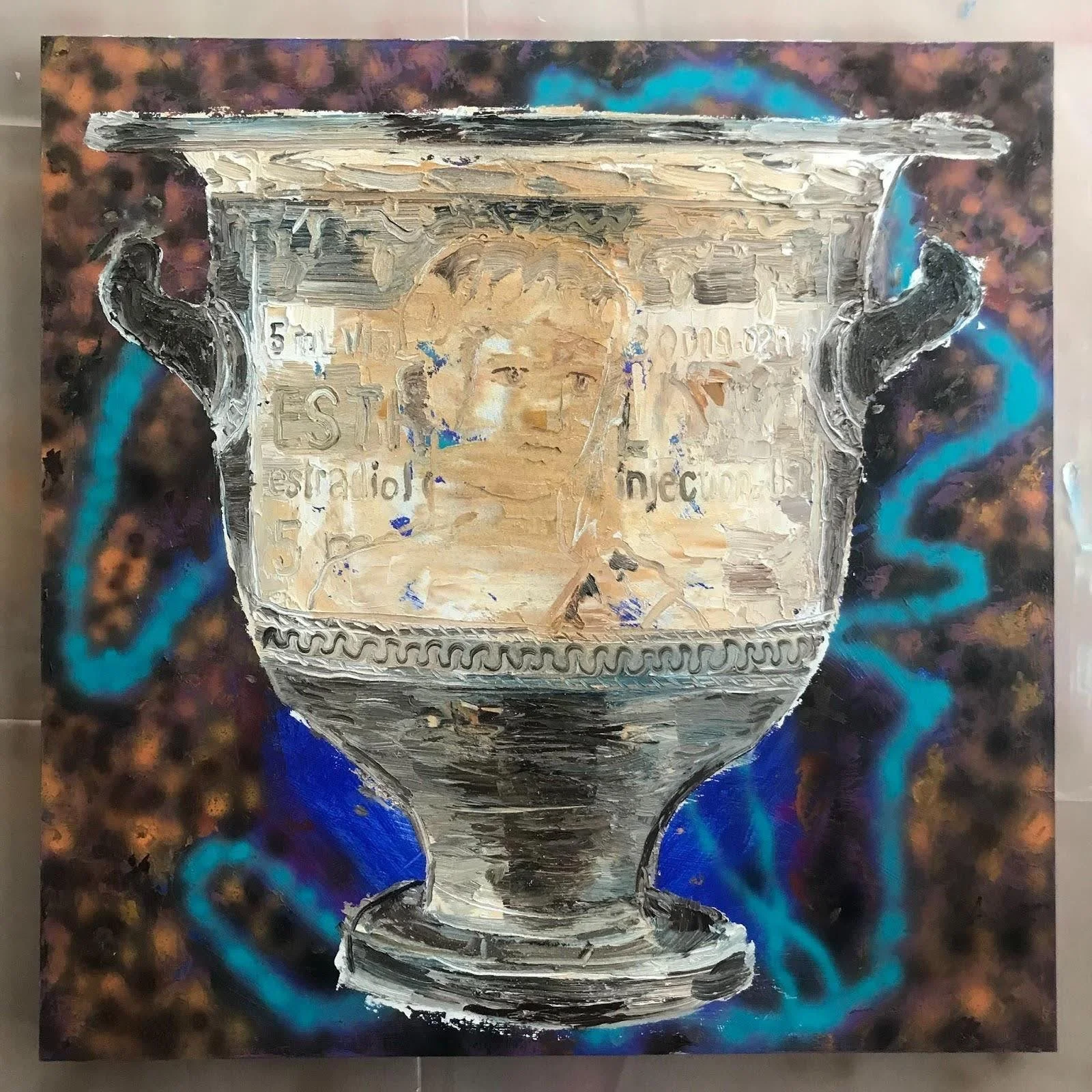
Elle, Hendrickson, Olympian (Amphora), oil and acrylic on masonite, 2026
Like a koan or myth, Hendrickson’s paintings function on many levels. This is especially true for the paintings rendered on silver screen, a reflective fabric with microscopic beads of glass embedded in its surface. The material is most commonly used in athletic gear, or the stripes on crossing-guard vests. The elusive, ephemeral material has the power to conceal and reveal the paint, depending on how it exists in relation to light and shadow. This interplay of concealing and revealing makes the painting impossible to capture or contain in one glance, which adds to its power and allure.
The viewer is challenged to activate the work. This challenge, if accepted, brings the viewer to a threshold. Amidst the predictable tableaux of stiff, unmoving patrons standing before a painting at an appropriate social distance emerge “the seekers". The seekers dart and shift like birds, undulating their necks, perching at the bottom edge of a painting to gaze upward. Some wield iPhone flashlights like a detective’s magnifying glass and inspect every inch of a painting for its hidden images and messages. Others discover tree-stump candelabras on the snack table that illuminate more than the charcuterie boards. If we gaze at the silver-screen paintings through candlelight, halos and rainbows abound!
Crossing the threshold is an initiation into new ways of relating and receiving. My conception of the mediums Hendrickson uses expands beyond paint on surface to include light, shadow, and the embodied participation of the viewer. And yet, that’s not all. Mythological elements are at play. Core mystical teachings are embedded in the work.
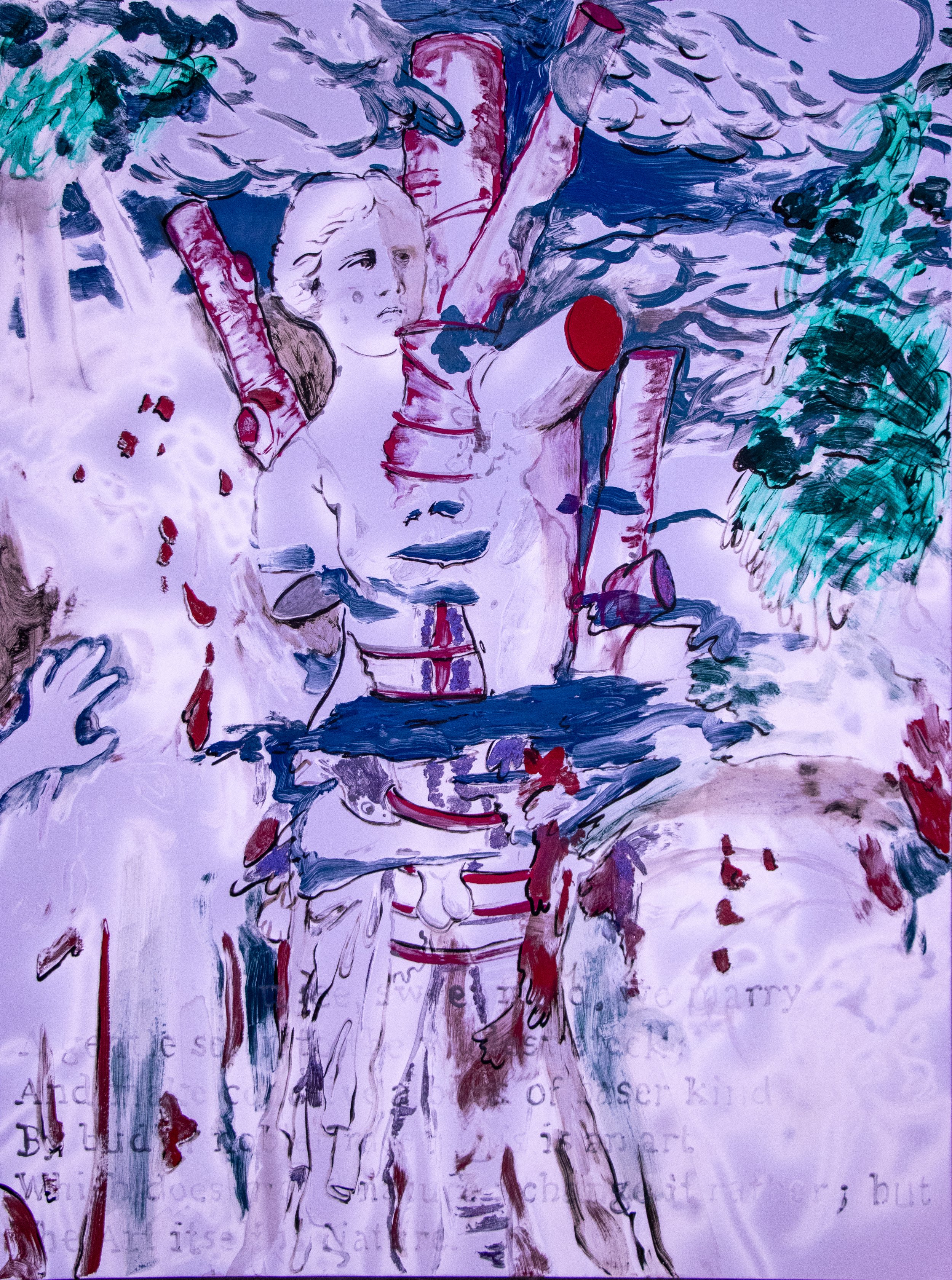
Elle, Hendrickson, The Art Itself is Nature, acrylic and fluorescent gouache on silver screen, 2026
In Greek mythology, nymphs are feminine nature spirits that reside in and protect the place where they are rooted. Nymphs are both a place and the personification of that place. Salmacis, the notoriously horny and aggressive nymph in Ovid’s Metamorphoses, is synonymous with an ancient, defunct fountain or spring located in modern-day Turkey. But to reduce Salmacis to this dried up place would be as slanderous as serving you the silver screen paintings as I have seen them in their most dormant form — lined up in the dark, cluttered hallway of the apartment. Salmacis, in her fullest incarnation, is the divine feminine revealing herself in the form of an alluring fountain, pond, natural spring, or pool.
What activates or is transmitted in the exchange between skinny-dipper and pond, or painter and painting, or seeker and finder, is the dynamic, cosmic, primordial, feminine energy that pervades all aspects of life. This uncontainable feminine force goes by many names. I know her as Shakti.
It is Shakti’s nature to conceal and reveal, and to take on many forms, just like the silver-screen paintings. In this light, The Art Itself is Nature (2026) could also be titled The Art Itself is Nymph, because the art personifies and transmits the mystical qualities of Shakti.
My friend brought a shy, young trans woman who she was hosting from out of town to the opening reception. The next day, she texted to say, her friend, “almost cried thinking about the art exhibition because it was the first time she experienced art made for her. It made her feel seen and beautiful.” Receiving Shakti’s transmission will move us and fuse us.
In Porous Vessel (2026), I encounter the divine feminine in the form of the mushroom, signifier of death and decay. I contemplate the living-dying vessel that is my body. What is dying? What is being composted? Meanwhile, the neighbor beside me is moved by the mystery. They want to know if the base of this vessel is butt, balls, or boobs.
The only answer of course is, “They seem neither, and yet both.”
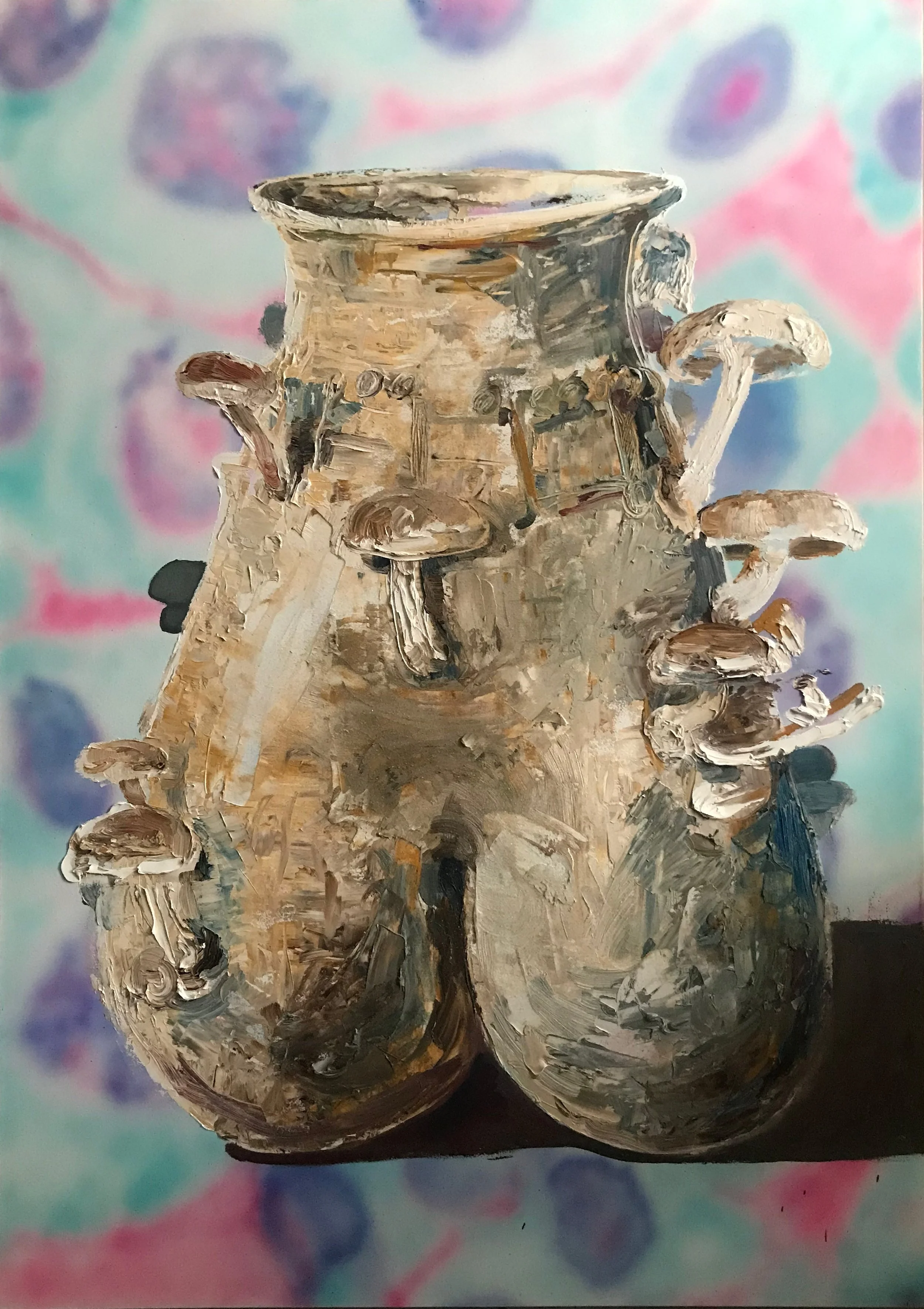
Elle Hendrickson, Porous vessel, oil and acrylic on canvas, 2026