
MIRAGE AND CONSEQUENCE WITHIN THE SUBURBAN MICROCOSM
Trey Abdella’s Bug Bites on view at KMAC Contemporary Art Museum.
Trey Abdella, Sealed with a Kiss, 2023. Photos via Max Trumpower.
There’s something familiar about the atmosphere created within Americana horror. Mediating between kitsch and craft, writers such as Stephen King invite readers into a landscape all of its own—somewhere between quintessential American literature, the uncanny, and the bizarre. As a genre, these facets of media capture the unexpected that lurks beneath the surface whilst breaking the facade of American exceptionalism. Through this subversion of normalcy, a unique heterotopia is created via brazen exploration of material and discomfort. Bug Bites, an exhibition by Trey Abdella on view at KMAC Contemporary Art Museum, faces this kitsch head on through the accumulation of objects and images of a neighborhood not too far away, and maybe even serves as a parallel to our own.
Alternating on the spectrum between high relief sculpture and textured canvas, Abdella creates a world that straddles the line between spectator and participant, distance and proximity. Bug Bites is an exploration into nostalgic Americana through utilizing metaphors of birth, death, and becoming through an obscuration of scale. Intense size abstraction, motion, and material shifts challenge the viewer to consider the hierarchy of importance within each painting. This immediate recognition of suburbia lends itself to the relatability of content, yet is distanced through abstraction of reality. This series of works acts as a visual display of the disjointment between ideals of American exceptionalism and imagery of insect life cycles—insinuating a certain violence that is inherent to these ideas.
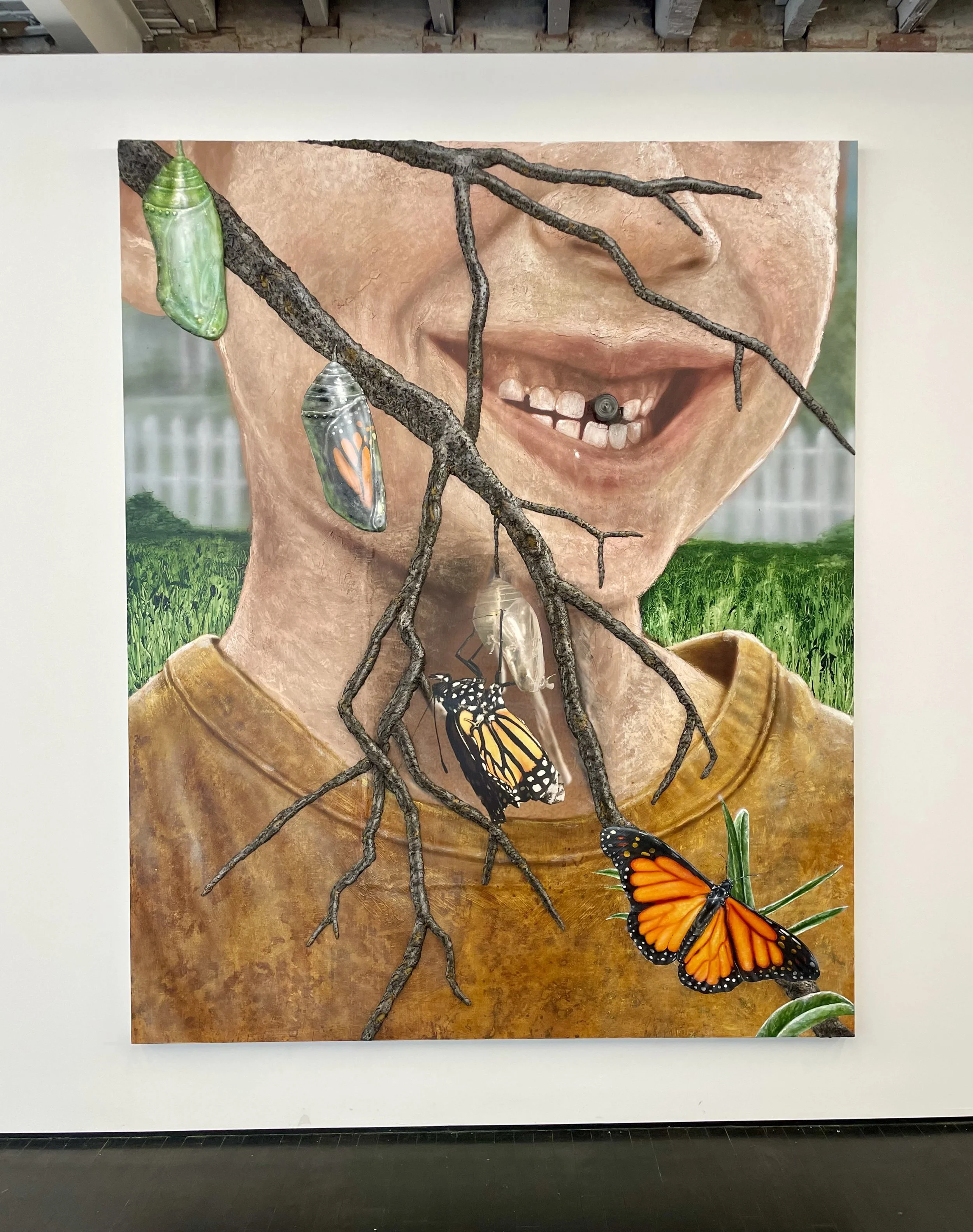
Trey Abdella, Loose Tooth, 2022.
I am drawn in by landscapes familiar to this fictional home; images of Southern suburbia in autumn beckon associations of Halloween, trickery, and the all-too-familiar damp heat that brings creatures to the surface. Confronted by scale in every aspect of the work, I am asked to question my relationship to the space, the surface quality of the work, and the iconography displayed in a context similar to that of my own front doorstep in southern suburbia. Through massive paintings, architecture, and sculptural elements, Abdella’s work dominates wall space through attention to detail, holographic elements, and the low buzz of a projector’s whirl—reminiscent of late summer insects.
Walking into the gallery space, viewers are greeted by an immense painting parallel to the entry. Loose Tooth (2022) exhibits illusions of depth, flat surfaces, and three-dimensional aspects that trick the eye into believing in a certain depth. Abdella’s utilization of lenticular prints within his paintings creates an apparition shuffling cards between images of our world and potential futures stuck within a moment of time.
Flying in controlled chaos, a buzzing fan demands immediate attention, serving as a visual function for the front tooth amidst the darkness of space. Across the image a branch protrudes from one corner to the other, creating a stabilizing foundation in which the stages of chrysalis are anchored within the foreground of the work. In the center of the painting, I am confronted with a lenticular print collaged within the work. Which do I choose to observe first? Which elements force my body to move around the work and engage with a painting as a sculpture? This seamless integration of print to sculpture to paint is what makes this body of work so compelling. Abdella has a clear language presented that transcends medium through sophisticated integration of material and craft skills, or material intelligence.
A representative of American culture, Abdella’s work speaks to a Norman Rockwell abstraction of reality. Through this materialization of American exceptionalism, we are left with a distant aftershock, resulting in the dissolution of societal rules. Abdella successfully captures these tense moments prior to the pin drop, where time stands still—but time in this world operates differently. Such ideas are emphasized in his work, Sealed with a Kiss (2023). The craft and care present in the materiality of the mosquito speaks to a larger conversation of intentionality within the work. Abdella displays this exact kind of care in the assemblage of such a creature, activating a topical space on top of painting that creates an invitation for deeper inspection. Down to the minute details, Abdella has abstracted the form of mosquitoes through the utilization of unconventional materials to ascribe an uncanny likeness of a genuine, large-scale mosquito. This confrontation with scale causes a visceral discomfort, but also sparks an intrigue that is much stronger: to peer closer at the underbelly of the beast.
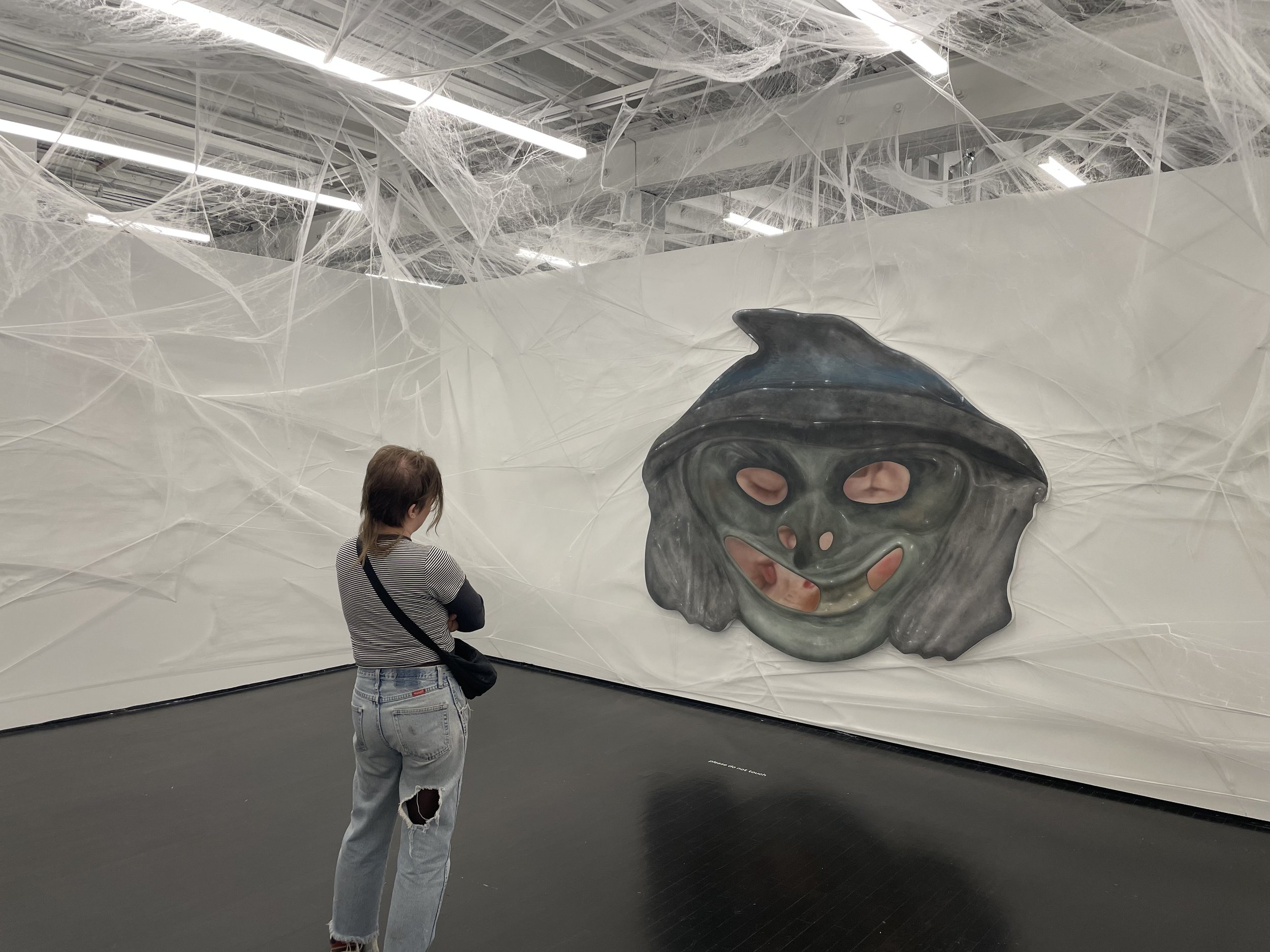
Trey Abdella, Through Your Eyes, 2023. Installation view.
Abdella has trained classically in figurative oil painting, which comes as no surprise while viewing the integrity of the painting quality. His attention to texture provides the perfect base for any physical sculptural elements, and lends itself that much more to the integration of material. Much of the canvas itself is manipulated beyond paint and epoxy, but is handled in a way that three-dimensional mosquito bite lumps rise above the textured ground of the canvas. Inspired by animatronics, he has mechanically engineered elements of a pump protruding from the mosquito, mimicking real encounters through near-autonomous puppetry. I am fascinated by the planar relief and levels of disruption to negative space, which is frankly hard to pin within traditional two dimensional surfaces. Expectation is thus successfully broken and pushed into ways of activating space above the painting’s surface, both in the physical and immaterial.
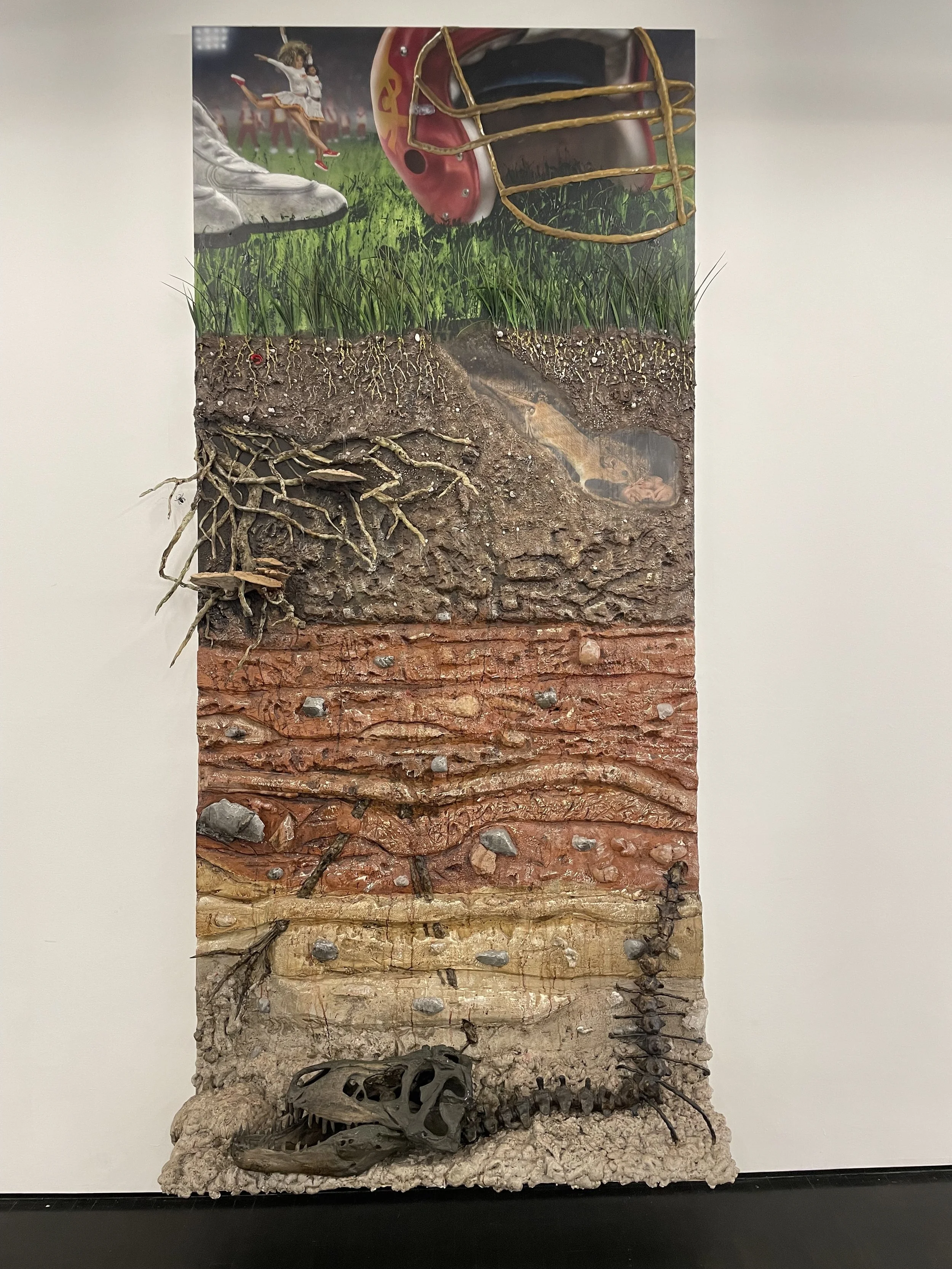
Trey Abdella, Six Feet Under, 2022.
Hidden behind several walls is an installation defining its own room defying the expectations of wall space. Cobwebs are strewn around the painting and around the enclosure, integrating the wall and ceiling space as a means of consuming those witnessing this work. Confronted with intense distortion, viewers of the work peer into the inside of a Halloween mask onlooking a couple’s embrace. In Through Your Eyes (2023), there is a clear pang of jealousy, otherness, and loneliness present through this lens. Maybe the viewer has stumbled upon an embrace that they were not meant to witness. As if emerging from the body, the viewer is distancing themself from the mask, becoming observer rather than participant in the viewing of this passion. Abdella includes these cobwebs not only as a reference to an ongoing theme present, but to the notion of recording memory. Similar themes of being on the inside looking outwards are prevalent in the work right outside of the enclosure, Jack O’Lantern. I am shrunken down to the size of a tealight candle, witnessing the world beyond my pumpkin home. Jack O’Lantern is another fantastic example of distortion of scale not only within the painting, but challenges how the viewer approaches their size relationship to the scenario that is presented. Abdella’s skill in rendering by means of paint again scratches an itch of sculpture and two dimensions, blurring the lines between each as its own classification or categorization.
Falling between kitsch, science history, and art museums, Abdella’s work can function in several capacities. This notion rang true upon viewing Six Feet Under (2022), which could exist without question in other places outside of the art museum institution. Playing on elements of stage and set design, Abdella utilizes materials such as paper mache and foundational elements for sculpture in order to create a layering of organic material beneath the soil that is believable, but lacks the real authenticity of bone. The viewer understands the falsehood of these elements, but is still understanding what these objects are representative of. Staged above layers of earth, a football game takes place amidst the turbulence beneath the soil. Viewers are drawn in to question what lies beneath our own foundations, what histories are being built over, and what role do humans actually occupy in terms of the infinite microcosms within earth’s core?
Despite differences in what is being observed about each work or the physical means of objects being presented, this series of paintings as objects as sculpture define an uncanny reality that lives right outside our periphery, a world where imagination wanders and time stands still. In this snapshot of a disparate reality, where do our own narratives become a collective understanding of circumstance?
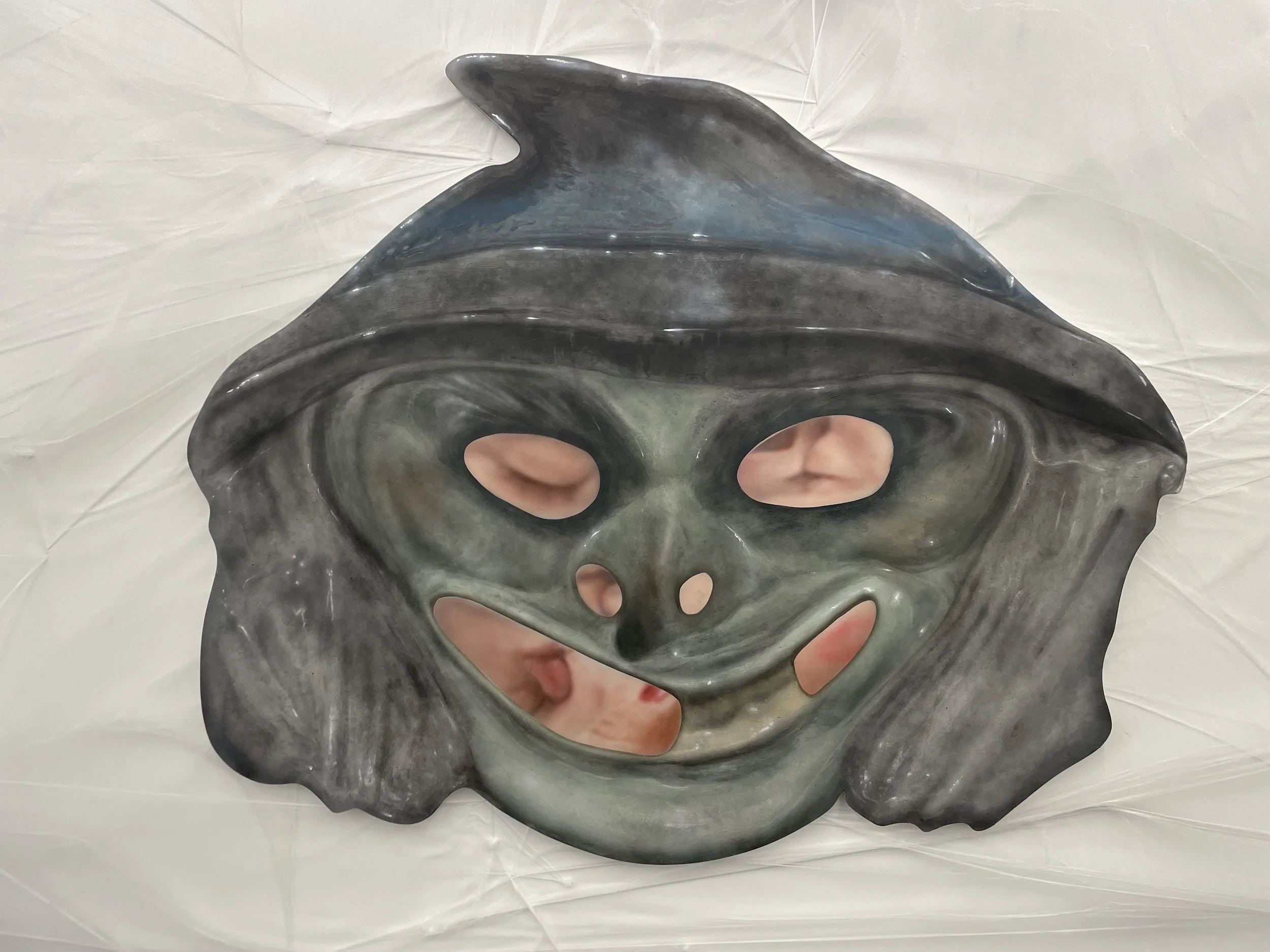
Trey Abdella, Through Your Eyes, 2023.