
JOHNNY RYSTER: THE MAN ON HOGTOWN RIDGE
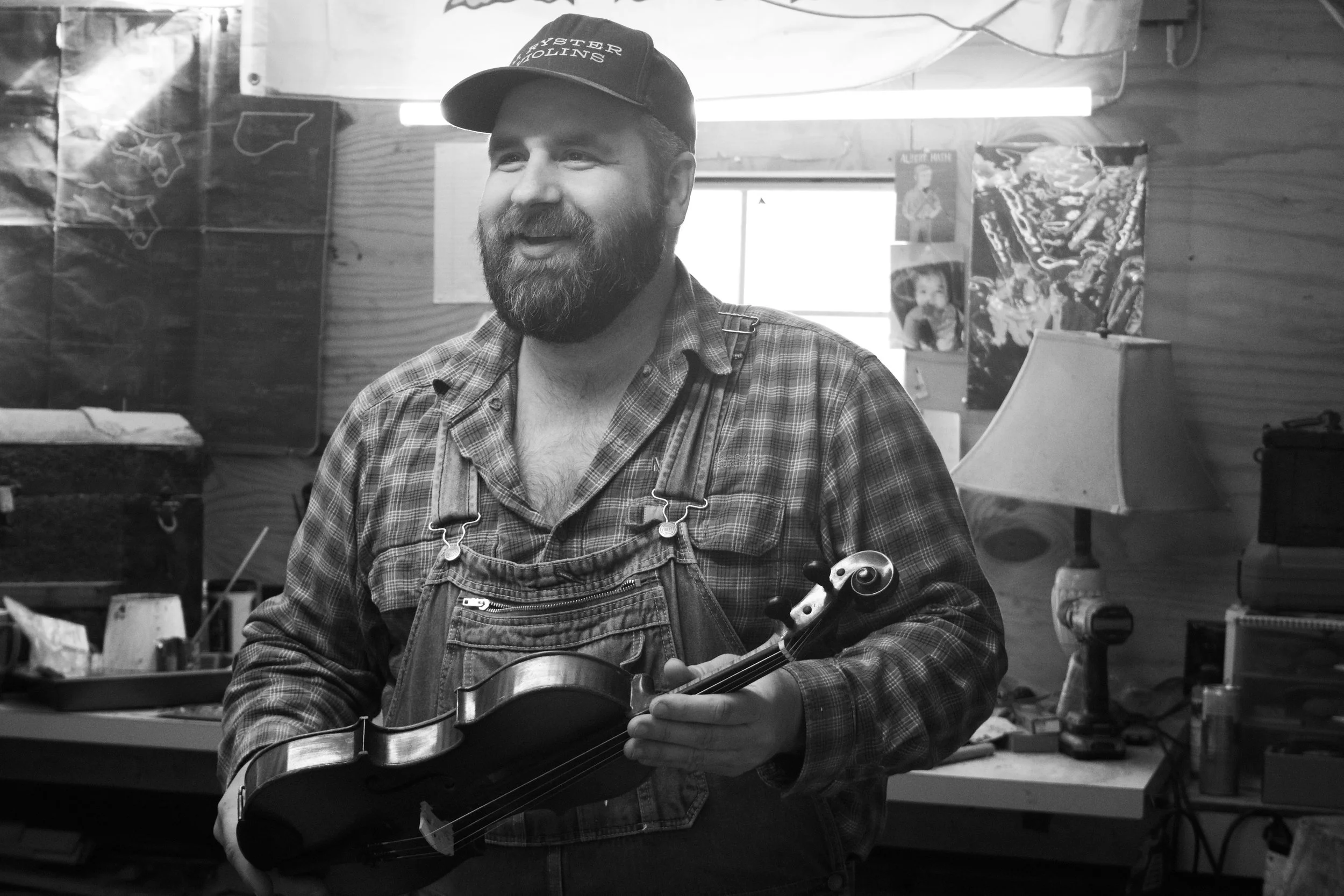
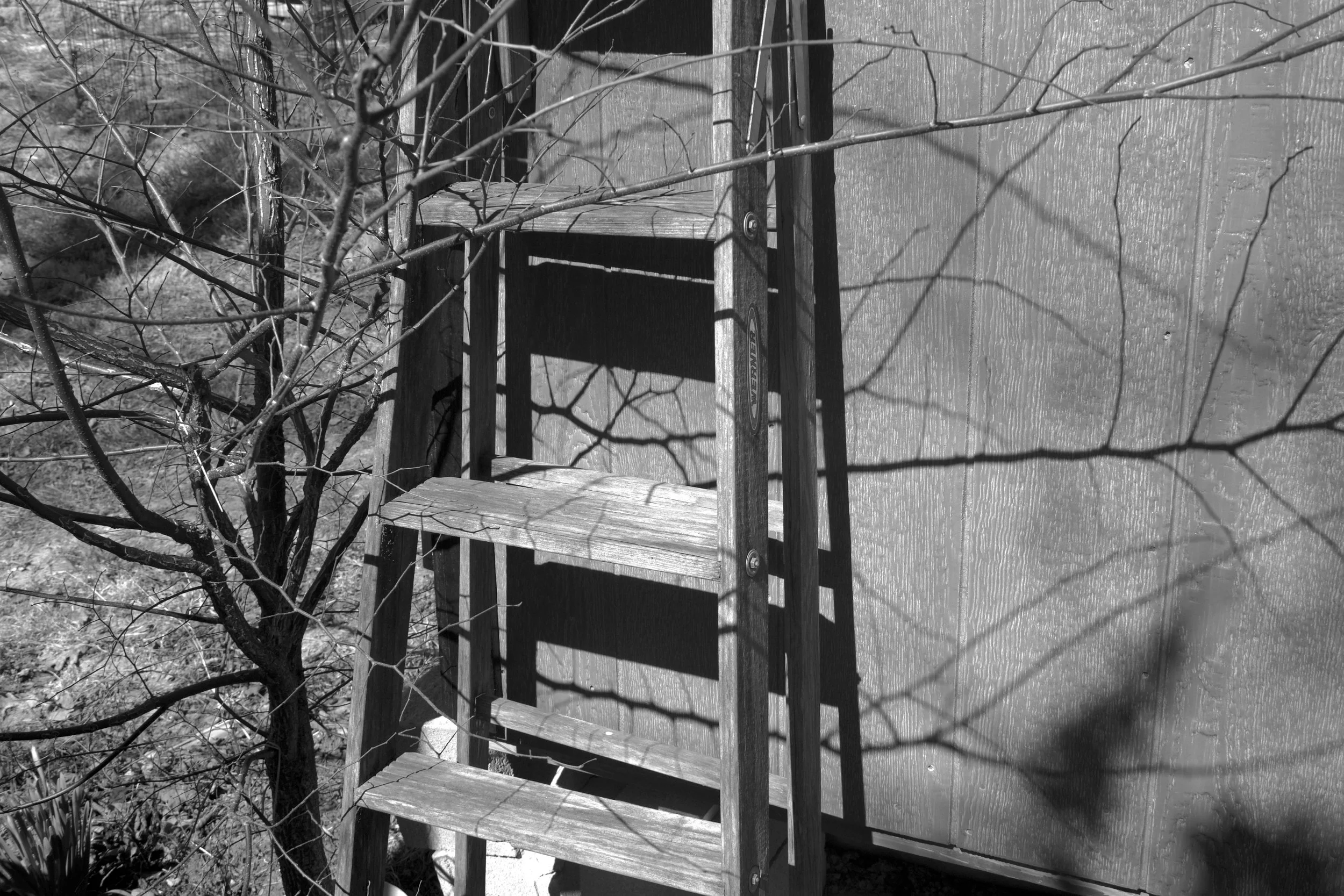
The fiddlemaker has made his place on Hogtown Ridge. From that perch, he surveys Laurel Creek and endless ample rises of Appalachian foothills that fold and ruffle their way to the Elliott County line and beyond. Hearing the report of visitors, the door to his shop swings open and hangs there in an obstinance turned to habit. There, the fiddlemaker stands with raised hand and hollered haloo. His workshop is hunter green and familiar, stood between mushroomed stump and gently smoking wood furnace. The roofline and siding cut an unassuming shape among the encroaching hilltop tree lines. Framing the door is a hand-painted sign that reads, ‘J. Ryster Violins’ and there are several fading and flecked guinea hens that peck amongst the lettering.
Greetings and handshakes ensue, questions on the quality of our travel, the quality of the sun in the late winter sky, the welcomed warmth, the fresh songs of birds and the whispers of breeze are all topics of discussion and introduction. We speak of big men in little trucks on journeys that last too long. We speak to the honor of the guinea hen. Of shared friends and acquaintances. His family has gone to town for a day of shopping, they may not return for many hours as they have gone the hour and a half or so to Maysville,
“I don’t know why they choose Maysville - but they always do. Must be somethin’ good there.” Johnny Ryster smiles out from between brushy beard and mustache, his demeanor is easy and strong, sure as his knuckled hands shoved deep into the pockets of his denim overalls. He stands tall and broad and earnest in this place, at the door of his den, pleased and firm-footed.
I lay out the plan for the day, endeavoring to set us both at ease, and he seems satisfied with the itinerary as it stands. Johnny beckons before stepping up into the shop onto plywood flooring meadowed with curly shavings of maple and chestnut, mounds of silent sawdust haunt each angle of the place, softening the edges of table and bench, bandsaw and bookcase.
“I do a big shop cleanup once a year. I did a big clean in January.” Another smile appears in the brush of his face, in and among his rounded features obscured by hair, crowned by an auburn ‘J. Ryster Violins’ hat, he pauses and sighs, “I clean about as much as I can stand.”
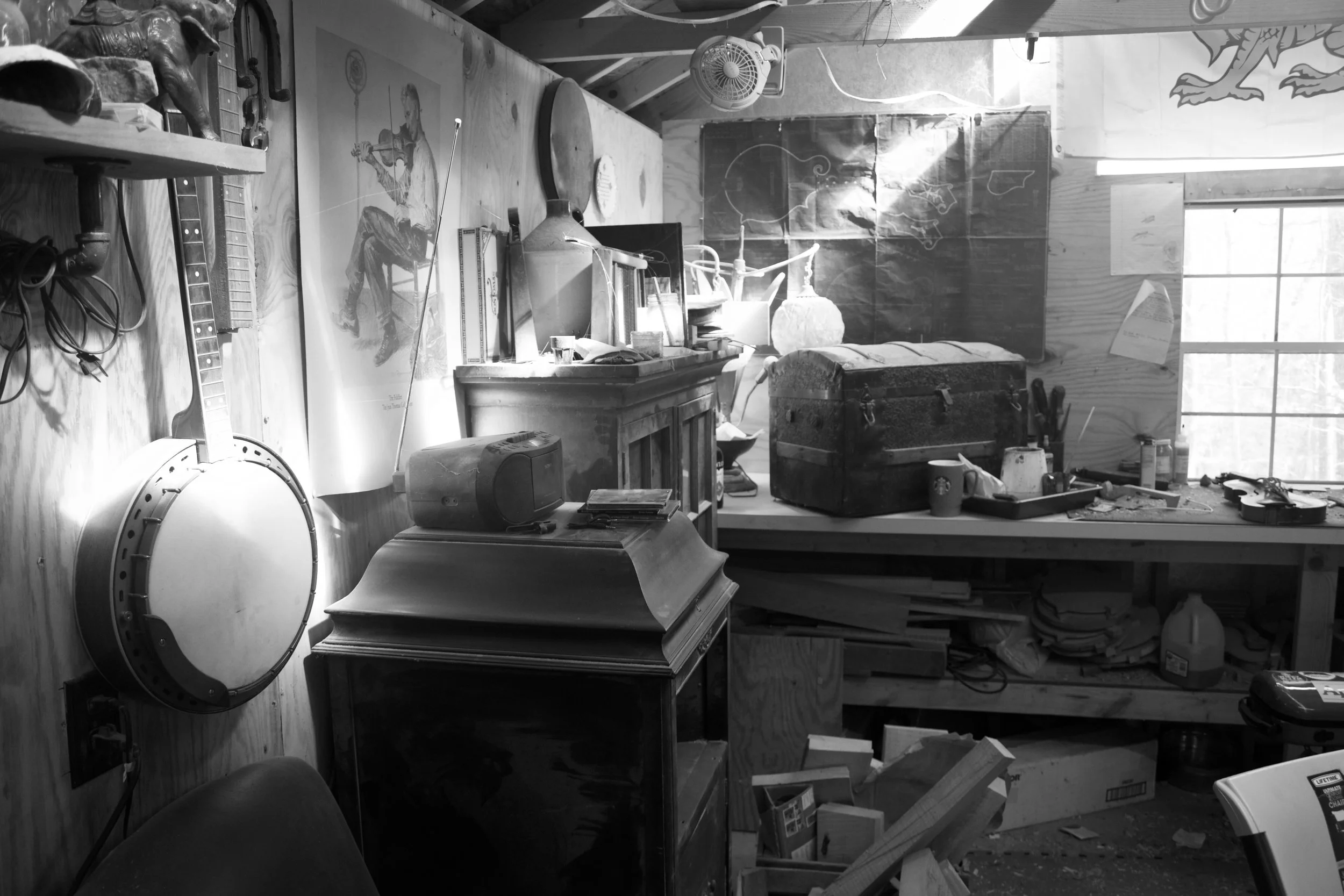
The shop is one room, a shed outfitted for work at bench or saw; the walls adorned with all manner of artifacts, some obscure and barely guessed at, others fully at home as if they had been placed there in a dream or as if the shop had just appeared the way it stood now, furnished lovingly and eternal in its configuration. I inquire at this or that framed photo and stand hand-on-hip and stare. There is a tacked up and curling crayon depiction of a fiddle, signed by Johnny’s daughter. There is a large print of a fiddle player, thin in frame, spectacled, fiddle in hand, leaning back onto a stack of boxes, ready to let out a squeal.
“That right there is Gilson Setters. He was the blind fiddler from Lost Hope Holler. Well, he wasn't really blind, and there isn't any place called Lost Hope Holler. One of those early, Appalachian exploitation deals. He was a recorded fiddler back in the 20s - but he wasn't blind. He did have eye surgery, but he wasn’t blind. They made him out to be some mountain fiddler, and they claimed he was from Morehead, but he was from Catlettsburg, and he was a street musician who moved to Morehead briefly. So -” Johnny trails off and we discuss the man who brought him the poster. A county clerk turned folk hero from over in Fleming County with an uncanny knack for finding unsought prizes and ragged heirlooms in the tri-county thrift stores.
On a gun rack above a window rests a peeling violin case, the faded reddish leather flaking and pulling apart, the words ‘Whitetail Ramblers’ are painted longwise. Johnny says this case is more a home for stinkbugs than it is a fiddle case. A Welsh flag hangs from the low rafters at the far end of the shop, the red dragon stamping and flicking its tongue. The shop is remarkably bare of fiddles. There are many fiddle parts, some broken, some in progress, some stacked and dusty and discarded looking. Some that show topographies of tool marks, blanks vised to outlines of fiddles, the maps of fiddles that lead the fiddlemaker through familiar passes to the next complete instrument.
There are more questions. What makes a fiddle a fiddle and what makes a violin something not a fiddle? This question goes mostly unanswered but not unremarked upon. In the past there were master makers, and those masters whittled down fiddles from some great immenseness of wood grained resonance, some incredible expanse of sounded string and vibrated hollow to make the first fiddles and all other fiddles are descended from them. Johnny nods to this dim lineage across the ocean wherein men like him stooped over benches with draw knives and patience, with careful and determined blade strokes. He says there is one complete fiddle in the place and it lay in wait for the man it was made for.
Kentucky folk musician Don Rogers pulls up in his silver prius and steps out. He approaches the shop with raised hand, watching his feet move through grass and among the bald and worn patches in the green. Without much in the way of greeting, Don steps up into the shop and is handed his prize. Johnny stretches over to a piled bench in the back of the shop and returns with a bow, handing it to Don as he surveys his new fiddle, spinning it with the fingers of his right hand, the base of the instrument resting in the palm of his left. He gingerly retrieves the bow from Ryster, bringing the fiddle to his chin, the bow hovering above the strings,
“Whadda we got here -” the fiddle lets out a squeal and rises as bow meets string, its voice fills the shop and the singing of the strings is gorgeous and spry. Don plays on, muttering intermittent comments on this or that sound, this or that syllable of warble as the fresh fiddle hollers and squalls.
“Ah yeah - that's wonderful,”
“Do ya like it?” the fiddlemaker inquires.
“I love it.” Don replies but he's already gone again. Lost in bloomed and blooming meadows of wheeling laddered tune. Don plays on for a couple more minutes and all present are silent. There are old stories in between the wallers and peels of sound and I smile, Johnny smiles, Don smiles too and takes the fiddle from his chin, looking at it again as if transformed or transfigured by the playing.
“Whadda ya think about it?” the fiddle player asks the fiddlemaker. The fiddle player plays on.
“I like it.” the fiddlemaker responds and watches.
“I think it's a good soundin’ fiddle.”
Johnny and Don converse on the instrument’s voice, new in the world. On brightness. On tone. On strength and clearness and volume.
“Wow this is incredible buddy.” Don speaks in a reverential whisper. The fiddle player continues to spin the fiddle with the fingers of his right hand, staring and observing, moving the angles and curves of the instrument to catch in the light. There’s the bust of a goateed man sporting spectacles and thin eyes carved into the grain of the fiddle’s back and Don tells the tale of the relief with eagerness,
“Aw that is Paul David Smith. Paul David was from Pike County Kentucky and when I first started playin’ fiddle, I was in a band with him playin’ guitar. He was kind of a legend. He really was a great banjo player. He played with this fiddle player named Snake Chapman. He played banjo.” Don pauses for a second, repeating himself, sifting himself from the tale as best he can, remembering, measuring where to take the telling next,
“He also grew up playing fiddle, and after Snake died, Paul just exclusively played fiddle. Played in our band, could play bluegrass, swing, old time. He knew a bunch of unique old time tunes.”
Don continues on his tale of the dead legend. Tales of heart attacks and widows. Gigs missed and gigs played.
“I think he went to the grocery or somethin’, with his brother maybe, and he came home and sat down on his porch, and his life ended. Not a bad way to go.”
There are murmurs of agreement throughout the shop and Don acknowledges that he’s been writing a song about Paul David.
“He was so zen-like. Always in the same mood and always in tune with what was going on with his fiddle and everybody around him. He’d stay up late at these festivals, as late as anybody, these young hippies, you know, going at it hard, and Paul David sitting there looking like that -” he points to the carved face, “with a back brace on, he always had a back brace on.” There are some laughs and the fiddlemaker agrees.
Don continues to saw on the strings here and there. Johnny brings a cable and they test the pickup built into the body of the instrument, Don plays fast and loud, smiling. The fiddlemaker and fiddle player continue to converse over top of and with the fiddle, they admire it and listen to it, speaking to angles and shapes and craftsmanship, how others like their fiddles, how Don likes his fiddle, how it is similar and dissimilar to the fiddle he has now. They talk about friends and allies, other players and their taste in instruments, tips and tricks and the shape of all things, fiddles and otherwise.
“Number 34,” Don remarks softly. Johnny takes the chance to describe the story behind each fiddle from 30 onward. Don listens with a smirk, knowing every name the fiddlemaker shares, matching Johnny’s tales to his own estimations. The conversation wanders, nosing between fiddle wails and everything in this world is comfortable and steadfast. There’s laughter and admiration in equal and in large amount.
When the question of payment comes up, Johnny won’t hear it. He says he’s been paid by the state of this one, that he was working on it with an apprentice that up and moved to North Carolina, didn’t finish the fiddle he’d started and that Don doesn’t owe him a thing. The fiddlemaker tells the tale of the failed apprentice,
“Hell, they’re not gonna let me keep doing this if I keep losing apprentices!”
The tone of talk turns wistful, hopeful but worried, looking forward into darkness of cloud on horizon, a pending twilight that the fiddle player speaks to directly and earnestly,
“Here’s one of my thoughts I’ve been kind of obsessed with lately. What are we artists gonna do when AI starts taking over? It’s not likely to make a fiddle like this under any circumstances.” There is much nodding and grunting in agreement, the fiddlemaker doesn’t know what to say. Don continues,
“Yeah if it did, it would probably make a fiddle that was blemish free and perfect and carbon fiber. It wouldn’t be this.”
The fiddle maker does, here, interject,
“I’d like to see AI forget what it’s playin’ halfway through a set.”
The fiddle player continues on to talk about Johnny’s band,
“I’m not kiddin’! I really think y’alls band, which is a raw dog, real band that’s very entertaining and is anchored in history and place and all that stuff that is very human ya know? That’s what I think is gonna become the most interesting, and the tool marks in this fiddle really tell a story.” And they do.
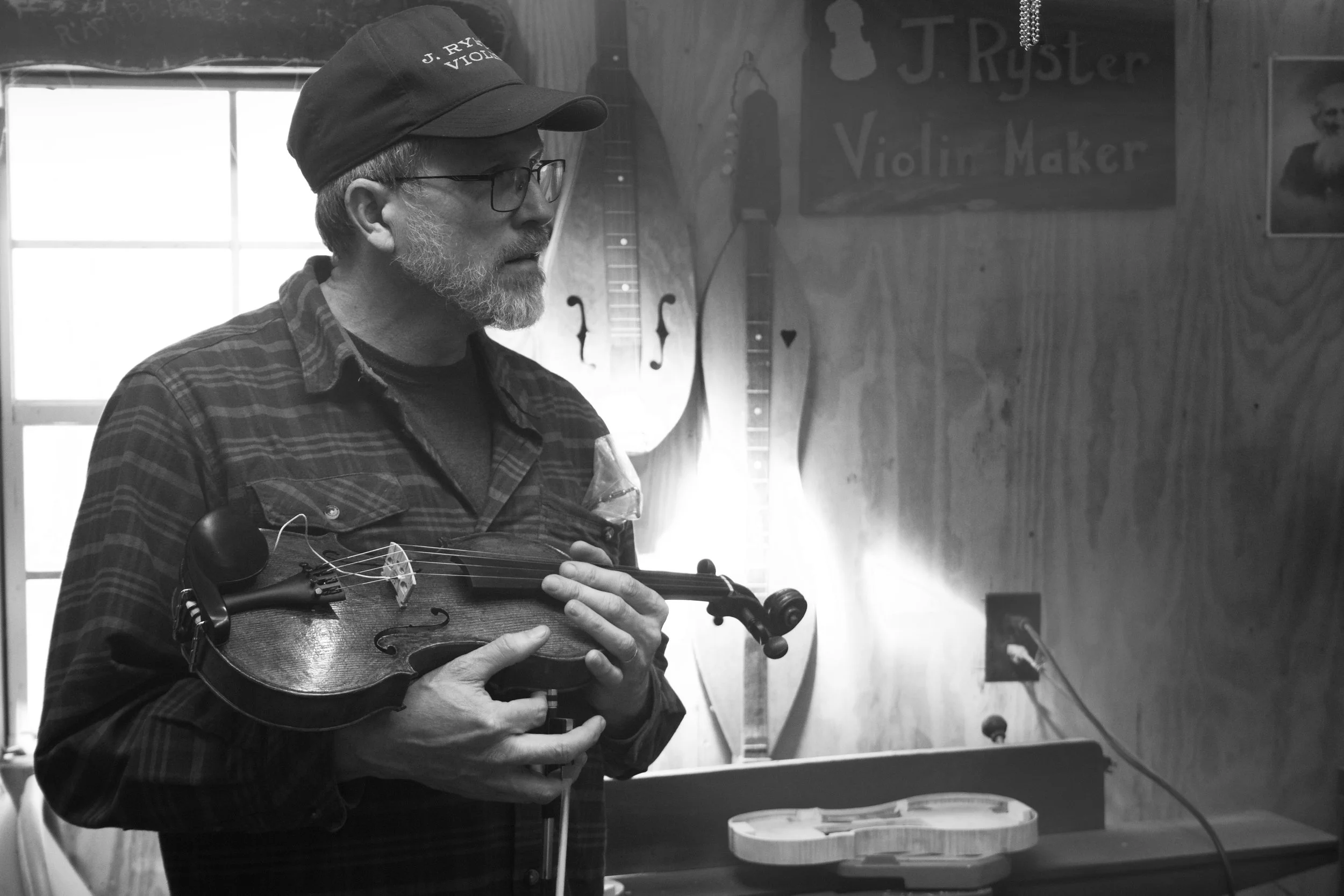
Each nearly flush shave mark in the fiddle is a story. The grain exposed. Each choice and conceit in its design a yarn spun. A carrying to this place. A transportation over land and time and heart to this exchange and its life beyond the cradled hands of the fiddle maker. A learned motion internalized as a tale is internalized. At first new and fresh and monolithic, but over time, worn and even warped and turned to other purpose and endeavor. Lived in, danced in, sung in and regarded as friend and enemy the same. End and means united in intention, the performance before the performance in an unknown green shed on a ridgeline.
Johnny speaks to his intention with subtlety and sweetness, his choices that are informed by his knowing the player, shapes and curves and angles and sounds, all joined in service. He speaks of giving chances, of taking chances, of using the feel of the fiddle to guide him, how it feels is how it will sound and the alchemy of feeling and sounding and grain and hum jigs with Don’s sawing.
“I have a general idea of where it needs to be and I get it there.” This is the axiom of the fiddle maker.
…
To continue reading, click here to get your copy of Derby City Midnight’s Zine Issue #12.