
KENTUCKY HOLY LAND
The Sisters of Loretto Motherhouse Artist Residency.
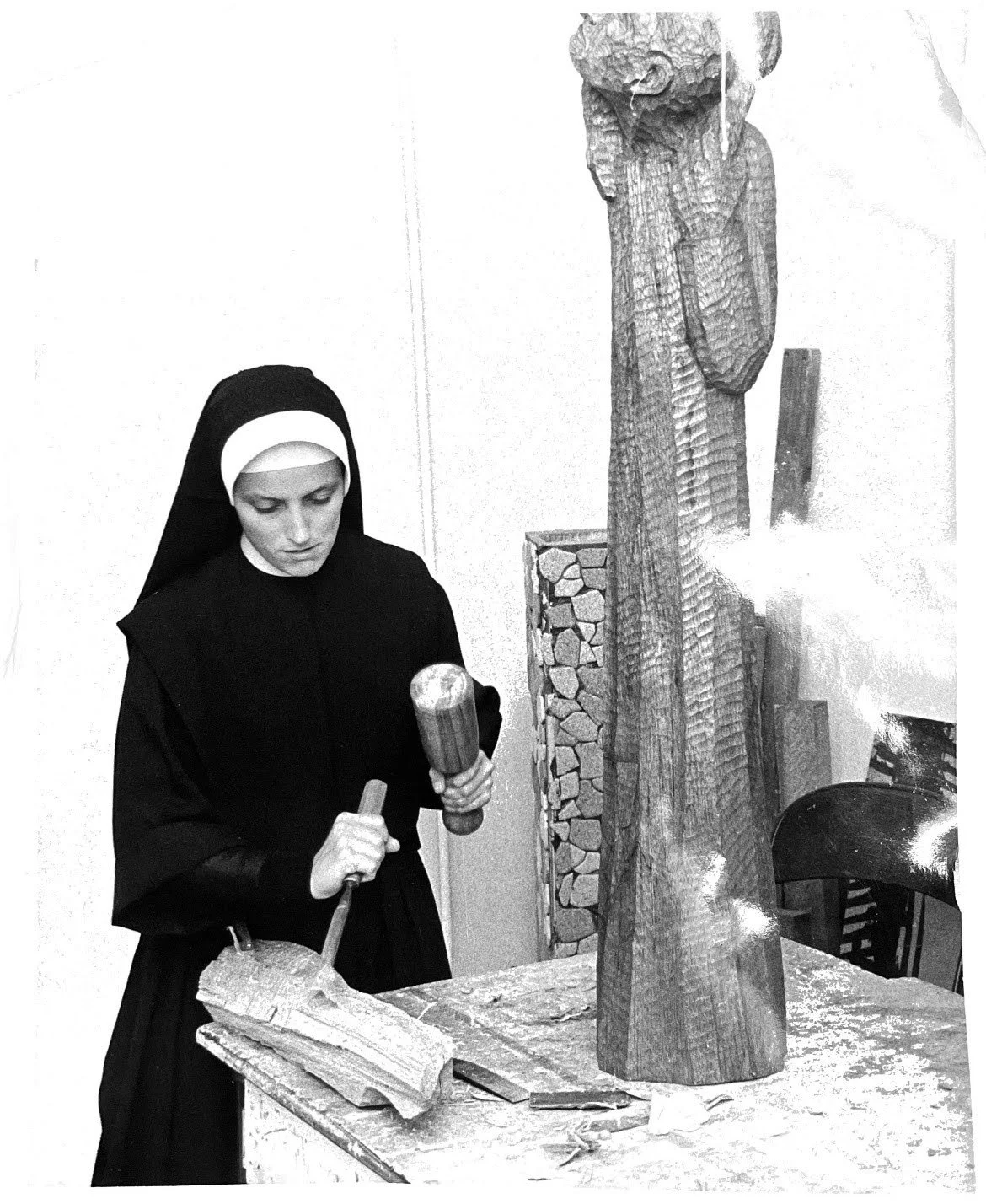
Sr. Jeanne Dueber working in the habit. Photo via the Loretto Heritage Center & Archives.
I am an unofficial ambassador to Kentucky’s holy land, an area in Central Kentucky, mainly Nelson, Marion & Washington Counties, abundant in creeks, knobs, convents, abbeys, and art. I love connecting folks, especially artists and activists, to the inspiration and repose found in these parts. I’ve yet to meet anyone who has taken retreat on this land and not walked away with a story to tell.
At the Sisters of Loretto in Nerinx, KY, the legacy of artist Sister Jeanne Dueber (1937-2026) shapes not only the land, but the creative lives of those who pass through it.
Large, animistic sculptures, assembled from materials Sister Jeanne gathered in the surrounding woods, hold court on the porch of Rhodes Hall and are scattered across the campus. A towering stainless steel sculpture presides over the AIDS Memorial Garden and cemetery. Her many crucifixions bear the literal imprint of her community: cast from the hands and feet of her fellow Sisters.
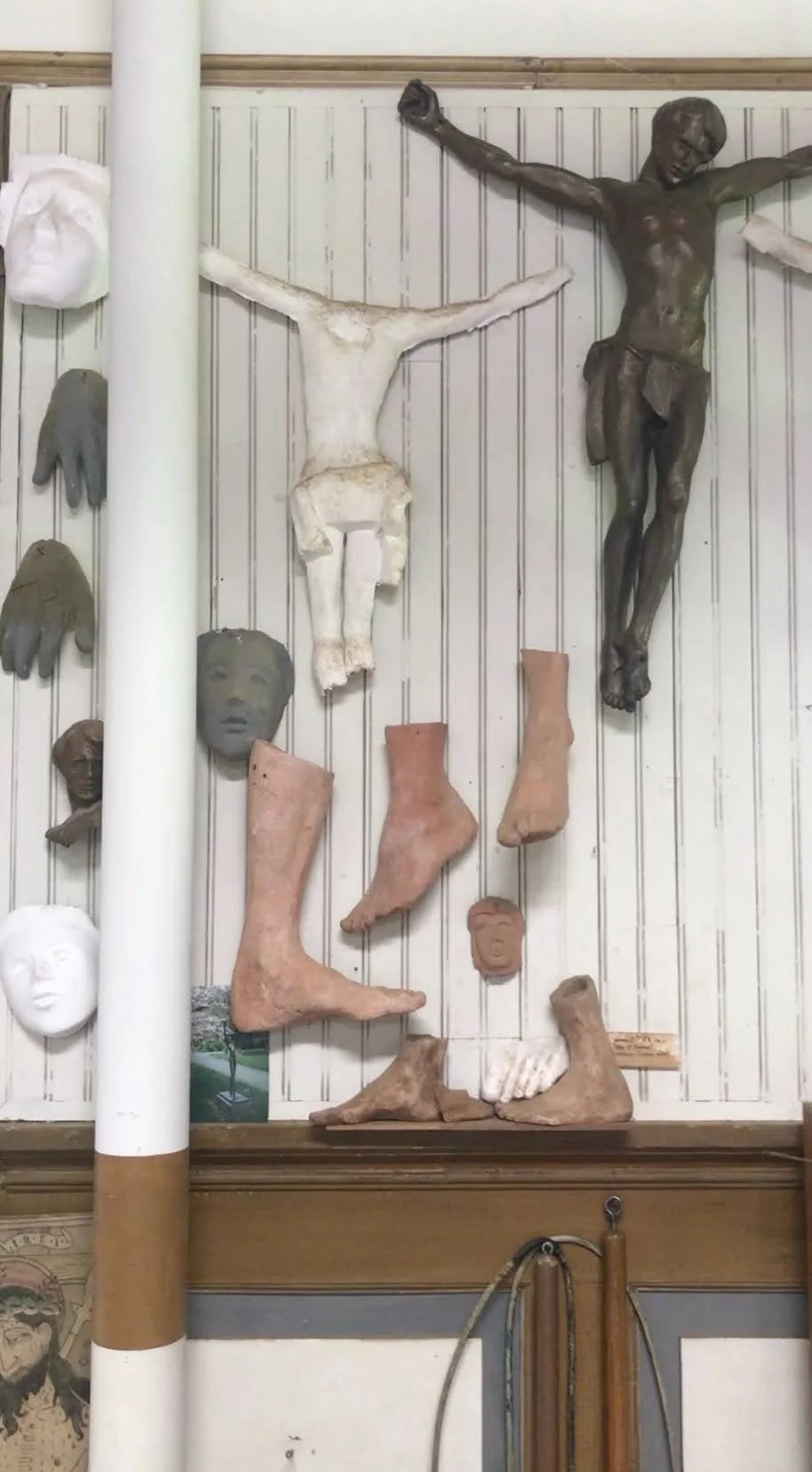
Rhodes Hall Studio. Photo via Elle Hendrickson.
Under Sister Jeanne’s leadership, Rhodes Hall was transformed into a dedicated arts space in the late 1970s. The first floor studio now serves artists-in-residence and community members like Sister Alicia Ramirez who crafts hand-carved, painted walking sticks and ornaments. The second floor was converted into a gallery and apartment, both of which hold Sister Jeanne’s presence and exhibit her life’s work. In the front room of the gallery, among framed works and drawings, sit a couple rocking chairs and a record collection, a makeshift living-room right outside her old living quarters. During her art practice, Jeanne would climb up and down from apartment to studio via a ladder affixed to a trap door. The ladder is gone, but look for the trap door on the studio ceiling or under the recliner in the apartment. Artists-in-residence housed in Rhodes Hall will find the cozy space blessed with Sister Jeanne’s books and chin-up bar.
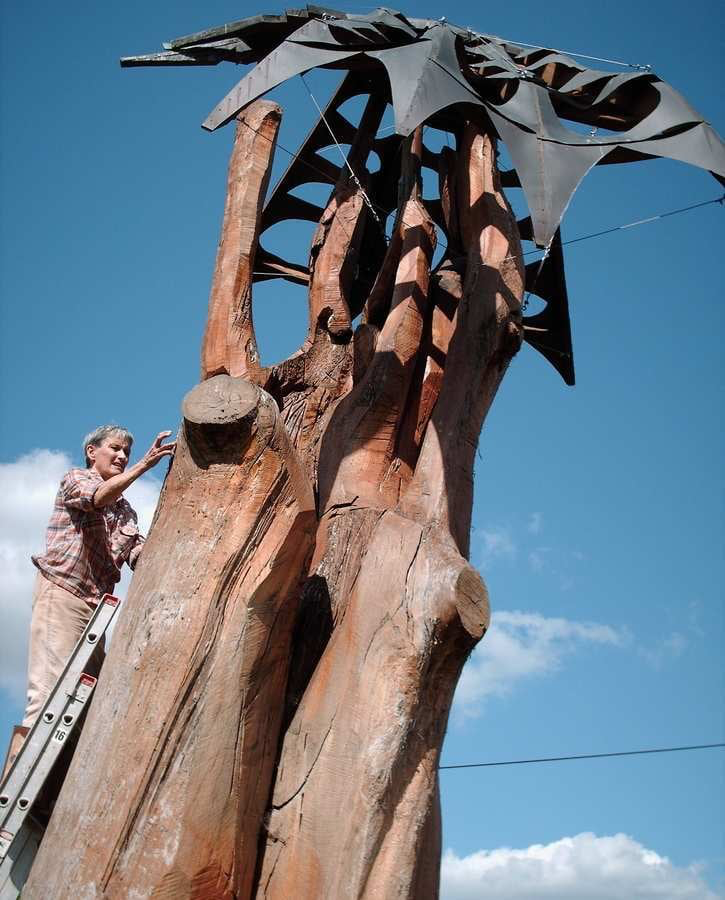
Jeanne Dueber working on “Protected Community” sculpture. Photo via the Loretto Heritage Center & Archives.
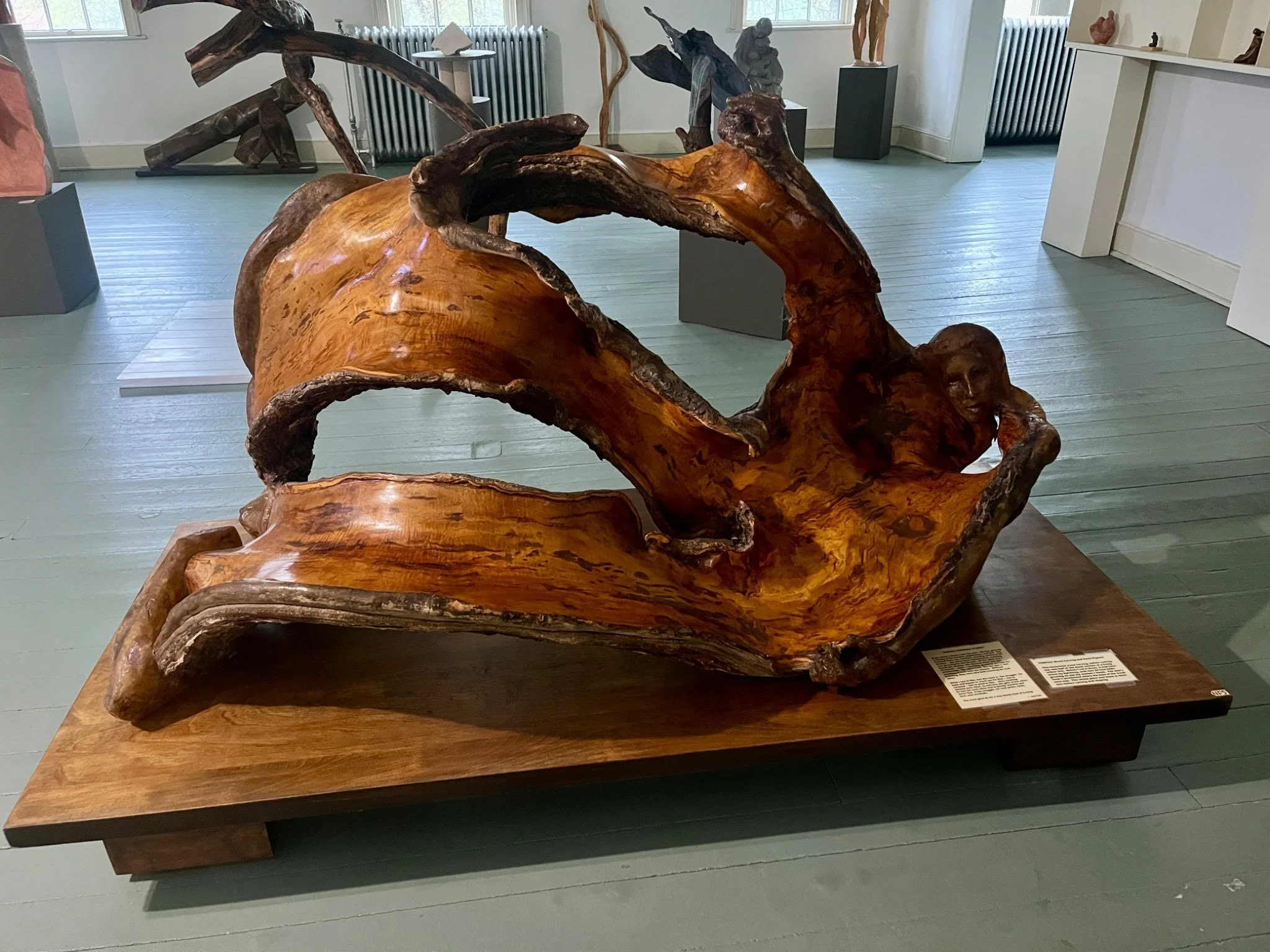
Jeanne Dueber Art Gallery. Photo via Leah Raidt.
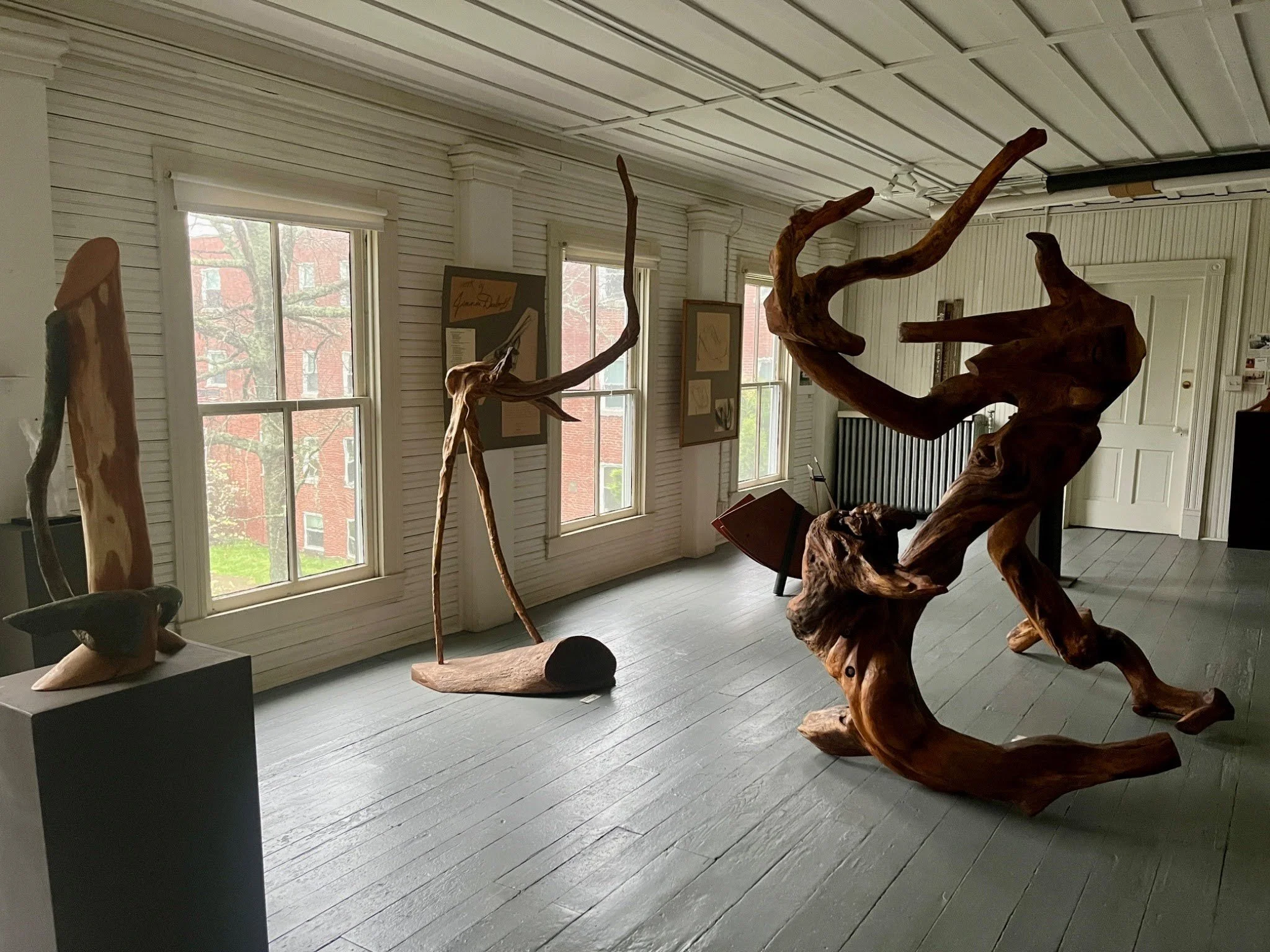
Jeanne Dueber Art Gallery. Photo via Leah Raidt.
The Loretto Artist Residency invites artists into a space where making work is inseparable from intentional living. Offered in partnership with the Kentucky Foundation for Women, the residency offers a meaningful enrichment opportunity to Kentucky-based artists.
Applications are accepted on a rolling basis and the residency duration ranges from one to three weeks. Artists of any discipline and gender are asked to share how their work or practice is feminist and social-justice oriented. A food stipend is provided, and communal meals in the dining hall are available. Housing options are the Rhodes Hall apartment or the Valley House, a one-room dwelling set among pastureland. I stayed in the Valley House, and enjoyed setting up my hammock between the two trees on the back patio.
“Loretto Hospitality” permeates the residency experience. When I arrived for the first time last spring, Sister Cathy Smith welcomed me with a detailed tour. In the dining hall, she pointed out the refrigerator designated solely for ice cream, and where to grab snacks or leftovers. She showed me the bulletin board where the week’s menu, events and announcements are posted. Artists are invited to community events, be it a daily prayer service, weekly protest in downtown Lebanon, or one of the free classical concerts Loretto hosts. Sister Cathy also pressed that there was no obligation to accept invitations, and told me what to do if I preferred silence or solitude during meals. As the tour led into the sanctuary, she encouraged me to use the church for my art practice. She said I could do yoga, play the piano or harp, or work in the space.
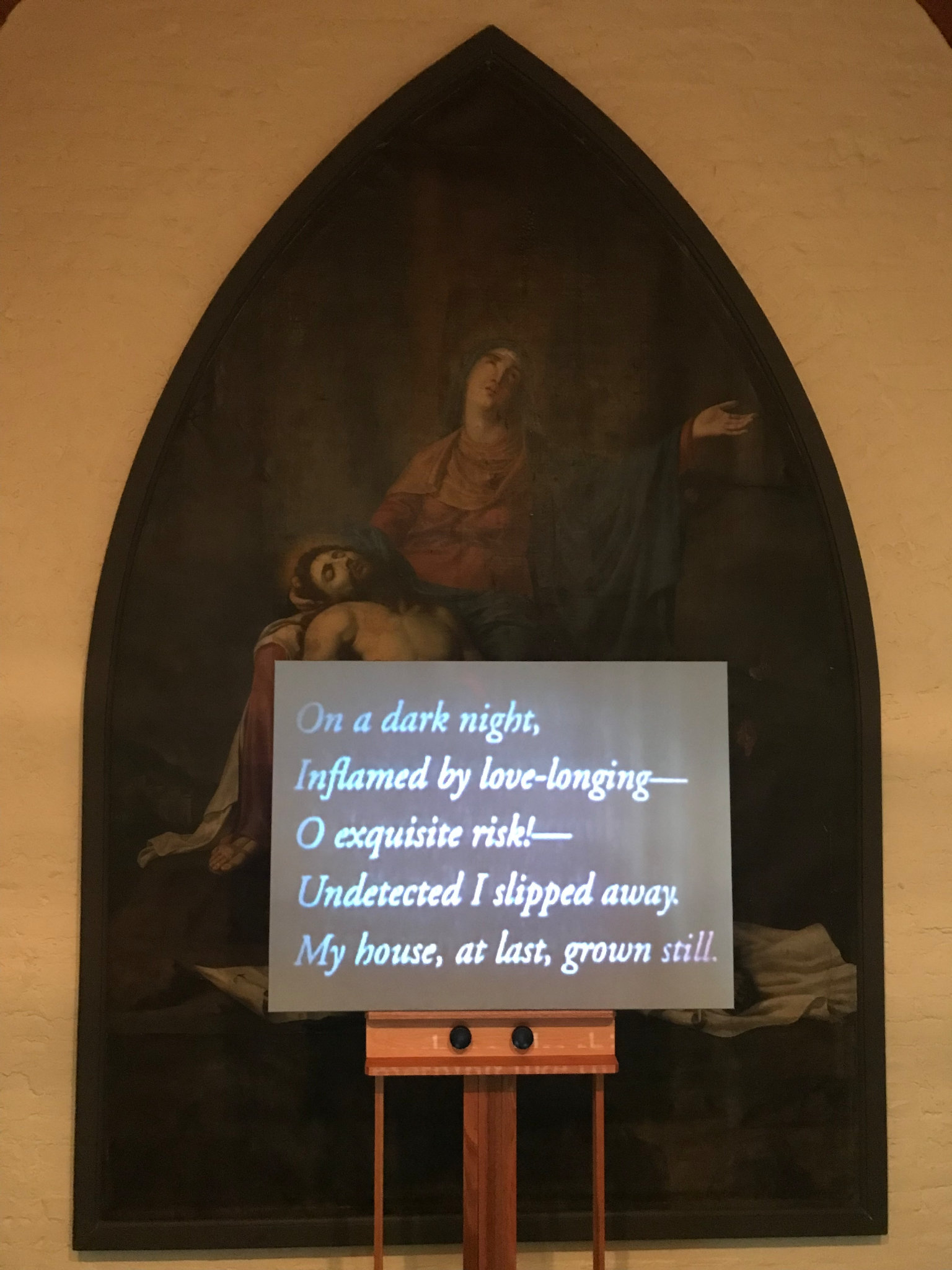
Saint John of the Cross Art Intervention by Elle Hendrickson on display at The Sisters of Loretto Motherhouse Church during their artist residency in Winter 2025.
What you will encounter at the Loretto artist-in-residence program is a community of elders full of deep curiosity about residents and their work. Contrary to what many may think, the Loretto community at the Motherhouse is not exclusively vowed religious women, nor exclusively Catholic. Former artists-in-residence often speak of the warmth extended to them—shared meals, thoughtful questions, genuine engagement. When I asked Elle Hendrickson, a trans/nonbinary artist and two-time artist-in-residence, what advice they would give to incoming residents, they said: “Be open to the possibility that the people, the place, the land can deeply impact your work.” That impact can be surprising. At Loretto, you’re more likely to encounter an elderly woman in a Black Lives Matter t-shirt than a nun in traditional habit. The first rule of Loretto’s school was “no denomination refused.” That inclusive, respectful ethos remains palpable today.
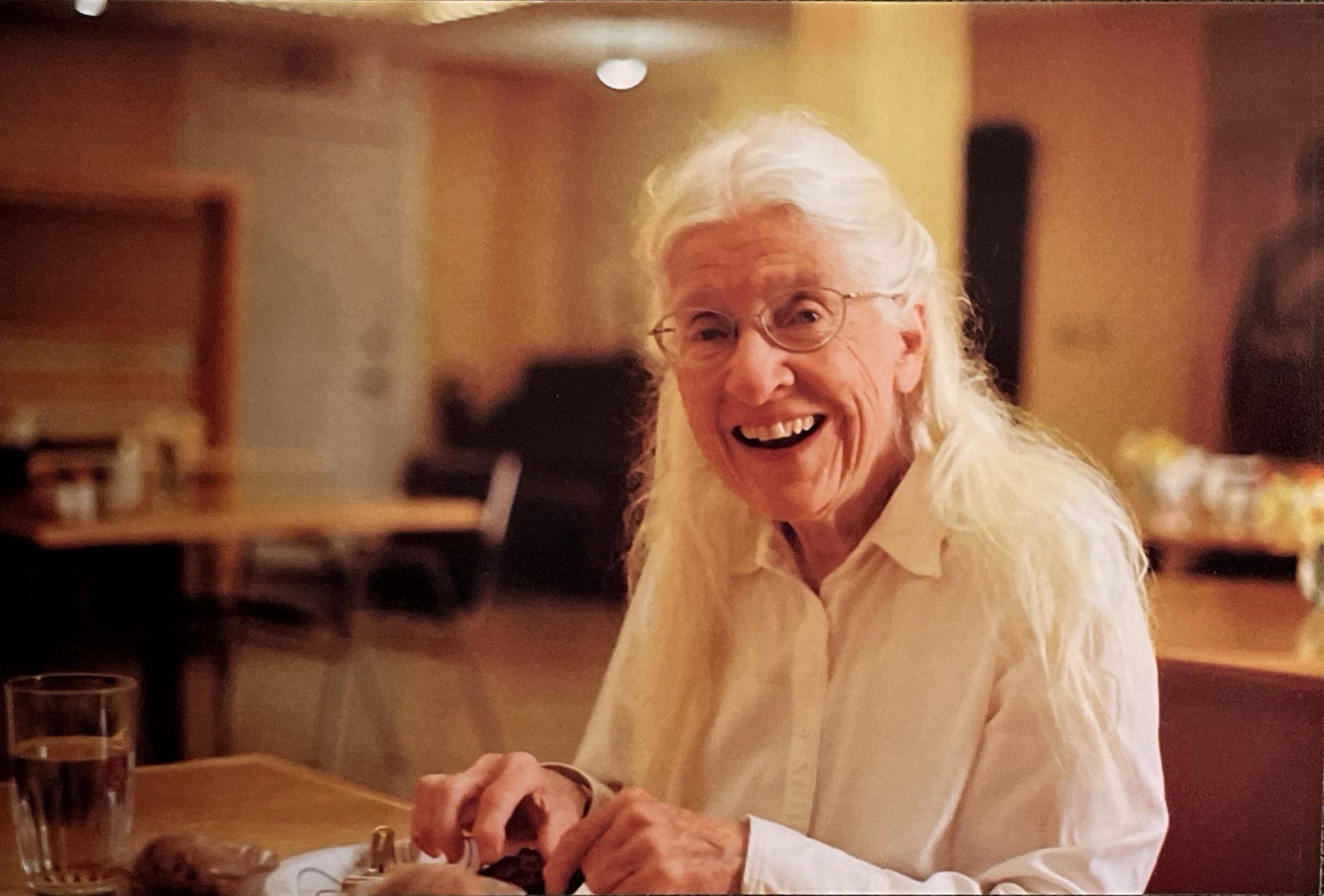
Sister Mary Swain at dinner, Spring 2025. Film photography by Leah Raidt.
At a prayer service modeled after the Catholic mass of my upbringing, I noticed patriarchal terms replaced with more expansive, inclusive language. Sister Alicia Ramirez spoke the name of each community member as she administered the sacrament of eucharist. I did not expect her to remember my name, so when she lovingly looked me in the eye and said, “the body of Christ, Leah,” I was deeply moved. This exchange re-enlivened an act that previously felt stale, sullied by harmful, high-control church doctrine. The service reoriented me to the sacredness of being with others in a shared rhythm of attention.
Sister Jeanne Dueber understood this kind of holy exchange. The cultivation of attention and creativity is a two-way street. We see and we are seen. We touch and we are touched. The work of the feminist artist is never exclusively about objects. It is oriented around relationships–the relationships between artist and material, individual and community, initiate and elder, body and spirit.
Make the most of your residency by embracing and engaging in the rhythms of relational exchange as a doorway into deeper receptivity. Let the bells, the meals, the rising and setting of sun and moon become part of your creative process. Make a friend. Meet an elder. You may arrive with a plan, but keep it loose. Let the work change.
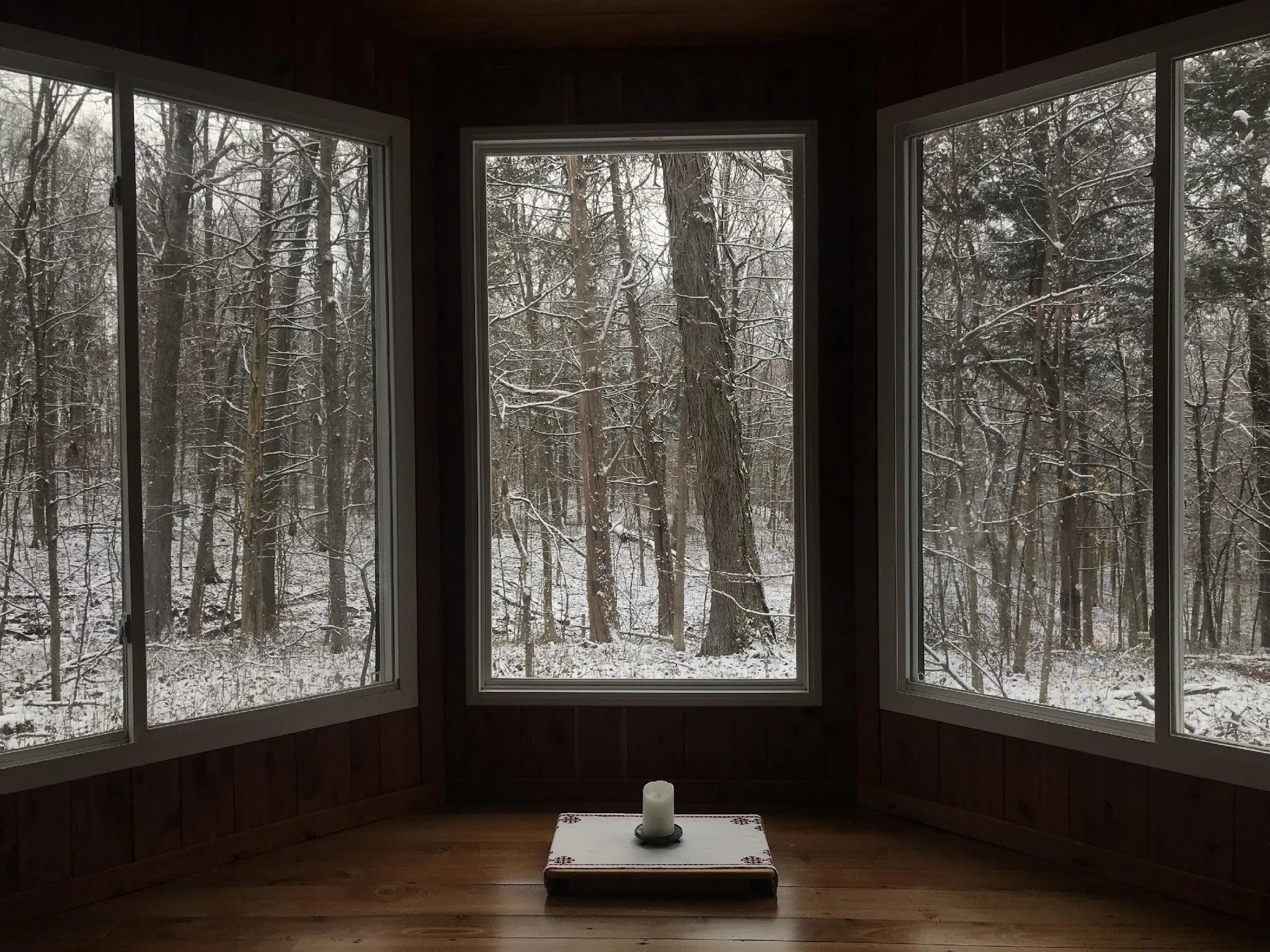
Chapel in the woods. Cedars of Peace at The Sisters of Loretto, Winter 2025. Photo via Leah Raidt.
An afternoon walk might lead you to the unexpected. I found an entirely gutted deer carcass on a hill and another day, I crossed paths with a kindred spirit. Apparently, it is rare for there to be overlapping artists-in-residence, so consider it a boon if it happens to you. The days that my residency overlapped with poet and visual artist, Meg Whelan, were fun, generative, potent days and far from the hermit fantasy I envisioned.
Meg and I workshopped writing together, collected stories from the community during dinner (which is actually lunch because at Loretto, lunch is dinner, and dinner is supper), and facilitated a Poetry Hour for the community. The program was live-streamed to the Living Center, the long-term healthcare facility on campus, through a closed circuit broadcast system. We performed our poems from the pulpit. Poems about the dead deer on the hill. Poems about queerness. Poems of reckoning with our white, Catholic roots. Members of the community performed poems too, both original work and the work of Loretto poets now passed. The cross-cultural and multi-generational exchanges I experienced during my residency ushered me toward knowing myself more fully as a poet and wisdom keeper.
Meg and I discovered a casket Sister Jeanne Dueber designed and built for herself in the attic of Rhodes Hall. At the time of our residency, Sister Jeanne was living in the dementia wing of the Living Center. She passed away in January 2026, and was laid to rest in the casket of her own creation.
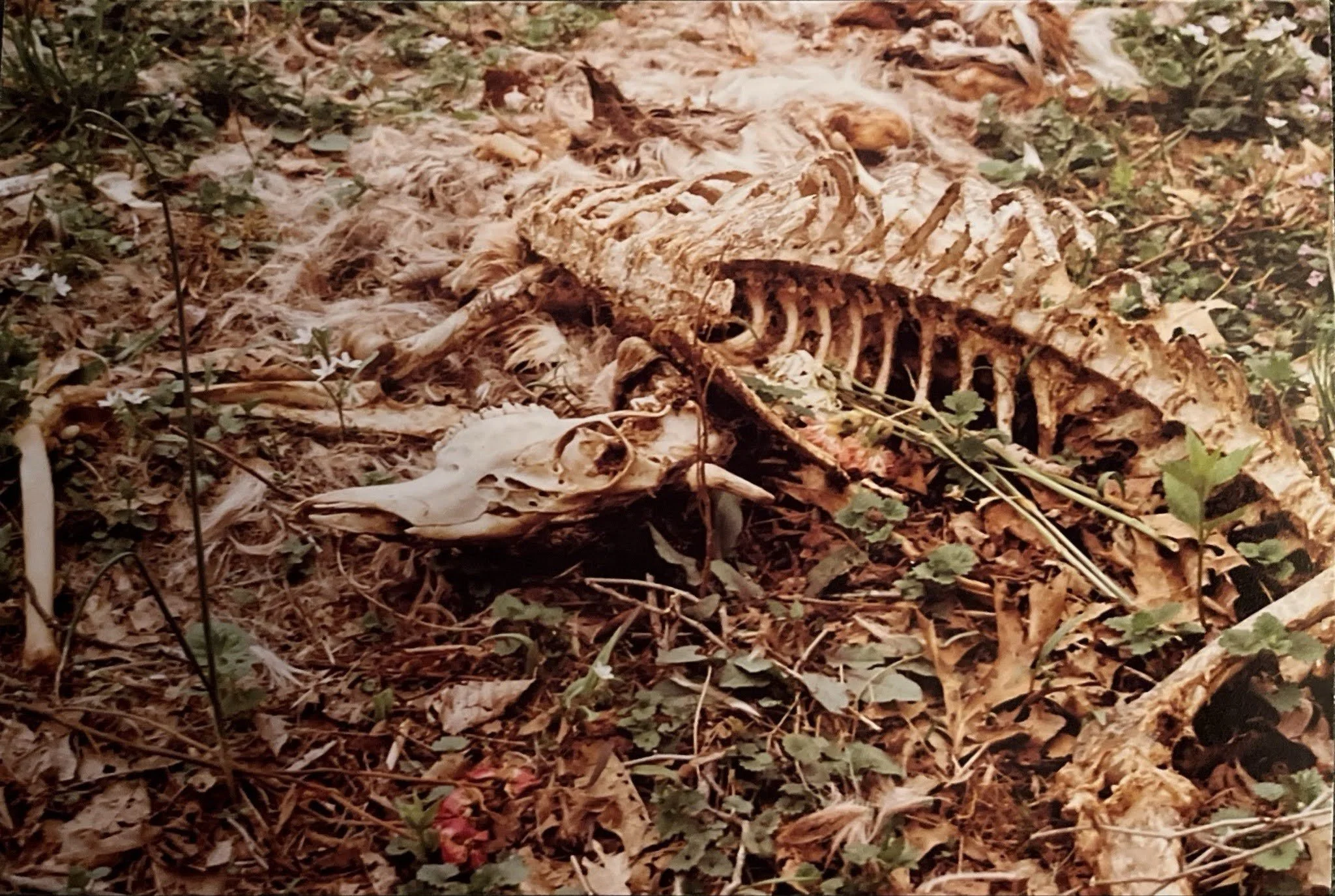
My Deer Dead Friend, Spring 2025. Film Photography by Leah Raidt.
Artists leave the residency at the Loretto Motherhouse with more than work. They leave with connection–to the land, to a lineage of artists who have passed through before them, and oftentimes to a spiritual elder. Every time I meet another artist who’s been touched by Loretto, I feel instant kinship. And I know that I am not alone in that feeling. Meg and I have facilitated Poetry Hour three times now, and we secured grant funding to support a collaborative memoir writing and oral history project with 91-year-old Sister Agnes Ann Schum. Many artists find reasons to return, booking cabins at Cedars of Peace or simply coming back to walk the grounds and visit the gallery.
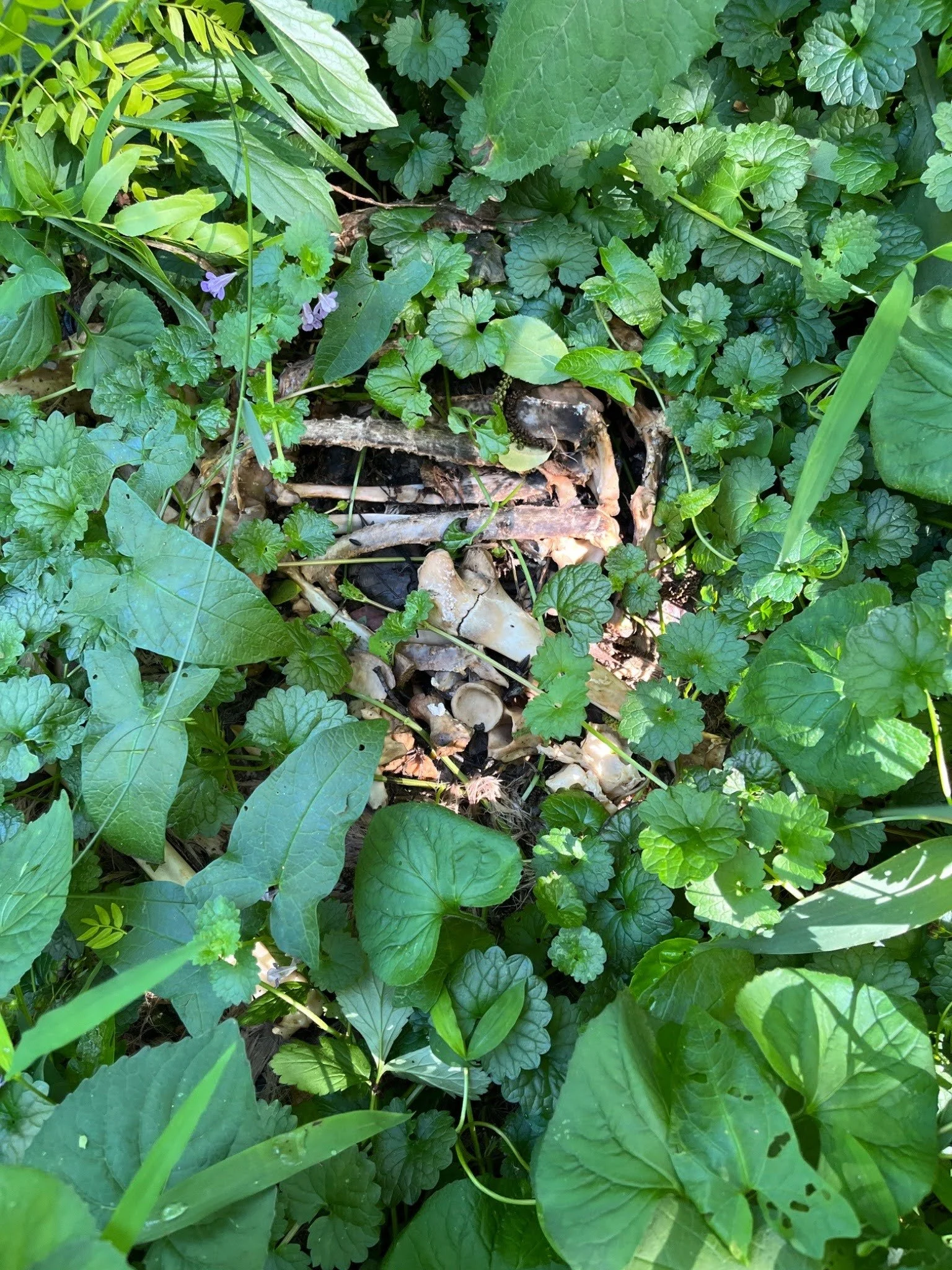
Deer Bones & Clovers, May 2025. Photo via Leah Raidt.
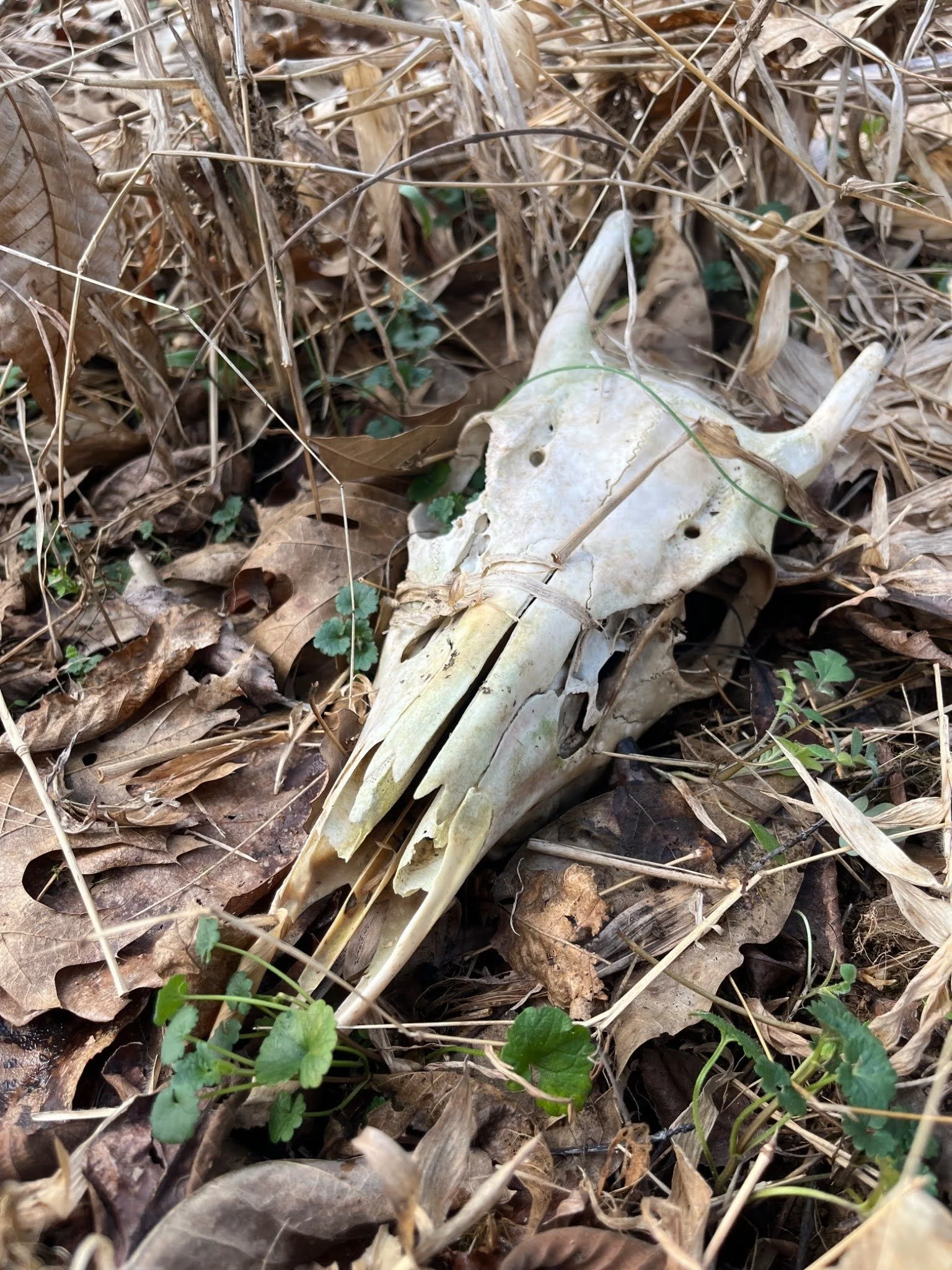
Deer Skull & Holy Ground, March 2026. Photo via Leah Raidt.
For those who are curious but unable to commit to a residency, the following is my proposed itinerary for a day-long Artist Date in Kentucky’s holy land:
Wake up early. Drive to the Abbey of Gethsemani, with audiobook accompaniment by Thomas Merton, the famous Trappist monk, or Fenton Johnson, an LGBTQ+ author who grew up in and around the knobs and the monks. Park at the visitor center. Check out the poetry and photography of Brother Paul Quenon, the abbey’s current resident artist. His books are for sale in the visitor center.
Hike the Statue Trail, where you’ll encounter impressive, life-sized bronze sculptures and a Rosary Hut where you can draw a picture or leave a message in the pilgrim’s notebook.
After the hike, whiff up the free smells of the church. Lingering frankincense, wax, wood, and damp cold stone silence. If they sold an Our Lady of Gethsemani cologne, it would be my signature scent.
Head into Loretto and spend time with Sister Jeanne Dueber’s work. Play a record. Draw or write in the gallery rocking chair.
End your day with a burger and a beer at the Sherwood Inn in New Haven. Look closely at the murals on the walls. Unable to find the name of the painter via Google, I consulted the aforementioned Fenton Johnson who told me, “They were painted by my one-armed great-grandfather, Thomas Hardin Johnson, known in his day as Hardin Johnson, the Union soldier whose portrait hangs in an oval frame at one end of the bar.” There was more to the story Fenton shared. That’s the thing about Kentucky’s Holy Land. The stories are everywhere. I have no doubt there’s a story here for you.
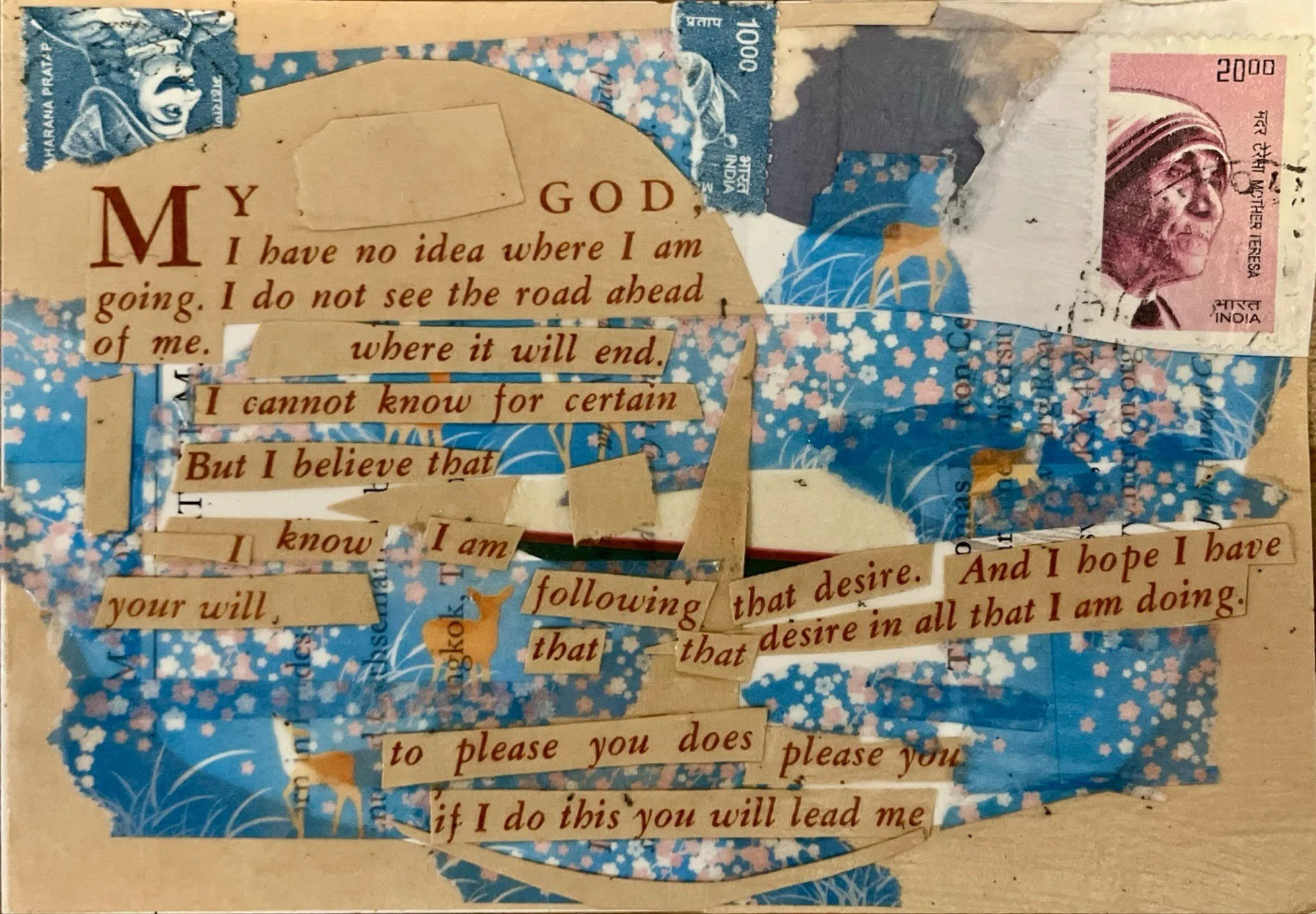
Erasure Poem-Collage with Thomas Merton’s Prayer of Unknowing by Leah Raidt.
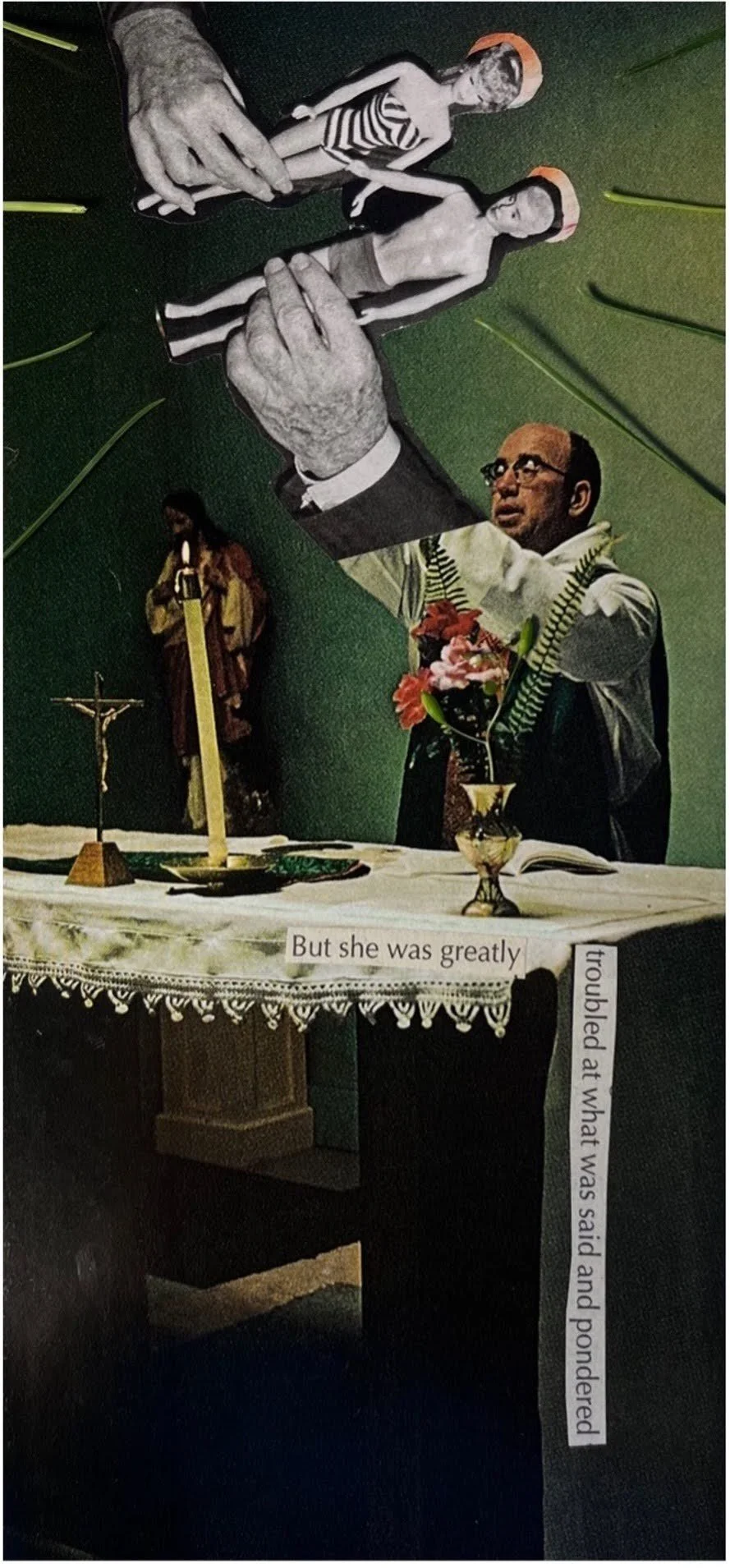
"Worship" by Meg Whelan, first published in So to Speak Journal: language + feminism + art.
More about Sr. Jeanne Dueber can be found here.