
SIX SMALL WORKS AND A STATEMENT
Text sculptures by Thaniel Ion Lee, on display at the LVA gallery.
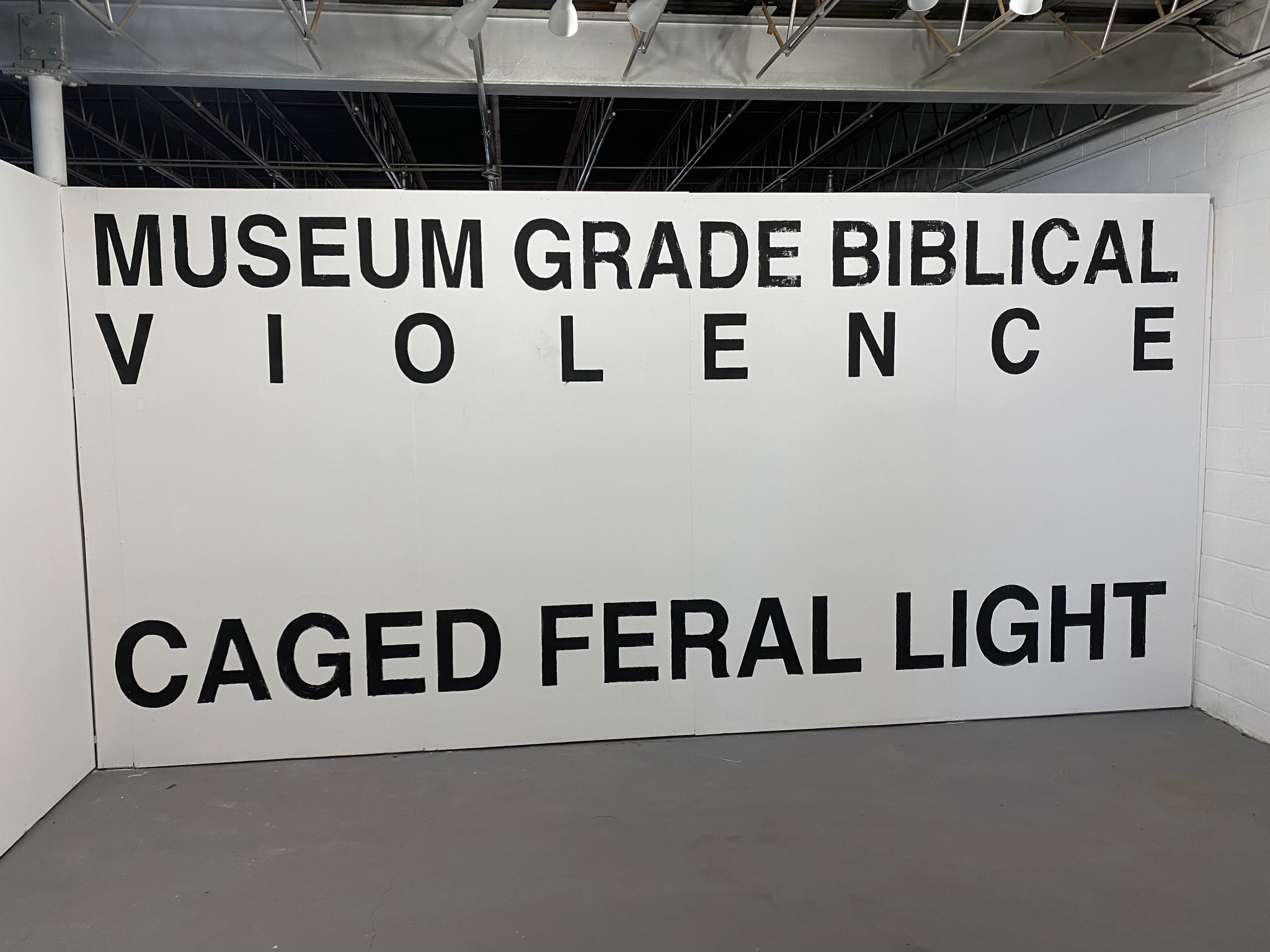
Thaniel Ion Lee, MUSEUM GRADE BIBLICAL VIOLENCE (2025) and CAGED FERAL LIGHT (2025). All photos via Sean Rose.
The cynical viewer would look at Thaniel Ion Lee’s new show and think, “That’s it?”
But cynical minds, apart from being depressing and boring, are reflexively resistant to collaboration, and Lee’s show, Six Small Works and a Statement shown at LVA’s gallery until July 5, demands a level of participation from viewers that is easy to underestimate and undervalue.
The “text sculptures” featured in Lee’s show are primarily a collection of phrases painted in large black, sans-serif font directly onto the white walls of the LVA gallery. Someone having a bad day or expecting to see something more conventional might scowl at the scattering of words written on a wall and think, “I could do that.”
The arduous and painstaking process Lee follows to make the pieces, however, is something that nearly no one would do, and the intellectual layers that the work inhabits are so stimulating and so tongue-in-cheek that it makes this author chuckle and think long after viewing the work.
The context surrounding Lee’s creation of these text sculptures is important to consider. In a statement, Lee explains that words have always been a tool featured in his work, whether it is text describing his life as a person with a disability or words hiding in drawings. After physical difficulties limited Lee’s ability to draw in 2013, he began working on what’s featured in this show.
The piece MUSEUM GRADE BIBLICAL VIOLENCE is the most striking and also the most accessible of these works. On the back wall of the gallery space is the bold, block text, all capital letters simply reading, “MUSEUM GRADE BIBLICAL VIOLENCE.” It’s a striking string of words and as a viewer sits with them, some image will undoubtedly arrive in the mind. For me, it was a stuffy Renaissance painting depicting one of God’s true Old Testament cataclysms. Something involving angels of death or the slaughter of Egyptian sons.
Of course, everyone would have a different take and a different image they conjure (more on this later), but after an image forms in the mind, a viewer might focus on the word play involved. What is “museum grade” anyway? It’s clever. It’s silly. It’s a little diabolical in this context. What makes some violence more highbrow than others? What makes some violence worthy of being displayed in a formal setting and charging admission to gaze upon it? Is it an art critic disregarding portrayals of the common blood and toil of everyday American living? Maybe they see something fanciful and blood-soaked and say, “Now this is a depiction of violence worthy of our halls. This is the real deal.”
Again, this is what was happening in my head. What you imagine may be different. I imagine this difference in perception is exactly the intent of Lee. In many ways, these different mental conjurings are the art show. Part of the fun and impact of these text sculptures is that each viewer has a different connotation and a different interpretation to sift through. Lee provides a prompt to the viewer and the rest is up to us. Take this and run with it, the work seems to invite, and make sure to share what is on your mind with someone else.
At the show’s opening, Lee spoke about this intent during a Q&A, referencing the theory of a billion Mona Lisas.
There’s only one Mona Lisa, of course. It hangs in a climate-controlled chamber behind protective glass in the Louvre, where it’s visited by upward of ten million people per year. Each one of those people who sees her takes a different version of the painting with them. There’s a conversation that happens as a result, an interplay between the work itself and what someone sees or doesn’t see or values or disregards.
In Lee’s show, he zeros in on that conversation, stripping the art itself down to the bare necessity, and nonetheless delivers compelling images.
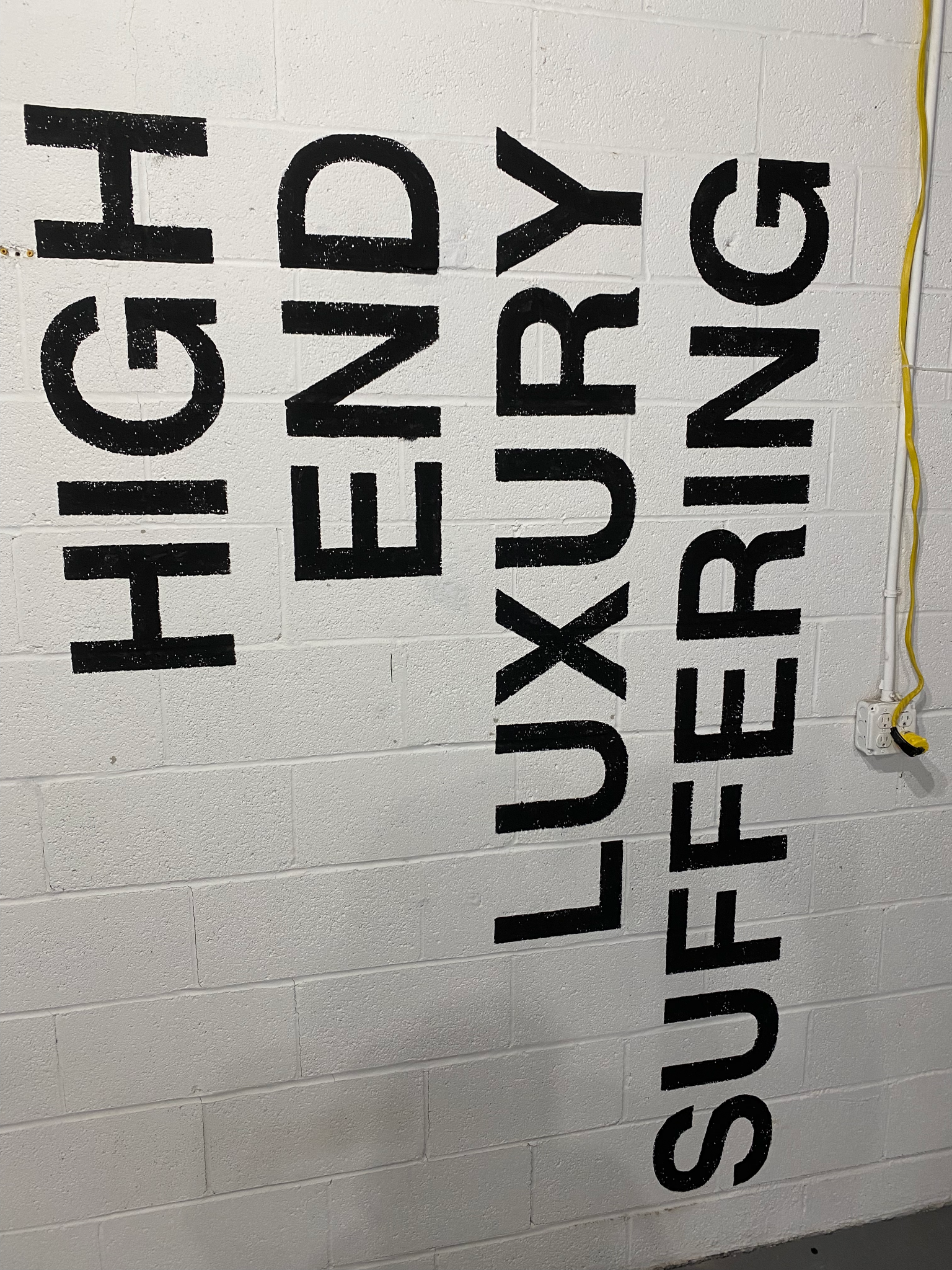
Thaniel Ion Lee, HIGH END LUXURY SUFFERING (2025).
Part of the reason these simple phrases deliver such a compelling reaction in the mind is that Lee approaches the text with the same painstaking work ethic of a poet. In explaining his process during the opening reception’s Q&A with curator Joey Yates, Lee said he starts off with a basic phrase and then sweats every single word to make the most compelling image possible. For the more abstract piece CAGED FERAL LIGHT, he estimates that he went through a million other adjectives before he settled on “feral.” He reads these all out loud, caring about the rhythm and prosody of the words. There are more than 300 of these text sculptures on his website.
Lee said he refers to the works as “sculptures” because he thinks of them as sculptures “that can only exist in the reader’s head.” But as a writer, I would say he is as much a poet as a visual artist in this show. Lee dismisses this notion. During the Q&A he said, “If I’m a poet, I’m the crappiest haiku poet.” But clearly, he’s doing the work of a poet–thinking deeply within an image and picking apart every single word of each creation. This is something that every poet I know and respect does.
Two of the longer works, THE LONG, SLOW ACHE OF TRANSMOGRIFICATION, DOCUMENTED IN DNA AND BONE and A SHIP OF THESEUS, read like more traditional poems as well. There’s something ironic about the fact that the longer works are also the smallest in scale, presented in neat frames on the wall. Perhaps these two works were closer to poems in the artist’s mind. In the Q&A, Lee spoke on the work A SHIP OF THESEUS, saying he thought of the human body and its inevitable aging and breaking down as our own personal ships of Theseus that we have to manage. That might suggest the two smaller works were more narrative-driven than the image-driven, larger pieces. These two works also might be in frames because they’re simply easier to read on a smaller scale than plastered across a wall. Lee talked about practicality being a part of his practice as well.
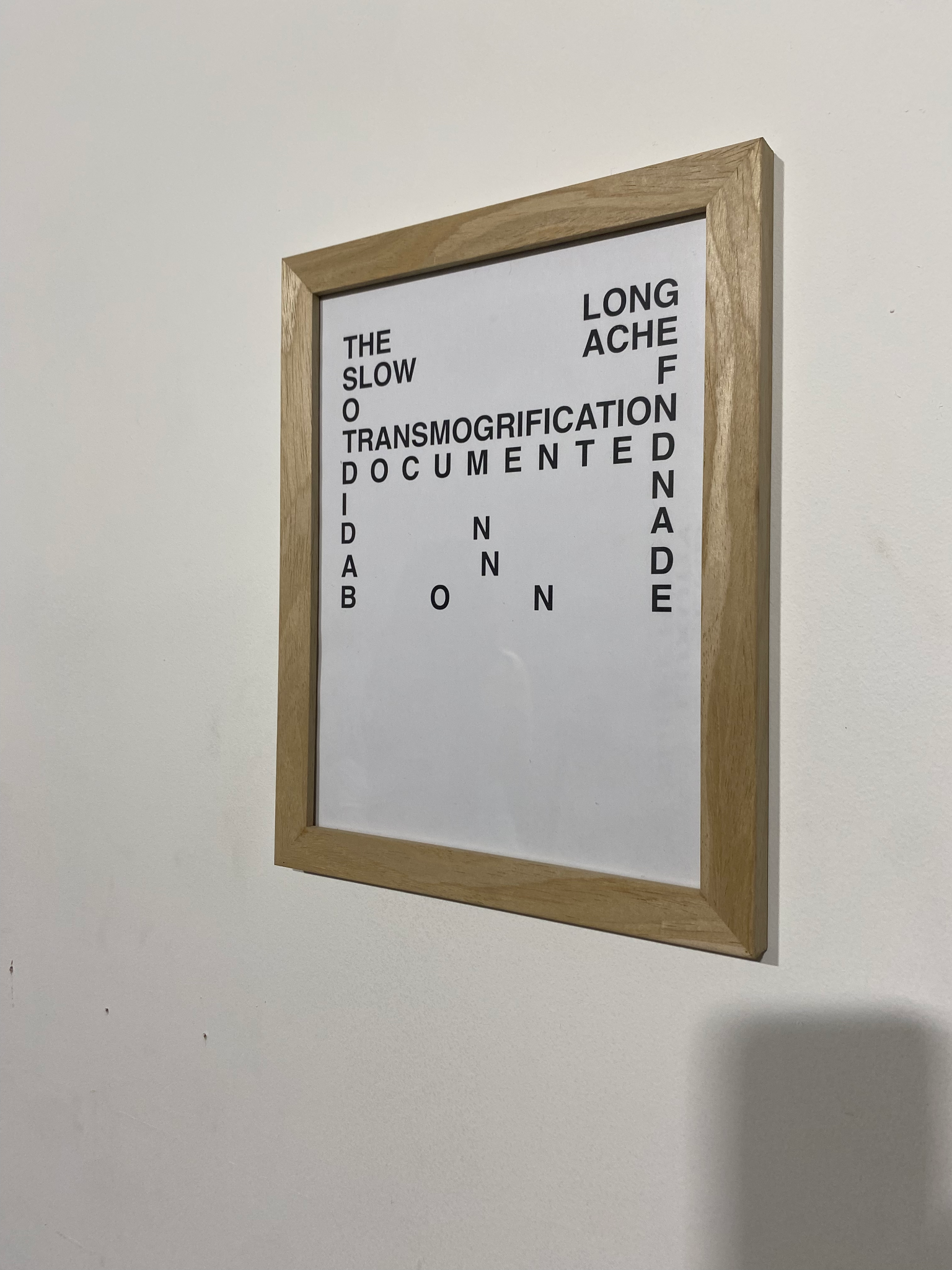
Thaniel Ion Lee, THE LONG, SLOW ACHE OF TRANSMOGRIFICATION, DOCUMENTED IN DNA AND BONE (2006).
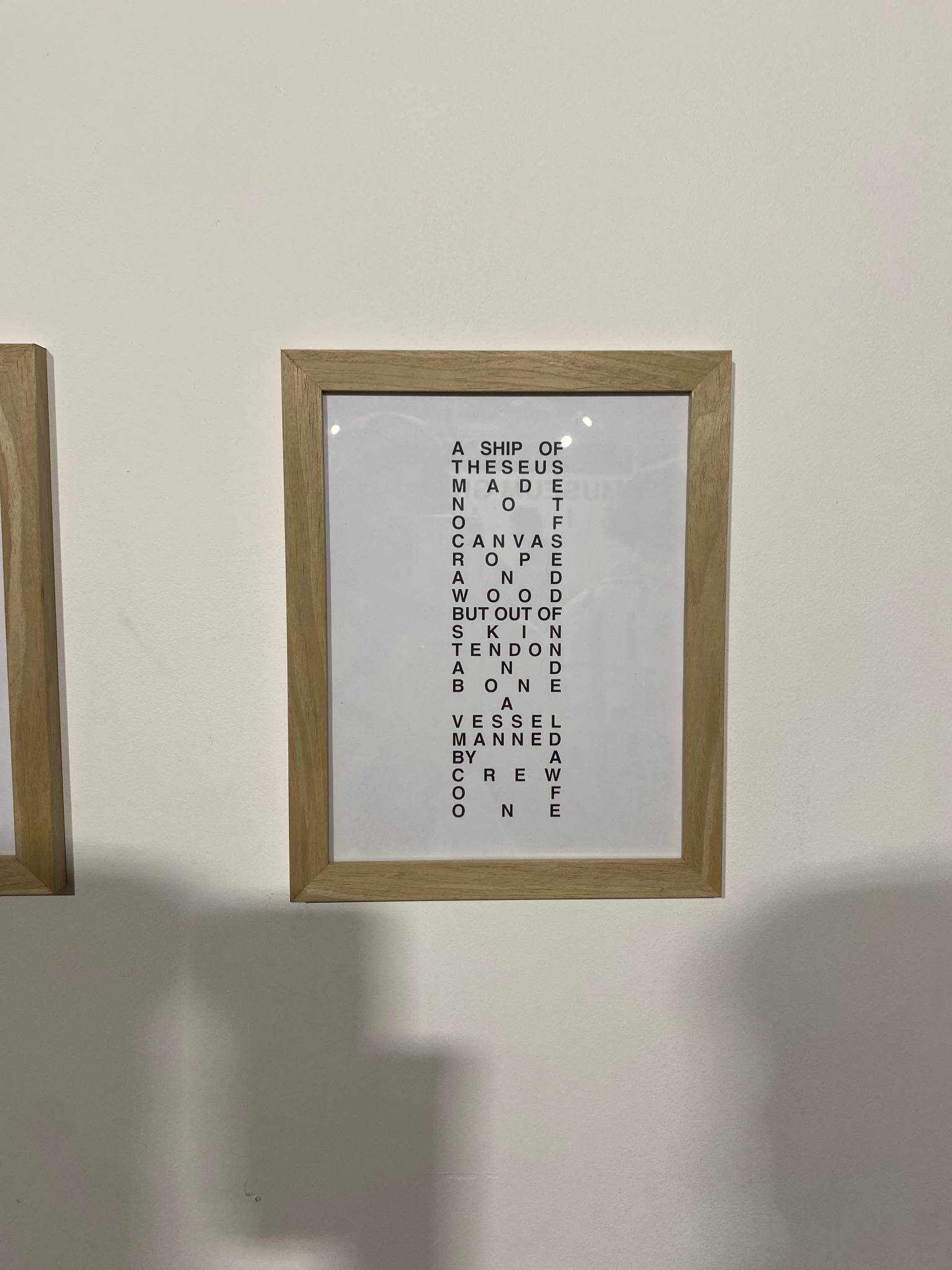
Thaniel Ion Lee, A SHIP OF THESEUS (2026).
There is only one physical sculpture present in the show. In the middle of the floor lies a shallow mound of dirt, with a small headstone bearing the words, “WE BECOME THE SOIL UPON WHICH WE STAND.” It seems that the words in this text sculpture presented an opportunity to be paired with a physical piece in a way that Lee couldn’t ignore, and it certainly feels as if it is the dominant image around which the exhibition pivots.
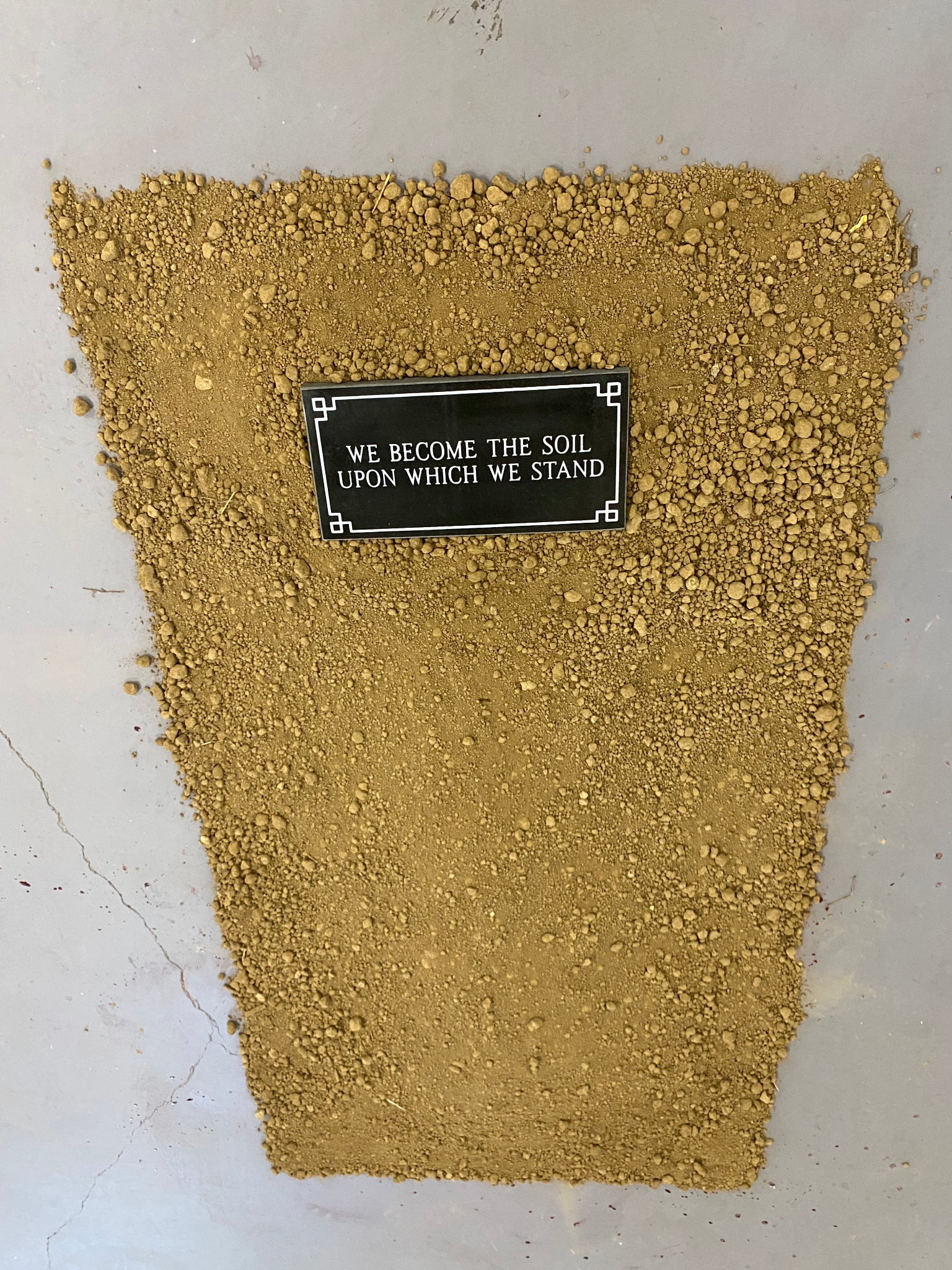
Thaniel Ion Lee, WE BECOME THE SOIL UPON WHICH WE STAND (2025-2026).
These works follow other artists who have used text in a conceptual way, and in his statement, Lee credits Weiner, Kosuth, Holzer, and Baldessari as influences. But his process and his motivations are purely his own. He’s managed to create a show that doesn’t really exist in physical space, which seems to be a true feat for a visual artist. Perhaps that’s to be expected for an artist who makes sculptures from words and who makes poetry while denying he’s a poet.