
ECOLOGICAL KINSHIPS

Installation view of Another Forest. Photo via Connor Stephenson.
It is the middle of summer, and Louisville is heating up. This year already, we have experienced near record-breaking rainfall and stifling humidity levels. Light pollution is disrupting bird migration, and there are fewer fireflies out than ever before. Ecological precarity threatens to overwhelm. Against this backdrop of uncertainty, artist-curators Clare Hirn & Alana Fitzgerald find themselves turning towards ecology as both an artistic tool for understanding, and an urgent topic to be understood.
Hirn’s exhibition, WITH INSECTS WE SHARE THE SAME LIGHT, opened May 9th at MaybeItsFate Cooperative. A week later, Another Forest, a collaboratively-curated exhibition by Alana Fitzgerald, opened at Louisville Visual Art’s project gallery. Visually, these shows differ greatly. At first, the precise realism found in WITH INSECTS seems at odds with ephemeral abstraction in Another Forest–and yet, we found something deeply compelling tying the exhibitions together.

Installation view of WITH INSECTS WE SHARE THE SAME LIGHT. Photo via Clare Hirn.
It is tempting to look at ecology solely as something humans study, rather than something we are actively part of. Ecology, however scientific, is relational; a system of individual relationships creating wider structures, built to benefit each other. With Insects and Another Forest ground themselves in this environmental symbiosis. Through world-building and abstracted representation, these exhibitions immerse the viewer in imagined ecosystems, reminding us that we are not just spectators of ecology–we are active participants within it.
Installation view of Another Forest. Photo via Connor Stephenson.
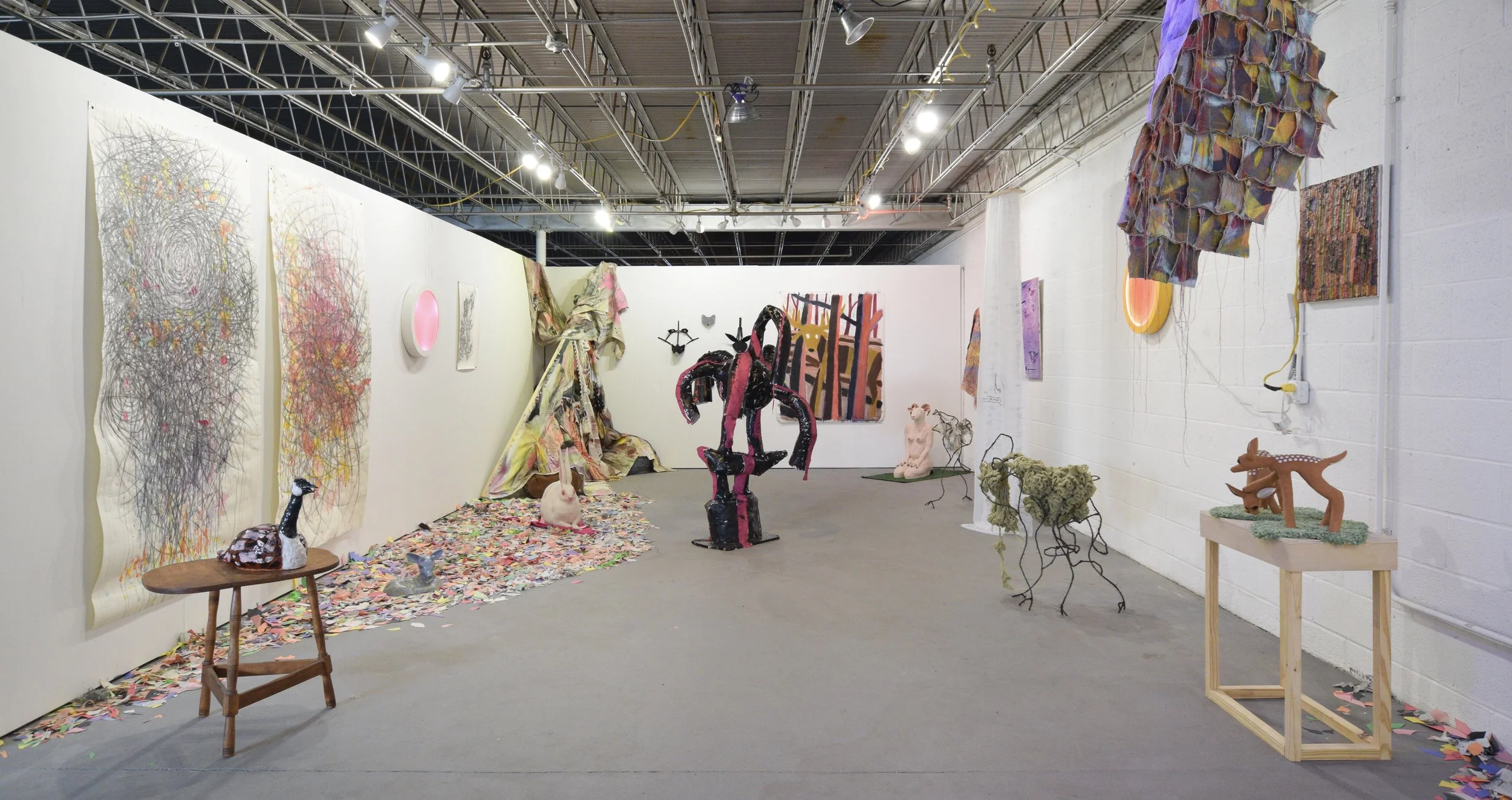
Another Forest bloomed as an experimental, abstraction-driven exhibition of artists both in and outside of the University of Louisville Hite Institute. While working alongside artists within the Master of Fine Art program at UofL, Fitzgerald noticed a throughline of experimental abstraction and invited other artists working with similar themes to join the exhibition. Each artist brings their own playful interpretations of natural form, from Connor Stephenson’s black and red tree in the center of the room, to Max Trumpower’s friendly goose waiting to greet visitors at the front of the exhibition.
During installation, artists were invited to partake in the curatorial process, adjusting the exhibition’s environment. Each artwork shifted over time, morphing the show’s layout into an end result that wasn’t premeditated. Many of these artists worked alongside each other, creating their work in tandem and building relationships that are reflected in the exhibition. These works aren’t concerned with portraying accurate depictions of flora and fauna. Instead, the anthropomorphic qualities of natural forms are used to express human emotion and identity. When asked, Fitzgerald noted she was open to a variety of artistic styles– realistic or not. An ecosystem leaves room for both things to exist, regardless of style. That experimental breathing room is a large player in what allows Another Forest to inhabit and construct a true ecosystem. Rather than leaning completely into a unified methodology, it embraces difference,¹ letting things sit in the tension of each other. The cohesion of the work comes from artists operating no longer as single organisms, but as components of a symbiotic relationship. Ecology then becomes the mode of art-making, socially and environmentally.
Installation view of Another Forest. Photo via Connor Stephenson.
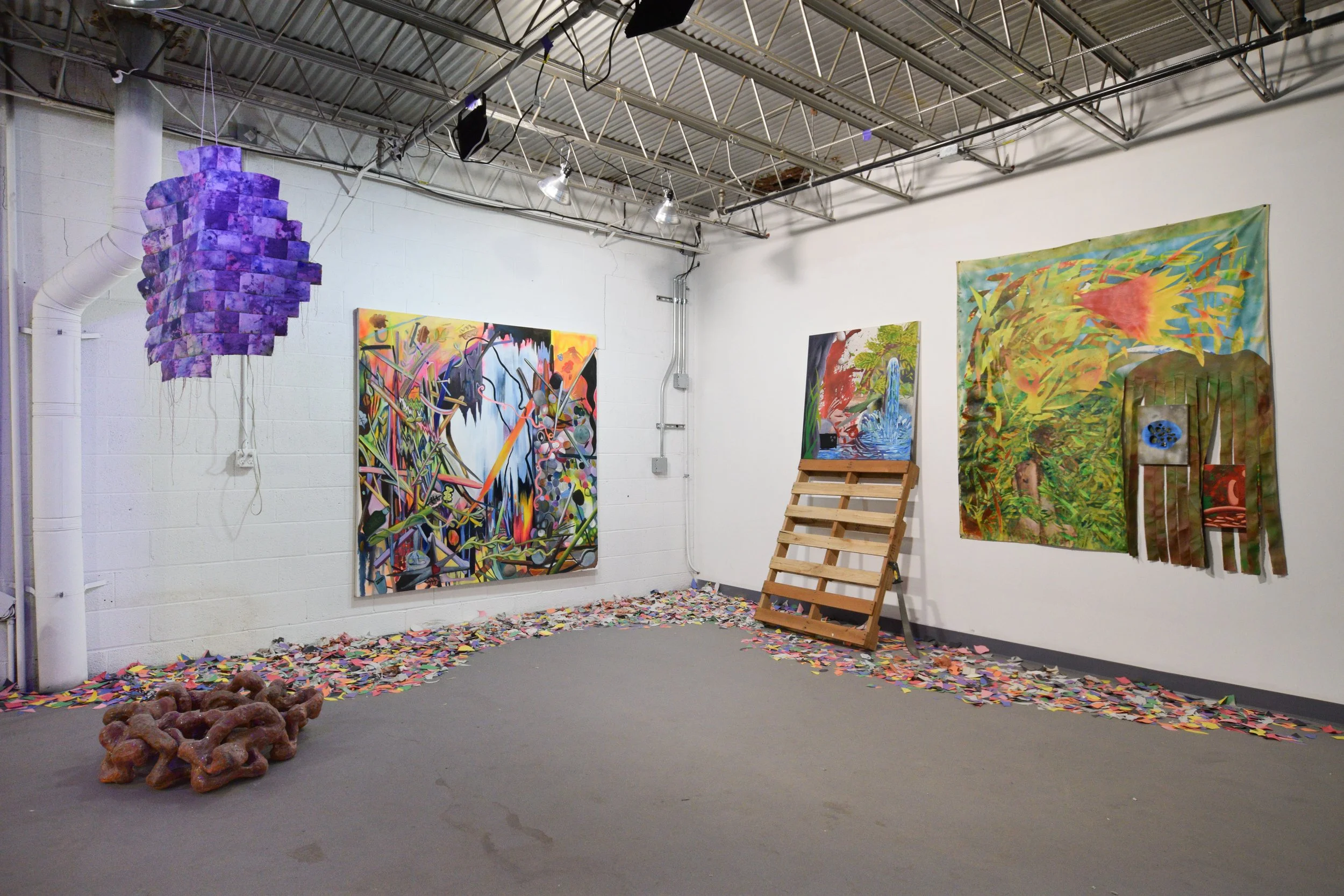
Upon entering the industrial project space, viewers step into an imagined world with ceramic animals, colorful plant matter, abstract two-dimensional paintings, and multi-media artwork enhanced by light and sound. Piles of multicolored leaves made of paper and fabric scraps cover the fringes of the space, forming a protective field around the small sculptures nestled within. Marcia Holloway Ross’s textile moon hangs over Drew Scanlon’s tangle of ceramic vines. Sara Noori’s soundscape plays overhead, adding to the immersive ambiance. As visitors walk further into the space, deeper into the forest, they encounter creatures that seem to take on a life of their own, occasionally obstructing the path and forcing one to walk around the space another way.
Placing these works in close proximity, their narratives culminate into a layered microcosm reflecting an interpersonal, relational ecology. This mode of layering encourages visitors to engage in communal worldbuilding beyond the gallery walls by considering their own relationships, carrying forward Fitzgerald’s intent of creating ecologies. The exhibition succeeds in this endeavor by placing the visitor in close proximity with each piece, pushing to consider relationality as they move through the physical space, further immersing them in this imagined world.

Installation view of Another Forest. Photo via Connor Stephenson.
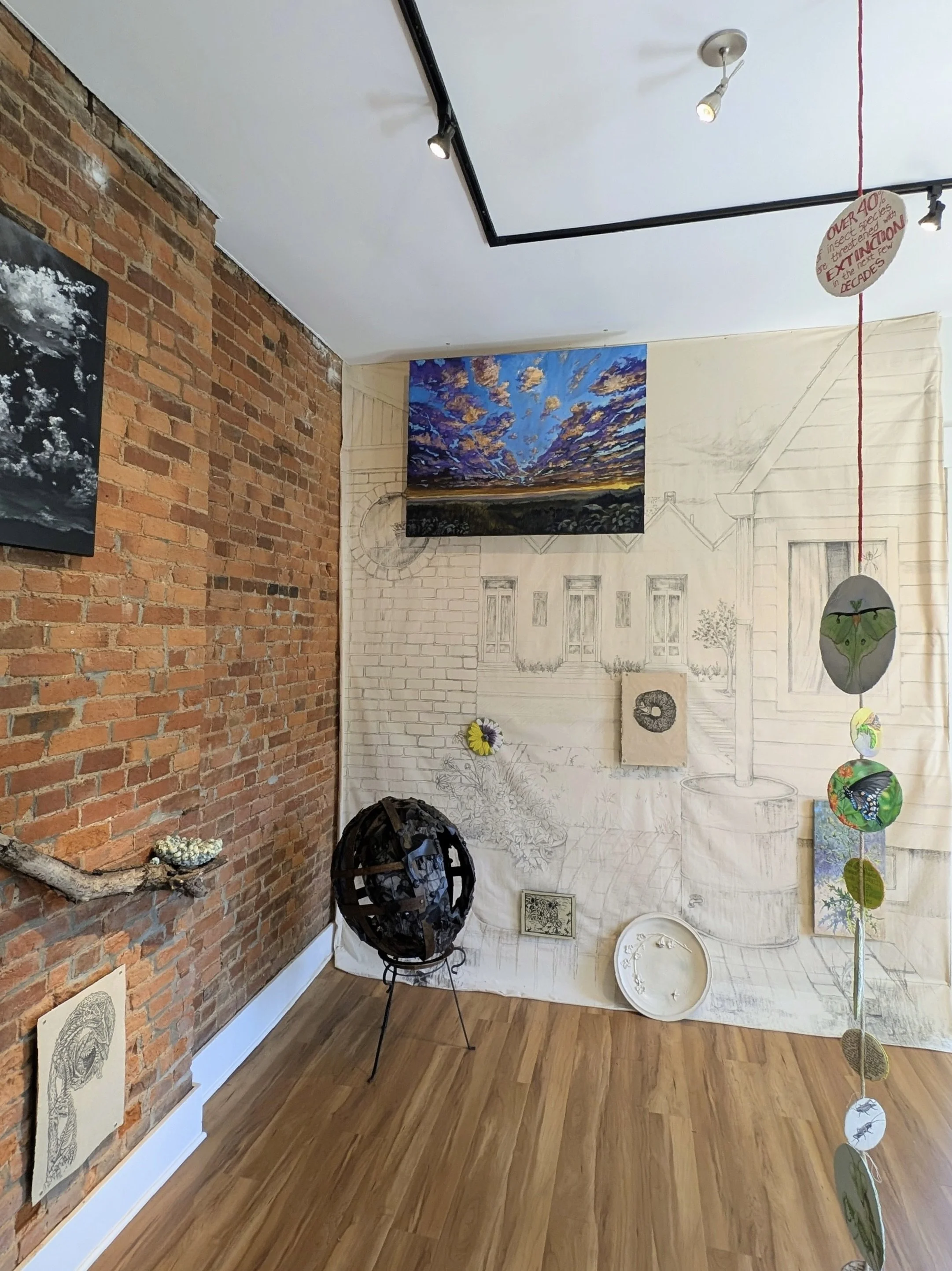
In WITH INSECTS WE SHARE THE SAME LIGHT, Hirn uses this same immersive world-building as an educational tool through the commission of two large canvas backdrops hand-drawn by set designers Sabra Crockett, Catherine Irwin, Brenda Kiefer and Hirn herself, to ground the show. These eight-foot-tall backdrops feature both urban and rural landscapes. Artworks are placed throughout the space at varying heights in relation to the backdrop illustrations. Within the urbanscape, Rachel Singel’s meticulously rendered maggot print hangs in front of the backdrop’s city sidewalk, mirroring where maggots might be tucked away under concrete in real life. Similarly, Elle Hendrickson’s botanical painting Theōria depicts a thick tangle of grass and wildflowers that seem to burst from the ruralscape backdrop. The pop of green and periwinkle–the only color on this side of the room–entice viewers to look deeper and contemplate new ways of seeing through an insect’s eyes.
In the same fashion, several more pieces by Gwen Burke, Sandra Charles, Douglas Miller, JD Schall, and Kat Smith are spread against the walls, some even spilling onto the floor. A string of circular canvases hangs from the center of the room, each featuring an illustration of a native Kentucky insect. Informative facts about the bugs are handwritten on the backside of each canvas. The top forty percent of the string is painted a vivid red, marked by a harrowing written reminder that forty percent of insect species are in decline and may face extinction in the upcoming decades. Hirn integrated sound, video, and physical plants, further enhancing the feeling of stepping out into your backyard. Elle Hendrickson’s single-channel video installation lies on the floor before the ruralscape. A screen faces up towards the viewer, playing footage of insects moving through compost. Leaves and branches submerge the ground around the screen– a nod to the necessity of leaves in the composting process. By the window, a live footage feed reflects the inner worlds of the plants growing beside it, encouraging the viewer to look into a real example of the simulated world. In the background, Ben Sollee’s soundscape plays quietly, setting a contemplative mood.
Installation view of WITH INSECTS WE SHARE THE SAME LIGHT. Photo via Clare Hirn.
The first and most obvious distinction between Fitzgerald & Hirn’s exhibitions lies in their relationship to representation: Another Forest builds ecology through abstraction and layered artistic relationships, while WITH INSECTS embraces direct representation as a tool for environmental education and urgency. Though the two curators grew these ideas separately, their coincidence in exhibiting simultaneously raises the question: What can the relationship between ecology and art reveal to us about living in the Anthropocene?
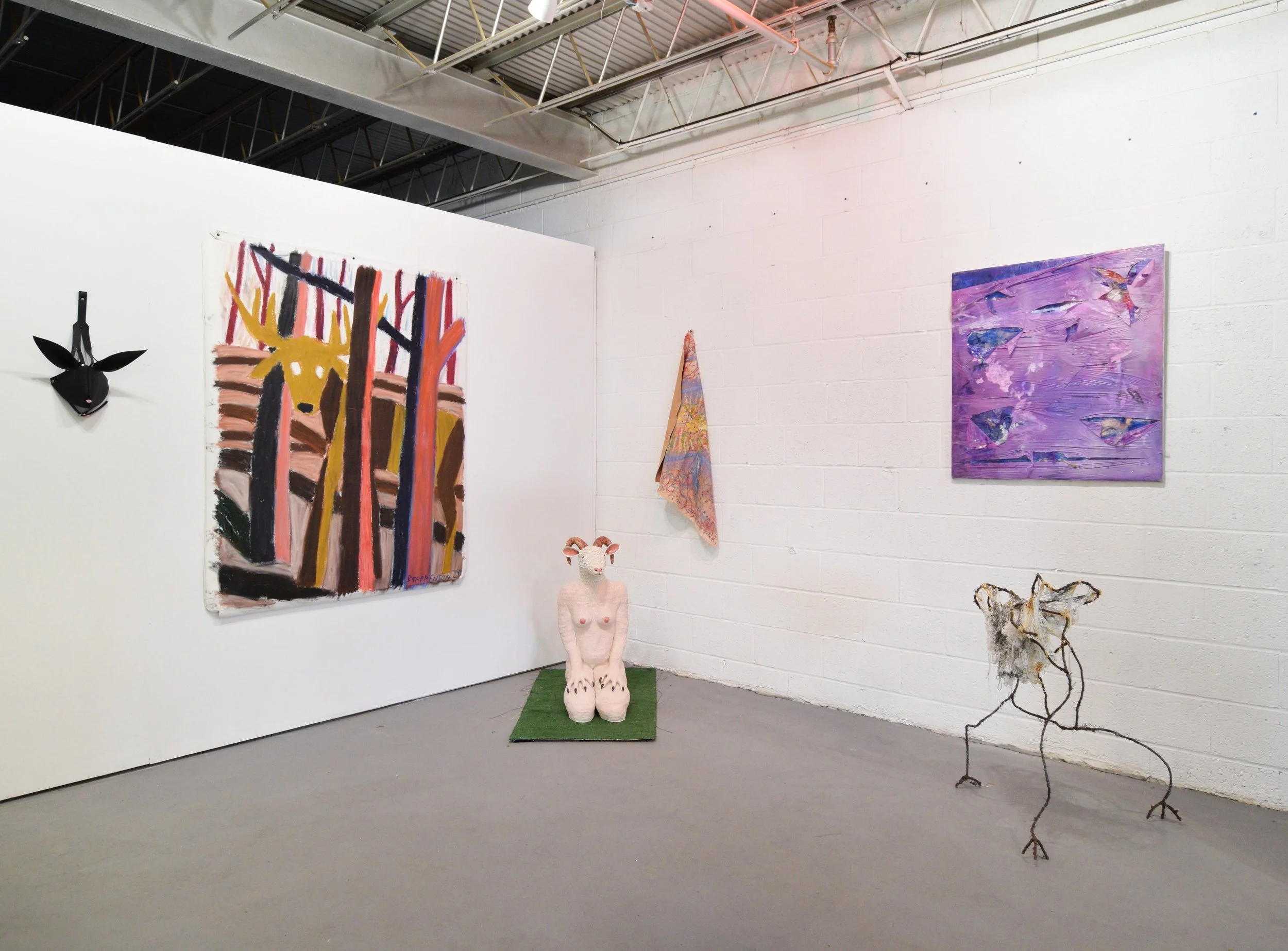
Installation view of Another Forest. Photo via Connor Stephenson.
In WITH INSECTS, art becomes the main modality to educate the viewer. Instead of looking to represent ecology through interpersonal systems, the work here points towards the material. WITH INSECTS asks us to consider how familiar, everyday scenes, a backyard garden or a forested park, can incite curiosity of the wider environment and the creatures within. Drawing from Hirn’s background as a medical illustrator, the exhibition emphasizes how realism requires a sense of appreciation during art-making. When slowing down to painstakingly render the details of a maggot, one can’t help but meditate on its existence and our relationship to it.
Despite stark visual differences, Another Forest and WITH INSECTS WE SHARE THE SAME LIGHT emerge from the same desire to witness and act upon the looming threat of environmental precarity. The call for urgency and action within these exhibitions lies within the relationships between the works themselves, encouraging viewers to reconsider our responsibility to care for the shared world around us and each other. As these exhibitions hint at, if we fail to recognize the importance of ecological kinship²–to the bugs, trees, and to each other–we risk falling even further into precarity. By understanding how ecology can be utilized as both a subject and a methodology artistically, we can begin to realize that the task at hand isn’t ‘human versus nature’, but rather ‘human as nature.’
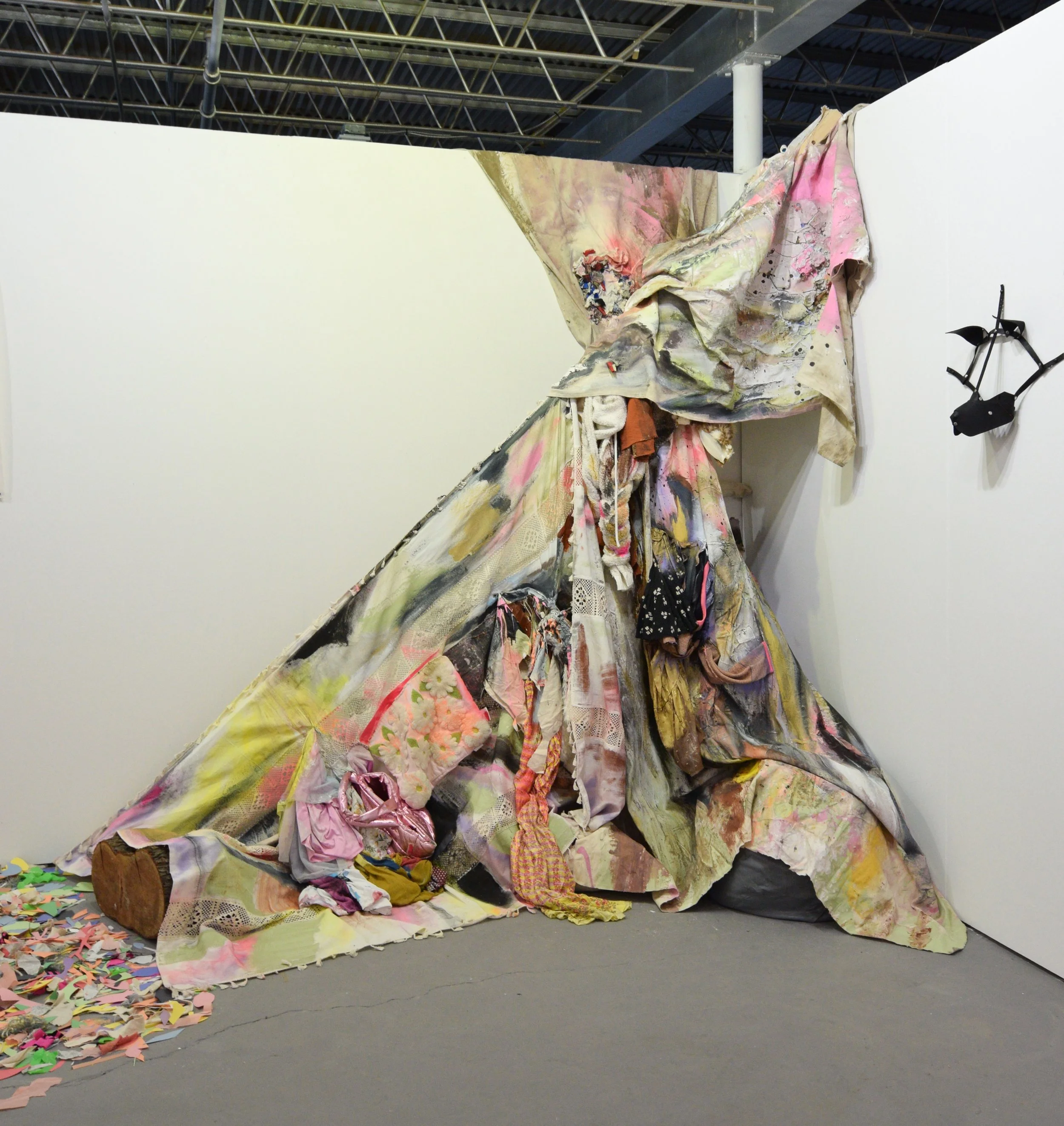
Installation view of Another Forest. Photo via Connor Stephenson.
¹ For more on this, read Our Everyday: The Intangible yet Tangible Tensions between Commonality, Contrast, and Co-operation within Design Education by Nan O’Sullivan in Commons in Design.
² For more on this locally, see the current The Speed Collects: Native American Art, curated by Assistant Curator and NAGPRA Coordinator Sirene Martin, which is centered on the indigenous worldview of Kincentrcity.