
A LIMITED TIME
On Jacob Heustis’ A Limited Time exhibition.
All photos via Elle Hendrickson.
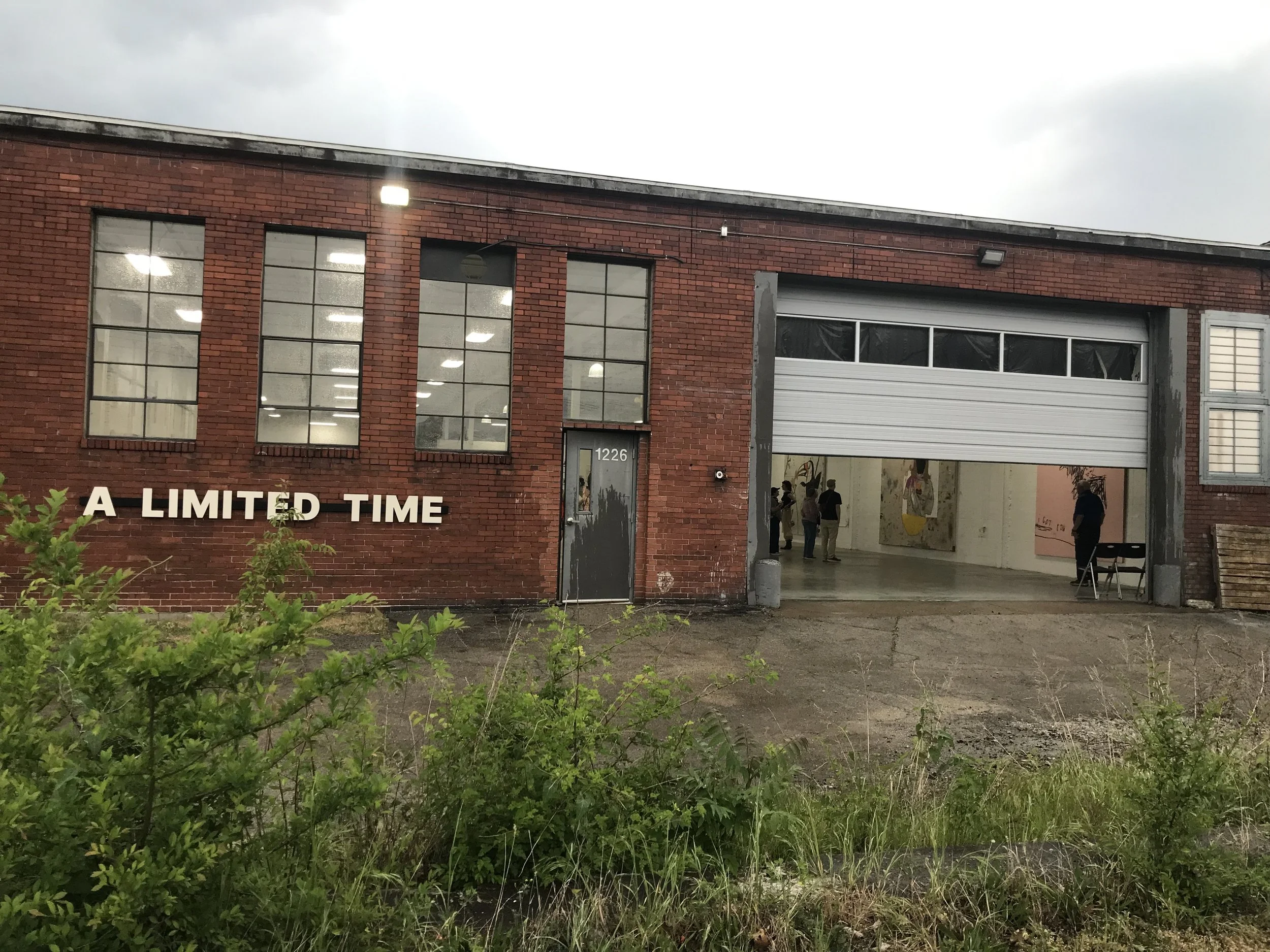
As I approached A Limited Time—Jake Heustis’s first major survey exhibition since 2019—wildly chaotic weather swirled overhead: waves of humidity colliding with polar air from an imbalanced jet stream. I couldn’t help but feel queasy as I moved from the dilapidated exterior into the dizzyingly well-lighted, whitewashed, freshly painted and renovated warehouse. Something unspoken seemed to hang in the air, perhaps the pretense of an absurdly outmoded mix of Southern hospitality and Midwestern sentiment in a world increasingly out of control. The exhibition felt like a public secret—something everyone knows but dares not say aloud, except in hushed whispers or private rants.
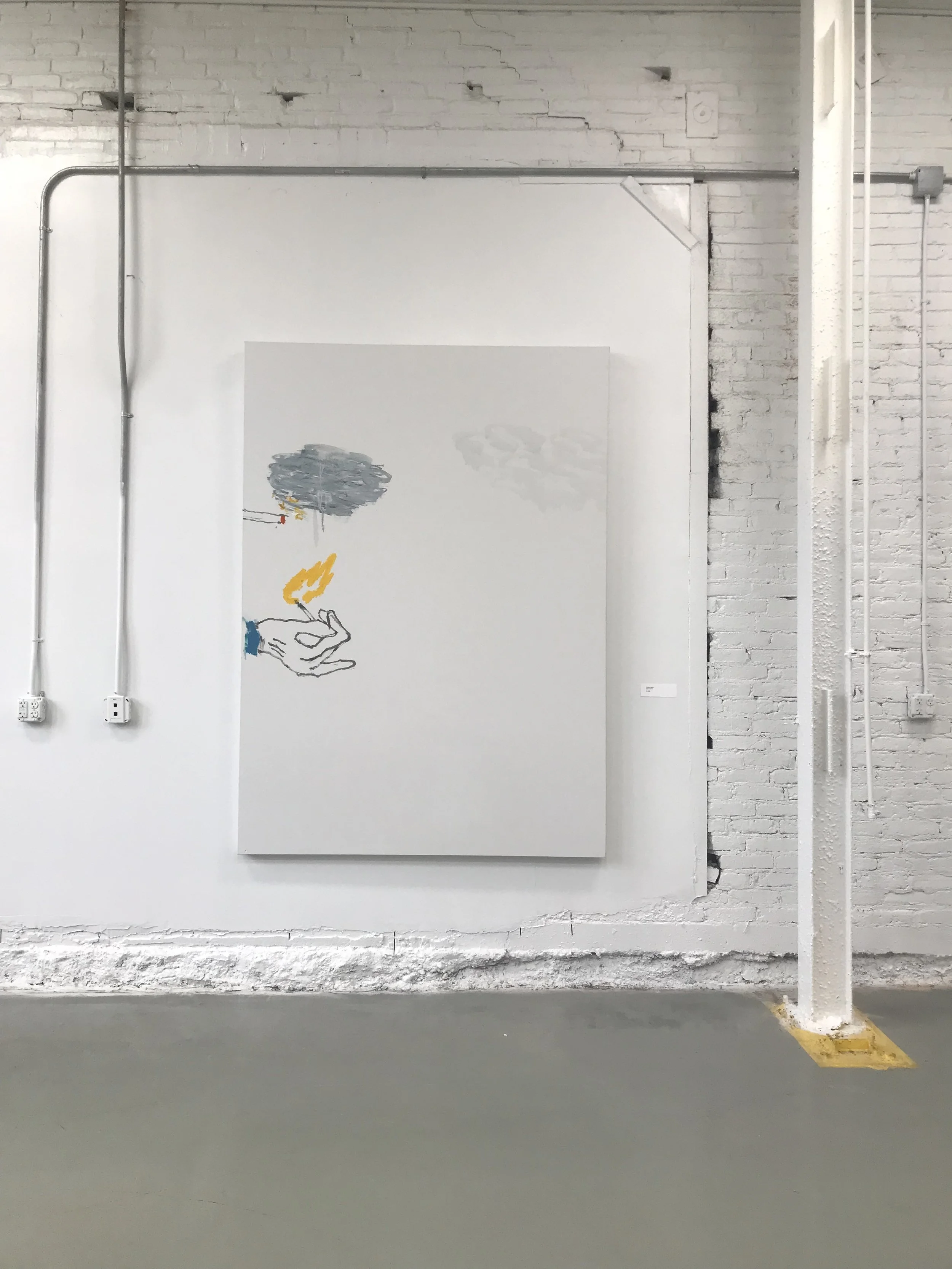
Perhaps all of the atmospheric fuzz had something to do with the urban redevelopment projects underway in Portland, the long-redlined West Louisville neighborhood, seems to be suspiciously wink-winked at by the white-gloved Mickey Mouse smoking hand painting that opens the show. Or perhaps it is revealed in the pastel pants, stylish mugs, and sidelong glances of sun-tanned attendees and onlookers testing out their spring-break legs in a world on fire.
Even the exhibition’s title, A Limited Time, gestures toward the absurd situational pageantry: an event staged in a recently sold building, a limited time offer of a long disenfranchised and fraught neighborhood for the taking, staged for economic overhaul. And in the background of it all: the decadence of the overhyped “fastest two minutes in sports” that defines Kentucky Derby season.
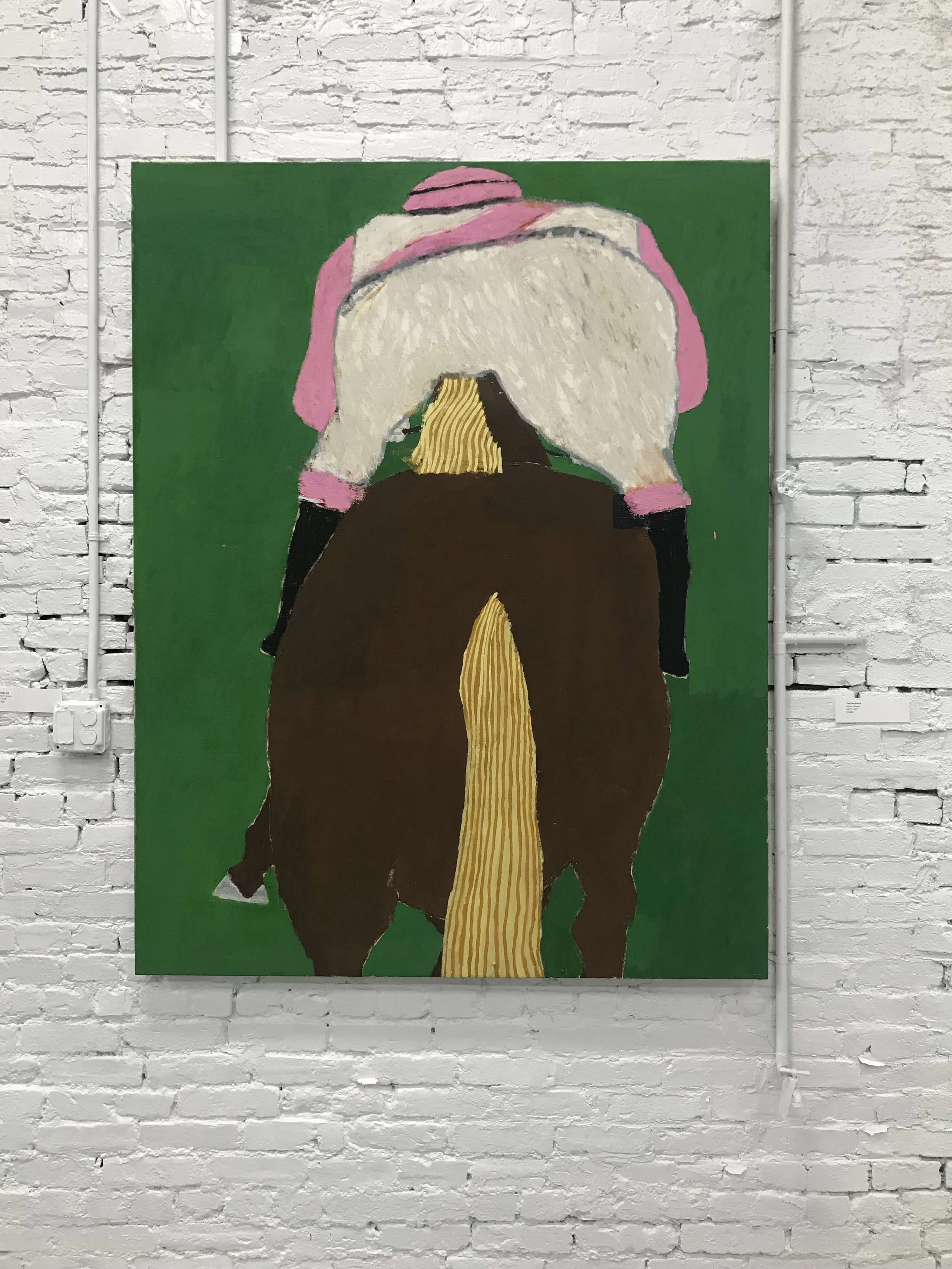
Whatever the pretext, Heustis’ paintings present themselves as deliberately easy. They are often delightfully derivative, shamelessly nodding to—or outright borrowing from—well-known artists of the modern and contemporary canon (Philip Guston, Raymond Pettibon, and Cy Twombly, to name a few) and pop-cultural imagery and language. At the same time, they feel confidently “undefined” and spacious, monumentally cheeky, and mischievously naive.
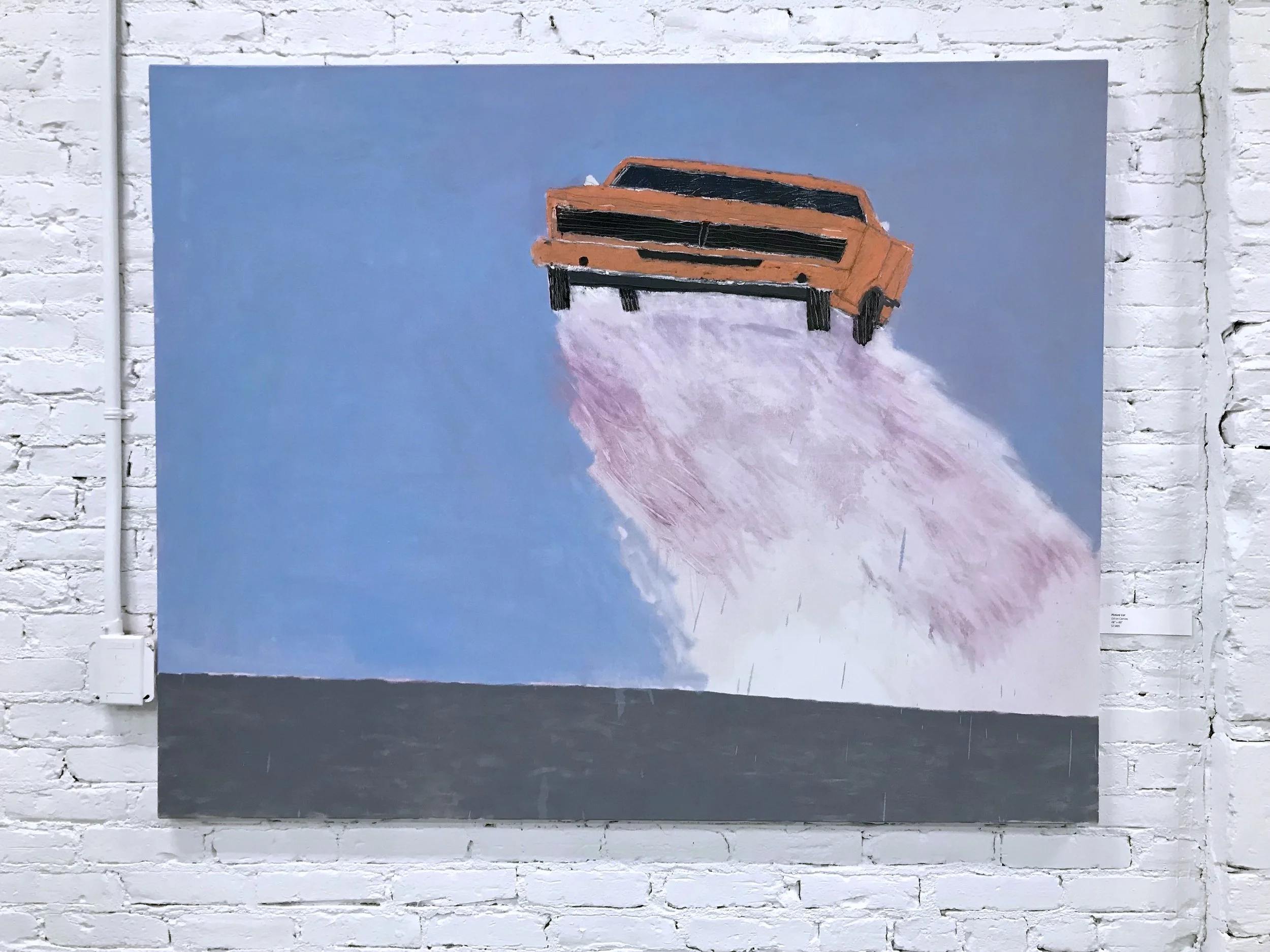
A compelling example of this cheeky mischief is Picture Car. Based on an iconic image of The Dukes of Hazzard’s General Lee—an orange Dodge Charger emblazoned with the Confederate flag—the painting appears to leap off the white wall, much like a child’s drawing springing from a refrigerator door, its idea barely contained by the edges of the page. This cultivated un-refinement gestures toward the kind of childish psychosis embedded within our overly billboarded, belligerent, and algorithmically blinkered dis-society.
I’m not saying this work glorifies the Confederate South by any means but it definitely knowingly nods to a collective notion of American outlaw culture. Nostalgically pining for a bygone era of Jeffersonian and libertarian self-made vigilantism, Picture Car is a symbol of the unhinged pleasure-seeking and gun-it accelerationist warmachine of NOS infused and TESLA-fied move-fast-and-break things–tech-bro white supremacist individualism spun out of control. The painting’s crude abstraction reflects a deeply misanthropic and outmoded colonialist worldview rooted in macho man-ifest destiny. Meanwhile, sketchy contours and an unstable horizon appear to collapse inward, regressing toward an idiocratic, adult-swim-like wasteland defined by cartoonish productivity, belligerent homogeneity, and meaningless horizontal achievement.
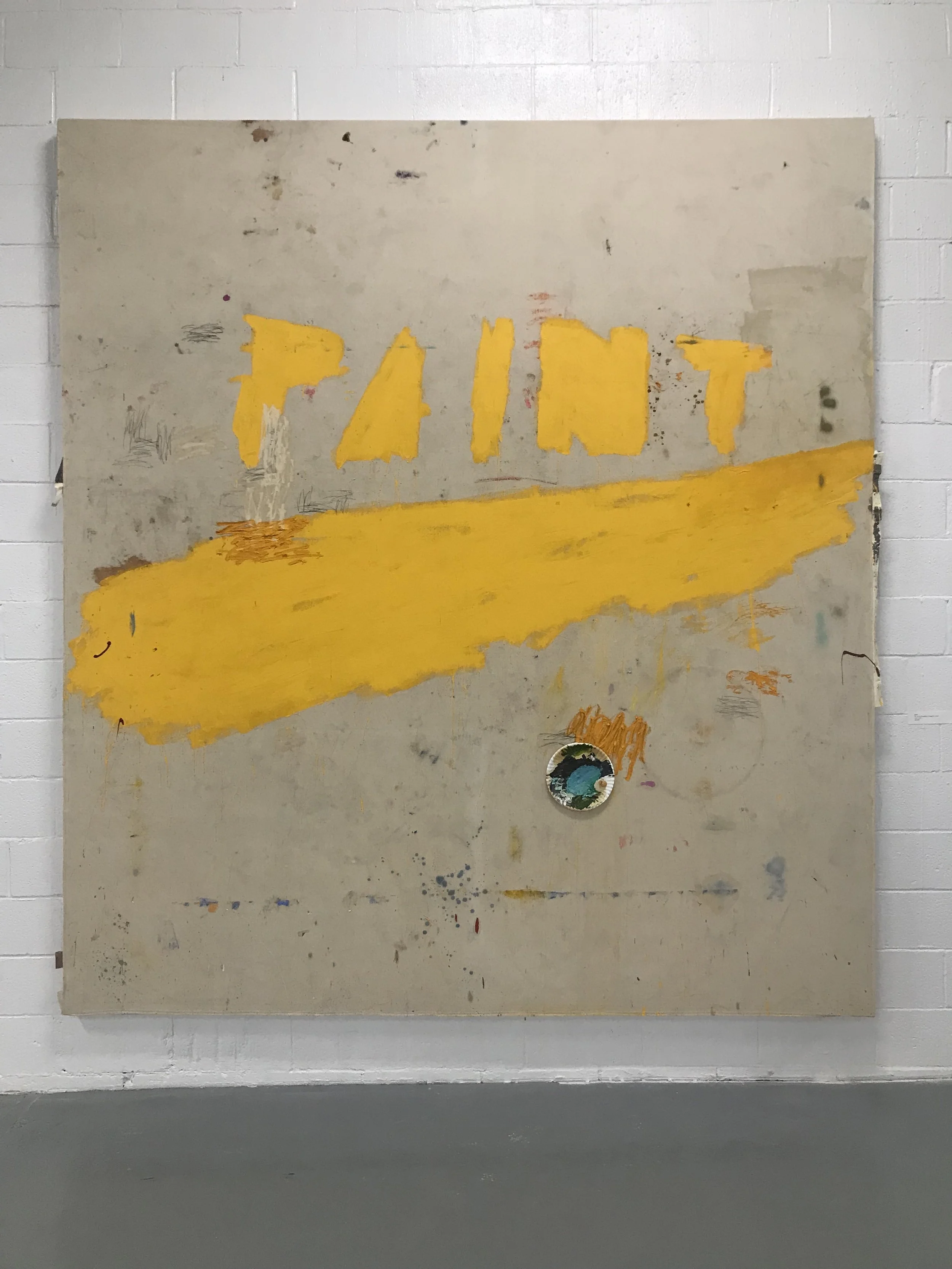
Another picture that comes to mind is Paint. This kind of image making–at once self-referential, knowingly brazen, intentionally accidental, and palimpsested surface that forms an overall from-the-hip kind of redactionist mark making–seems to lie at the heart of the Heustis vocabulary. Paint at once seems scatalogical and at the same time assertively and almost sardonically frank in its tautological semiotics, something that brings to mind Rene Magritte’s The Treachery of Images, or Joseph Kosuth’s One and Three Chairs.
The flip-flopping between mark and erasure as mark—gesturing toward a kind of Zen immediatism, a cultivated “suchness”—inevitably recalls the stylish negations of Abstract Expressionism, particularly the satirical mysticism and political commentaries of Philip Guston. Yet it also echoes the Suprematist proposition of painting as an end in itself. No comparison feels more relevant here than Kazimir Malevich’s black squares: acts of essential reduction that hover between void and declaration. And yet, for all the play and polyphonic drift that typify Heustis’s mark-making, there seems to be one rule he refuses to abandon (at least in this body of work): the rectangle of the picture plane itself.
Looking across the works—especially the large, monolithic painting of Jesus on drop cloth—I keep returning to the ways entire neighborhoods are redacted, covered, gerrymandered, or redlined in the name of redevelopment and/or the seemingly endless, dividualist privatization and neo-fascist power grabs. In the “blackface” of Jesus, there is an uneasy reminder of the entanglement of minstrelsy, religious imperialism, the New Jim Crow Military Industrial Prison Complex, and the white supremacist foundations of America. At the same time, the image suggests an inverted No-Face, the absorptive figure from Spirited Away, that mirrors the greed and gluttony of those around it.
Maybe it’s burnout. But I left the exhibition with a taste of unease, and disappointment, something between curiosity and doubt lingering as my eyes drifted over the seemingly inflated price tags and an artist statement saying “My work comes from an interpretation of my daily experience.” I thought to myself, these pieces seem far too discrete and overly simplistic in their scope to say anything meaningful about the complexities of being a human today. Perhaps that's where the knowingly ironic aspects of the work come into play, but for me this work rests too fully on a slapstick aesthetics of one-liners and koan-like paradoxes and universalisms to say anything meaningful about the lived experience of the artist.
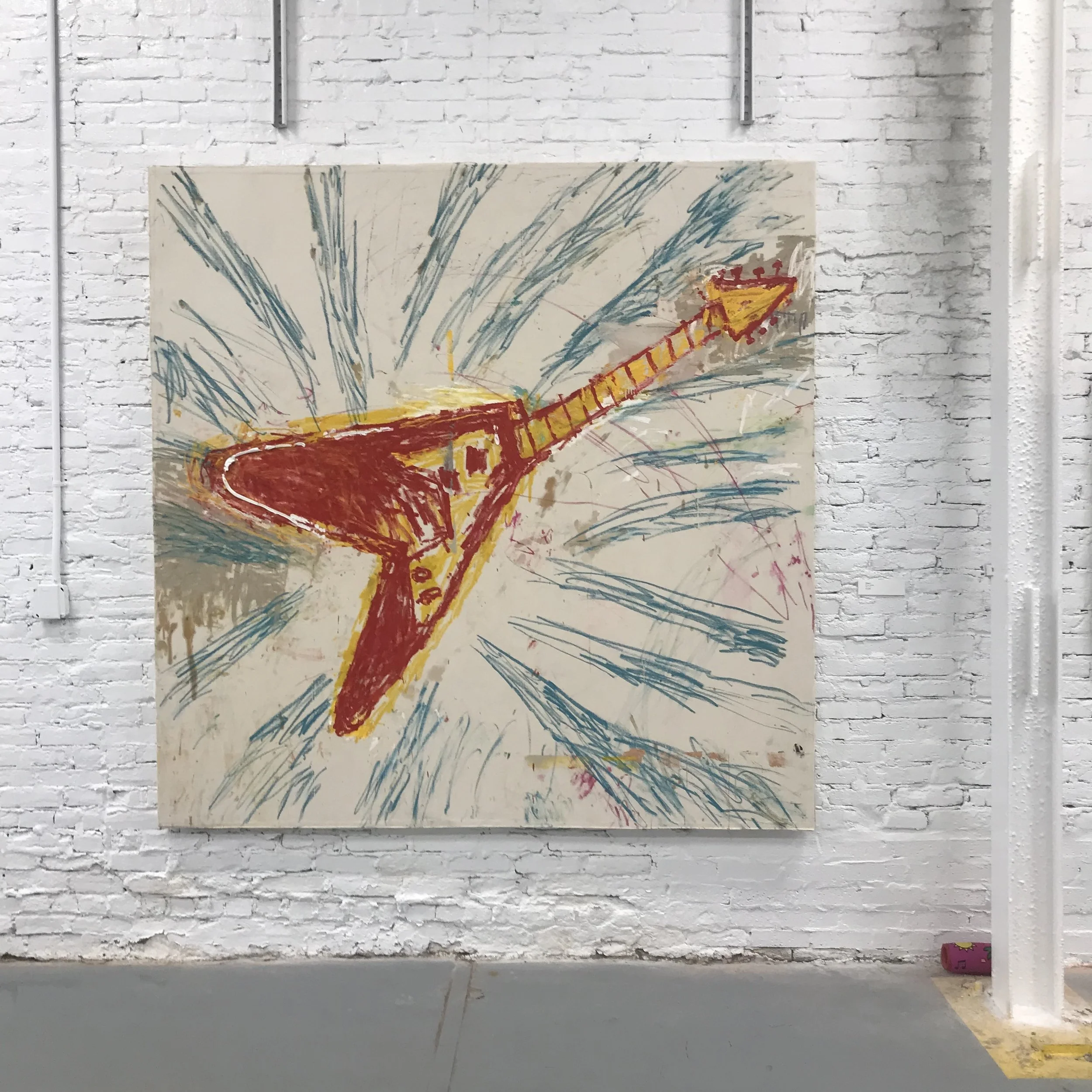
There is a possibility for this work to read like a parody of single-minded American optimism, something you might find, for example, in B. Traven’s The Death Ship. Yet, the work appears to emerge from a position of privilege and access, knowingly guarded in its coolness, relying on the stylish immediacy of surface over any deeper vulnerability or existential risk. Crudely drawn cars, horizons, bats, cool lyrics, Jesus, skulls, guitars, cocktails, paint… These things signify something, but what do they ultimately reveal about the artist's point of view? This mode of knowing naïveté, seemingly lacking in any deeper search for meaning, has the potential to collapse into a kind of vapid nihilism: hipster platitudes masquerading as critique. Maybe it’s just me, but these “it is what it is” gestures no longer feel adequate to the cognitive dissonance of living under disaster capitalism.
A Limited Time? Yes—beautiful work, decisive, bold and commercially accessible—but without vulnerability and deeper reflection from the artist, this exhibition could seem, to some, like a remarkable display of craft that never quite transcends itself.
If we continue to value algorithms, objects, land and benchmarks over people, slowness, labor and bio-diversity, as entire city blocks are rezoned into cultural voids and capitalist playgrounds for the few, and bets are waged on wars and genocidal campaigns to breed monocultural wastelands in the name of growth—data centers, ikea knick-knacks and Amazon fulfillment hubs for all—what role remains for the wild-hearted artist in a world that may no longer have any use for them?
Editor's Note (June 10, 2026):
This article has been updated at the author's request. Language in the paragraph beginning, “A Limited Time? Yes–beautiful work…” has been revised to better reflect the intended tone of the review.