
WHAT TO EXPECT WHEN YOU’RE EXPECTING
On the Speed Art Museum and institutional disappointment.
Footnotes can be found at the bottom of this post. The community letter to the Speed, and the Speed's response, are both there as well.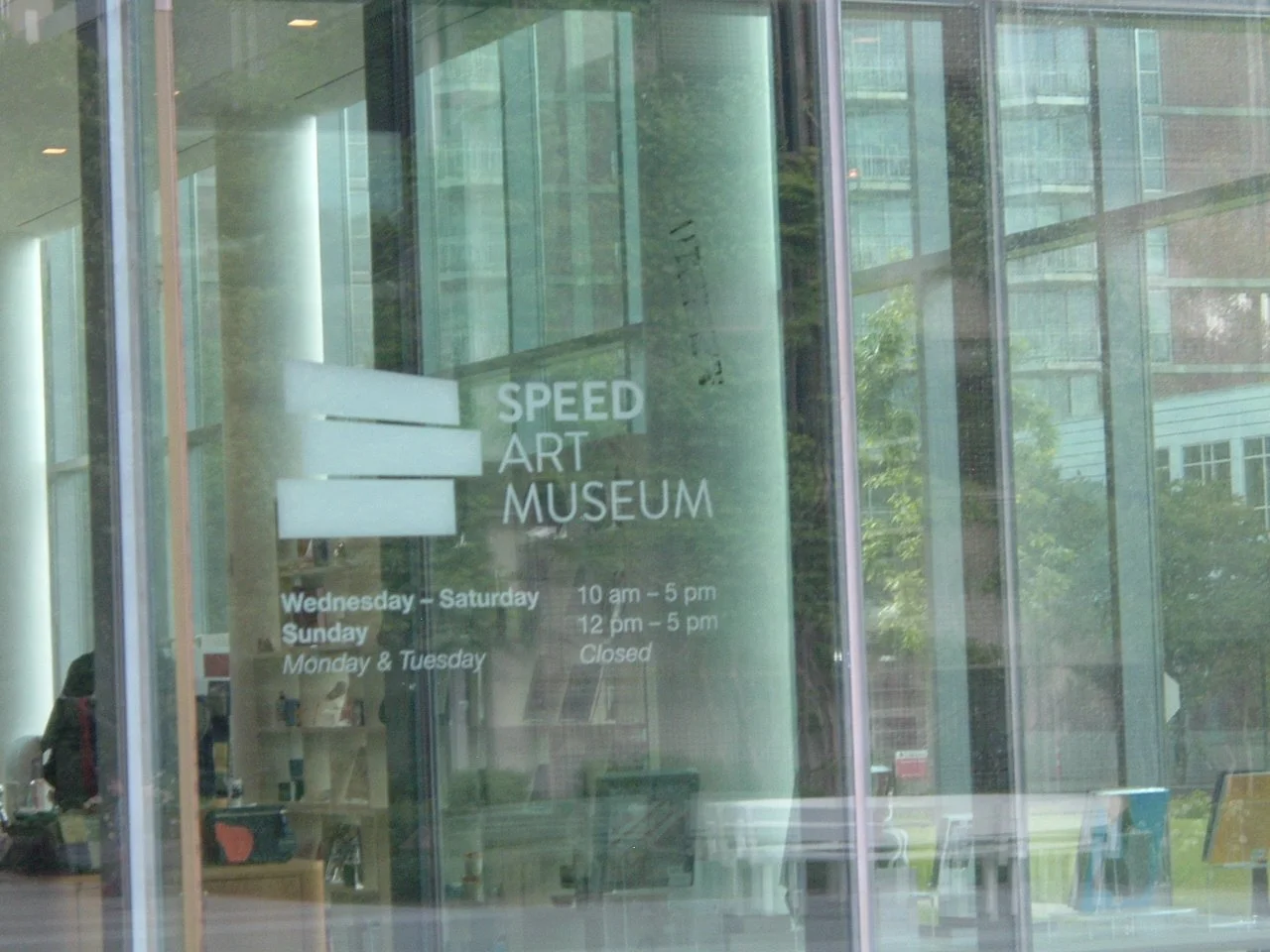
Outside the Speed Art Museum.
What can we reasonably demand of our institutions? What does it mean for a museum to be meaningfully involved in its community? Or, to be more specific: what can we, the community members, demand of the Speed Art Museum and expect to receive?
This question has been plaguing me since the Speed’s recent dissolution of their Learning, Education, and Belonging (LEB) Department last October, citing financial constraints that followed the expiration of COVID- and Biden-induced federal relief funding. A quick look into their finances will tell you that this is, to some extent, the case. The Speed is not unlike other museums and cultural institutions in this respect: museums generally lack unrestricted liquid assets, meaning they have limited financial agility (money they can choose how to spend). It is not uncommon for their sources of income to be accompanied by a slew of stipulations, whether via donors, foundations, or endowments, each, in some way, influencing or directly controlling the way funds may or may not be spent. In the United States, these restrictions become even more pronounced because of a cantilevered dependence on private donations. The Trump administration slashing government arts funding, specifically for Diversity, Equity and Inclusion (DEI)-based grants, didn’t do us any favors.
Via Valentina Tanni on Pinterest.
Recent budget cuts are not the only explanation as to why cultural institutions are struggling. Many have not been able to revive attendance to pre-pandemic levels (likely due in part to the ever-more-precarious financial situation facing the average person, but possibly also as a result of habit changes). This makes sense, I suppose. The larger part of the population had to alter their lives to accommodate the virus and resulting global recession. At the same time, we shifted even further into the immaterial digital world. But I found myself wondering: is that the full picture? I’d wager the problem is a cocktail of increasing economic peril, both for institutions and individuals, a general malaise that has settled under our shared skin as we watch once-perceived-solid infrastructures crumble, and a creeping disdain for and mistrust of said infrastructures that, as their contours come into clearer focus, do not serve [the collective] “us”.
Can it be that, aside from factors outside of institutional control, visitorship is down because museums no longer share our values? Or rather, they never did, and this is a reality we are only recently awakening to? Is it possible our values have changed?
Let me take a step back and define what I mean when I say “cultural institution”, “infrastructures”, and “community”. Buzzwords like these tend to bog down the clarity of arts writing (less a side-effect and more a feature). When we use capital “A” Art World jargon that gets thrown around, loosely defined, in capital “D” Discourse, which continues to fold in on itself as a result—an echo-chamber threatening to self-implode—lack of clarity becomes not only negligent but harmful, and the meaning of these words gets lost in our attempt at cultural and academic conformity.
How can we expect our claims and condemnations to hold weight when we aren’t even sure what we’re lifting? When I mention “cultural institutions”, I mean to say any public organization (most often non-profits) that works within a given culture to preserve, promote, and/or interpret its heritage and/or contemporary activity.¹ The Speed should be at the front of our minds here, but museums are not the only cultural institutions; some other examples include libraries, archives, galleries, community centers, and churches.
These are not neutral organizations—institutions do not form from nothing; they are shaped by the forces that sustain them. “Infrastructures” is a broad term. Here, I use it to talk about systems that regulate culture. Not only what makes institutions themselves possible, but what shapes the limits of both individual and collective actions. An infrastructure, taken in this context, includes (but is not limited to) philanthropic tax law, public funding programs, mutual aid networks, the Gallery-Industrial Complex, and the racist histories and present logics that continue to structure the Art World.

Via Xoce on Pinterest.
Finally, we arrive at the always-spoken never-defined term, “community”. I do not mean it to be synonymous with “audience”, the sort of “community” that institutions invoke when really they are talking about a consumer base that aligns with their strategic goals. I also do not mean an abstract, harmonious collective. Rather, the network of people who are materially and geographically affected by an institution’s presence (in this case, the Speed’s). This is certainly not limited to capital “A” Artists, though [they are included and] often we talk as if it is. It is made up of people who live nearby, work nearby (or inside), attend programs, send their children on school tours, who have felt traditionally included or traditionally excluded from it. It is the body of people whose lives intersect with the institution whether or not they choose to step inside. It is a fractured, layered, and intensely complex amalgam of people, often with varied interests and levels of investment. Now we may speak of the “infrastructures” that shape the “cultural institutions” within our local “community”—aka, the Speed Art Museum and the things that either hold it in place or threaten its stability in our city.
Back to the problem at hand. It is entirely conceivable that the Speed would have to eliminate a department, an expense. Money is tight for most cultural institutions, and in order to keep up non-negotiable operations like security and collection maintenance amidst an almost $4 million board-voted budget cut, something had to go. It is no secret that museums, like the majority of cultural institutions, are more focused on maintaining revenue than their purported vision—and naturally so, as there can be no vision or mission without revenue. This is not necessarily the fault of museums but rather is due to the infrastructures that they find themselves enmeshed in.
I find it somewhat odd that we all pretend that museums are not, at their core, businesses, at least in the United States. Museums and many other cultural institutions sling around words like “Learning”, “Education”, and “Belonging”, and we would be remiss not to realize that (at least) part of the reason they do is to gain revenue. More inclusion is not entirely altruistic; it translates to a wider audience base. I think this is maybe where some of the confusion and frustration lies with this decision. We are told by museums, like the Speed, that we matter to them. But to truly rely on them to build systems that benefit us would be much like asking questions posed in this tweet: Is Mastercard a queer ally? Is [insert corporation] my friend? Is the Speed Art Museum a feminist?
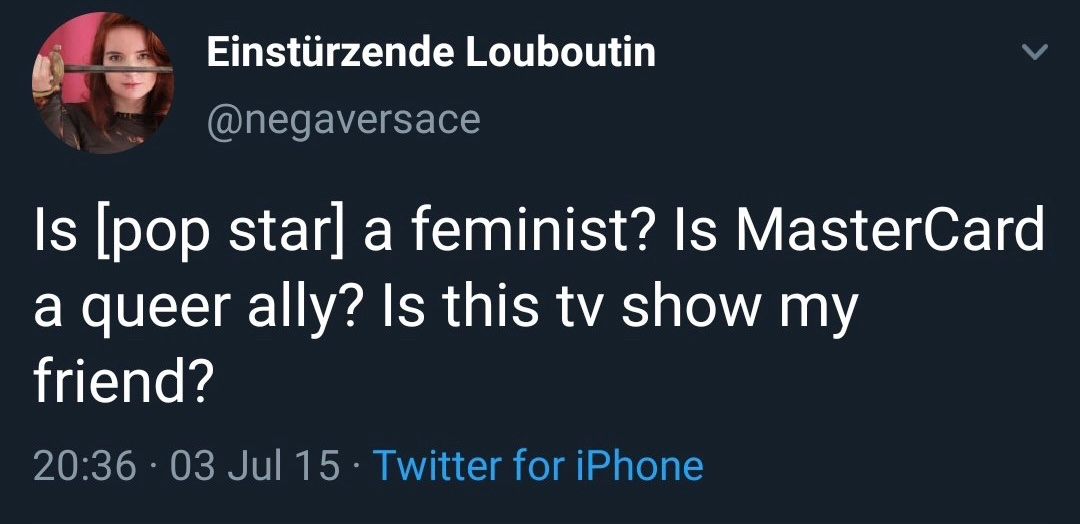
Tweet from @negaversace, July 2015.
As per Nel Noddings, no institution can ever be truly ethical or caring, by virtue of it being an institution. Institutional scale is too large to implement tailored, relational solutions, so instead must make decisions based on something akin to utilitarianism. Can we lay the blame on them for this? Maybe, maybe not. My theory, though, is that we need to find somewhere else to place our trust. A museum does not have the capability to be ethical—or to be unethical, to some extent—as a museum cannot engage in ethical life. We must resist the urge to imbue these organizations with personhood. We may refer to a person within an institution as being capable of moral decision-making, but not the institutions themselves.
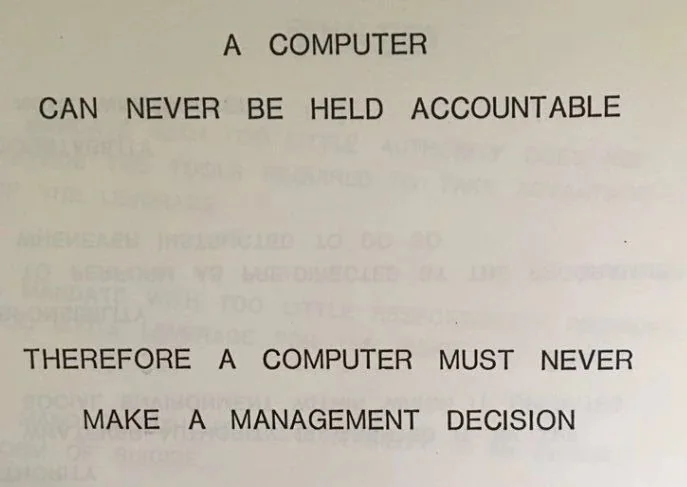
Excerpt from a 1979 IBM Training Manual.
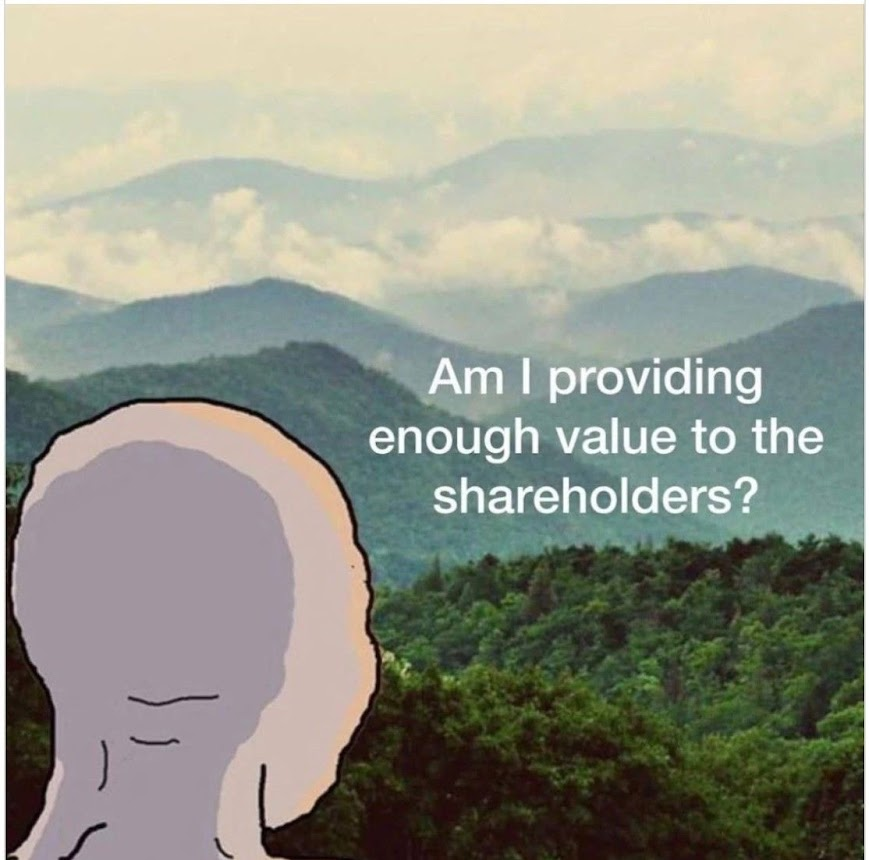
So, we know that they eliminated the LEB department due to budget cuts. My follow-up question would be: Why, specifically, did they eliminate the LEB and not a different department, program, or initiative? Especially when they are on the verge of unveiling a $22 million dollar outdoor sculpture park?² The answer is glaringly obvious—because it did not generate revenue, or at least very much of it (around $50,000). However, it’s unclear from their public financial records as to whether the LEB was a drain on the Museum’s finances. Their total listed expenses on the 2024 990 Form for “Education and Programming” comes in at $4,221,418, but Salaries and Accessions make up around 3/4 of those expenditures. Who is included in salaries for this section? Is it their Executive Director Raphaela Platow? How much of those salary expenses were directly from the LEB? Unfortunately, without further financial transparency from the Speed, there is no certain way to discern the answer to any of these questions. We can speculate, but without more information, we’re grasping at straws, and judging from their statement on the LEB, we are unlikely to get any.
Via Ford W. on Pinterest.
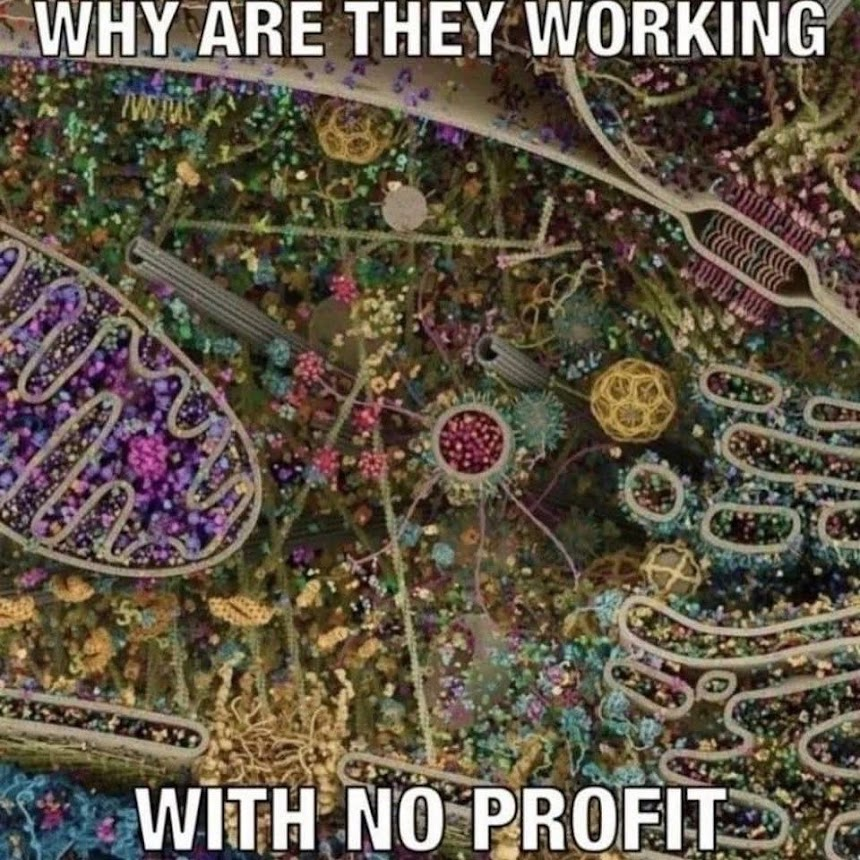
My point here is, that we know educational programming is not a money-maker; we as a community know this, we as individuals know this, and certainly the Speed Art Museum knows this, possibly better than any of us. So, then, how can we expect an institution which is propelled forward primarily by means of capitalism to embed education into its core functions? I am not saying that the Speed is without blame, and it is important to hold the people within our institutions accountable. But from an epistemic perspective, I have to wonder if accountability (in the full, interpersonal sense of the word) is even a possibility for organizations as large as the Speed or if we’re asking an ATM to bake us muffins? We have to stop being surprised and/or outraged when capital-driven institutions make decisions based on capital, or we will never reach truly community-oriented ways of being and working in the world, and continue to fall prey to hypostasization.
Via emj on Pinterest.
So where do we place our trust instead? I would love to give a clean answer to this question to tie everything up in a neat bow, but unfortunately the resolution is messier. While the community letter to the Speed was written with the best intentions, and of course it is important to hold Dick Clay’s³ feet to the fire, I am not sure that it will ultimately get us anywhere. Asking an institution (here, the Speed) to reform itself internally will probably either reproduce or reinvent the same issues (here, lack of concern for education and community in practice and not just theory). This paradox has long been in discussion, largely by groups who forefront decoloniality,⁴ but by many artists, intellectuals, and activists as well: Can an institution be reformed without replicating its “institutional-ness”? Can it be critiqued, either from within itself or without itself? Is, as curator Helen Molesworth asks (on pg. 207), the museum “one of the greatest holdouts of the colonialist enterprise”? Is “ the whole damn project of collecting, displaying, and interpreting [often stolen] culture… unredeemable”?
I am not so idealistic as to think that the public infrastructure of a museum does not serve many purposes, but whether museums, in their current iterations and forms, serve the purposes we long thought they did, I’m not sure. The reason I’m reluctant to prescribe anything is because there is no one correct answer for all cases, institutions, groups, and individuals. The restructuring or abandonment of the museum as a place for non-theoretical care and living, rhizomatic community will require many hands. It is my hope that this article will also be brought down from the nebulous plane of theory and into working practice. So, if you are looking for a next (or first) step to take, let it be that you start a conversation with other members of our community, and allow art and kinship to exist outside of institutional confines. Organize a show in your friend’s basement, or out of your living room. Organize in general. Start a writing group, a critical theory book club, or a crafting league. Engage in mutual aid practices and liberatory movements in your area. As much as we may want them to, museums are not going to save us. It is a valuable thing to push for institutional reform, and to advocate from within, but if history is any indicator of present circumstances,⁵ then bureaucracy is not going to pick up the pace just because we ask nicely. So, in the meantime, we will have to be the ones to value our education, our aesthetic practices, and our liberation. Though daunting, we can make it if we make it together.
Footnotes
¹ Whether they are successful at this definition or not is an entirely different question.

² To be fair to the Speed, the construction of the sculpture park has likely been going on behind the scenes for a while now. It is very difficult to re-allocate funds from one project to another (though there has been online speculation that this has been happening at the Speed with grant funding), and if we are giving them the benefit of the doubt, it is unlikely that the park unveiling and staff lay-offs happened in tandem.
This does not, however, negate the other ways that the Speed manages their finances. For example, in 2024, Executive Director Raphaela Platow received a salary of nearly $300,000, whereas the current rate listed on Indeed for a Gallery Attendant is $13 per hour, likely without benefits, which amounts to less than a $30,000 salary, which is within the federal poverty level guidelines for a family of four in the year of our lord and savior 2026. Not to mention the $50 million renovation from 2012-2016 intended to expand gallery space, which is now primarily used as rental space for weddings and the Museum’s gift shop.

³ (Richard) Dick Clay is currently the Interim Director for the Speed Art Museum’s Board of Trustees.

⁴ "Decolonization is grounded in the practice of living, encompassing both daily acts of resistance, refusal, and sabotage, on the one hand, and economies of love, care, and mutual aid on the other. in other words, the ethos of decolonization is inseparable from process and practice rather than an ultimate outcome posited in advance. Mignolo suggests that decolonial practices involve a “delinking” from the normative political categories of modernity, reorienting struggle away from the state as an ultimate horizon (which is not to say that they could or should ignore the force of state power)." (MTL Collective, "From Institutional Critique to Institutional Liberation? A Decolonial Perspective on the Crises of Contemporary Art", pg. 197)

⁵ And it nearly always is.
Community letter to the Speed
Dear Mr. Clay,

We, the undersigned artists, educators, and community members of Greater Louisville, are writing to express our deep concern and disappointment at the recent decision by the Speed Art Museum to eliminate the Learning, Engagement & Belonging (LEB) department. We believe this move places at risk the very relationships that the Speed has diligently built in recent years with schools, local communities, and future supporters of the arts.

As you know, LEB served nearly 20,000 people in fiscal year 2025 alone—including
marginalized communities, families, K–12 and university students, seniors, and artists across Kentuckiana.* Programming participation grew by nearly 200% in the past
several years—along with a 120% increase in program offerings and a 150% increase
in community partnerships.* These gains reflect thoughtful, community-driven work that
has strengthened trust and relevance.

Critically, many of these initiatives specifically engaged Black residents, the Latinx
community, older adults, and others historically underserved by major cultural
institutions. Ending these programs now—amid a broader national climate of hostility
toward inclusion and diversity in arts and education—sends a painful message that the
Speed may be turning away from its own stated values of equity, access, and
belonging.

We recognize the Speed faces financial challenges, including a reduction in the FY26
operating budget from $12.3M to $8.7M.* Yet this abrupt elimination of an essential
department raises serious questions about leadership foresight, governance, and
stakeholder consultation. We strongly believe donors, community members, educators,
and partners would have rallied to support a transparent plan to sustain the Museum’s vital education and community engagement efforts.

We respectfully request clarity on the following points:

1. What metrics led to the conclusion that eliminating the LEB department entirely was the only viable option to alleviate the Museum’s financial constraints?

2. Moving forward, how does the Museum intend to invest in education, preserve inclusive arts access, and rebuild the sense of community belonging fostered by the LEB department?

In our view, the long-term cost of this cut may far exceed the short-term savings. The
community served by LEB will not simply absorb this loss without consequences: fewer
schools will bring classes, fewer young people will form lasting connections with the
arts, and fewer future donors, artists, and cultural advocates will emerge from our own community. The Speed is not just any museum—it is Kentucky’s oldest and largest art museum, and with a collection spanning thousands of years and global cultures, the
only encyclopedic art institution within a 100-mile radius of Louisville. Its role in providing meaningful arts access for our community and surrounding counties is irreplaceable. When its educational infrastructure is dismantled, an entire region loses its most inclusive gateway to art.

We urge you to address these concerns promptly and outline a credible path to restoring education as a core function of the Museum. We believe this is a moment for the Speed to reaffirm its role as a place of community belonging, and to lead by example in championing inclusivity, accessibility, and relevance not only within its own walls, but in the experience of art itself for the next generation of learners and supporters.

Thank you for your attention to our concerns. We look forward to continuing this dialogue and to helping the Speed maintain and strengthen its role as a vital cultural hub for Kentucky and beyond.
Dick Clay’s (Interim Director of the Speed) response to the community letter
Dear Ms. Smith and signatories,

Thank you for your letter and taking the time to speak with me to share your concerns about the recent restructuring at the Speed Art Museum, including the Museum's decision to close the Learning, Engagement & Belonging (LEB) Department.

This decision was made in the context of a major reduction to the Museum's Fiscal Year 2026 operating budget. Reducing the budget required considerable adjustments across multiple departments, and LEB was among those impacted. The Museum conducted a thorough review of programs, staffing, and operating costs to determine how to continue core functions within significantly reduced resources. The decision to eliminate LEB reflects the Museum's financial constraints rather than the value of the department's contributions or the communities it served. We acknowledge that the LEB team cultivated important partnerships with artists, educators, schools, and community partners on behalf of the Museum.

Much of LEB's growth in recent years was made possible through time-limited post-pandemic relief funding and short-term grants designed to help cultural institutions rebuild after COVID-19. Those funds have now ended, and attendance and philanthropic support have not returned to pre-pandemic levels. Without those external resources, the Museum could not sustain the expanded model that was built during that period. These conditions, and the need for resulting budgetary cutbacks, have confronted arts and cultural organizations across the country.

Education remains a core part of the Museum's mission. While the former departmental structure is no longer financially viable, work is underway to determine what programs, partnerships, and services can continue within current resources.

For example, this fall, we continued to provide school tours as capacity allowed during a period of transition and will soon introduce weekly K-12 offerings for this semester. The Curatorial Department is also developing new programs connected to our permanent collection and special exhibitions.

The concerns raised about the impact on schools, families, artists, and community partners are central considerations as we build a revised model for education and public engagement. The Museum recognizes the importance of these relationships and will continue to foster connections and partnerships, even as we confront the limits of our present capacity.

You asked the Museum to outline a credible path to restoring education as a core function. Education is, and has been, a core component of the Speed's mission. Currently, the Museum's immediate priority is stabilizing its financial position. Speed leadership and the Board of Trustees will continue to evaluate how educational programs can be delivered sustainably given current resources.

As decisions are finalized, the Museum will communicate future plans and stay in touch with our community about next steps. We welcome continued dialogue as we move forward.

Thank you again for reaching out and for your investment in the Museum's role in the community.

Sincerely,
Dick