

And Then The Wheels Fell Off
Scott T. Anderson’s And Then The Wheels Fell Off at Outsider Art Gallery
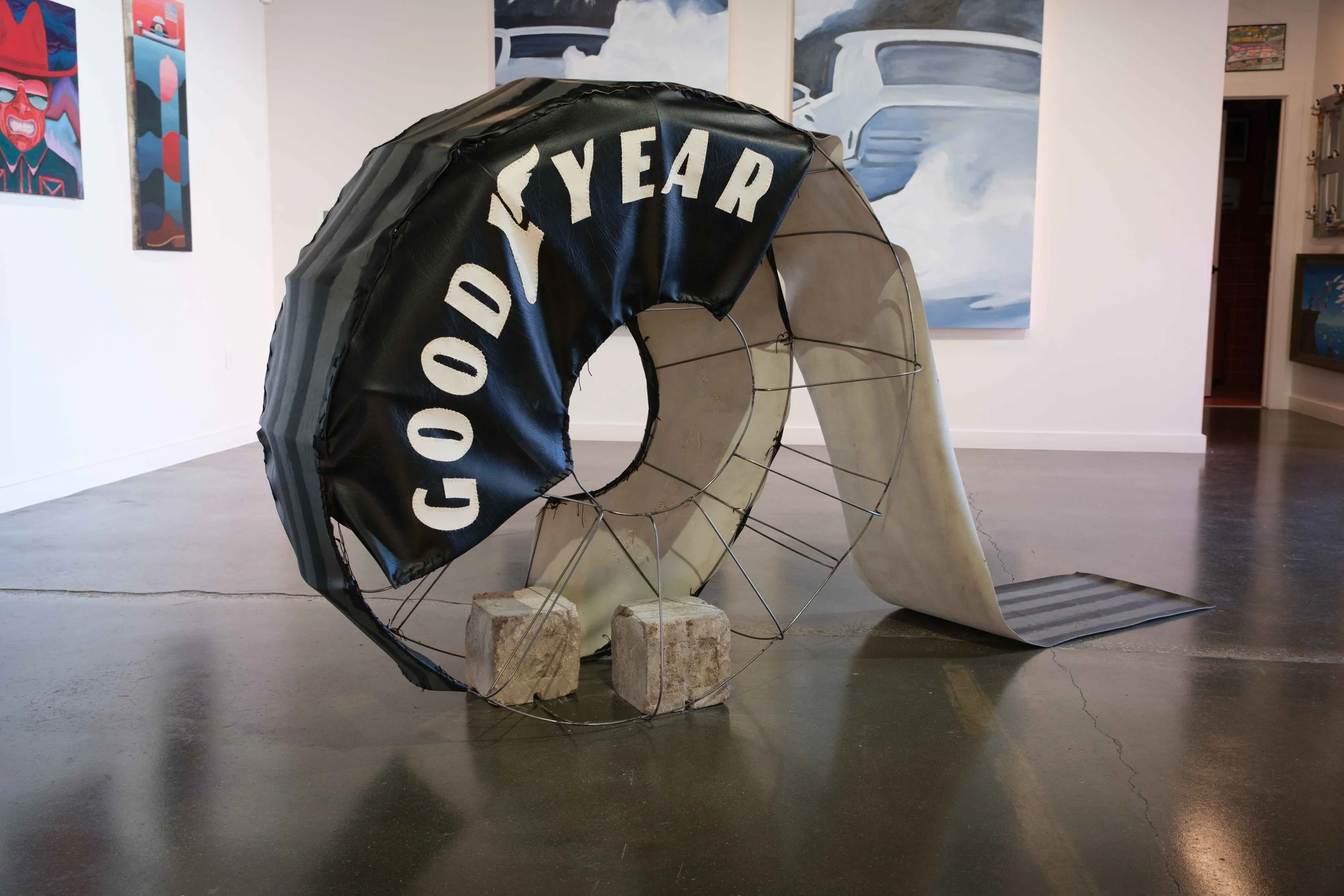
Scott T. Anderson, The Bones of a New Year, 2025, Vinyl stitching acrylic paint cinderblocks
Multidisciplinary artist Scott T. Anderson’s solo show, And Then The Wheels Fell Off, on view at Outsider Art Gallery, positions viewers within the American dream’s idle feedback loop. The exhibition forms an arena, a white-walled colosseum where national mythology plays out to the point of collapse. Symbols circle endlessly, spiraling the heights of Vertigo’s staircase without any potential of true ascent. Anderson’s visual language of strain and suspended motion reveals a carcass of American idealism. Repetition that persists without momentum builds an irresolvable tension that grinds hollow promises of prosperity into trails of burning rubber and collective exhaustion.
The towering scale and central placement of Anderson’s sculptural work, The Bones of a New Year (2025), beckon visitors toward the back of the gallery. Scrap remnants, easily identifiable through a commanding “Goodyear” tire logo, unfurl to expose a simple wire armature and two concrete blocks that arrest any possibility of advance. This vital mechanism of American action and enduring icon of the limitless open road is rendered utterly impotent. Inertia resigns the rubbery flesh of what remains to stand in shame—a child with dunce cap, nose to the wall—an absurd monument of utter futility.
Hanging on the back wall beyond Anderson’s tire, Going, Going, and Gone (2025) attempts to peel away from the scene of the crime. The diptych offers only two brief frames that catch the tail end of overexposed dust trails spat from an engine racing out of view. Our getaway car is blown out in a cloudy haze of blue and white. Resolution is lost as we spin our wheels, blinded by the fog of our own fumes. Turning over and over in place, the scene kicks up the violence of static repetition. As we press harder on the gas and find ourselves headed nowhere, we stray deeper into the bright light of obscurity.
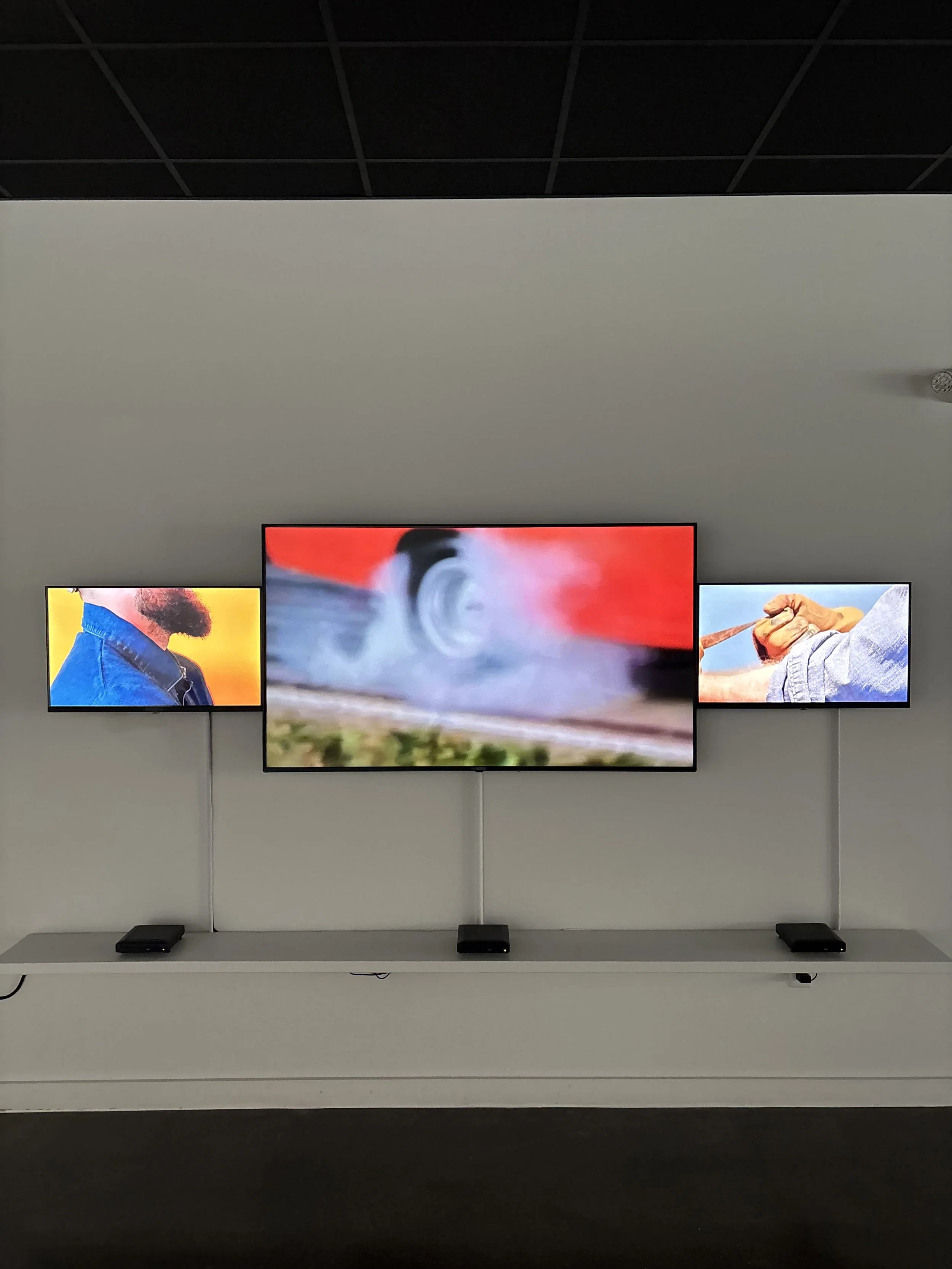
Scott T. Anderson, Feels like we’re gettin’ somewhere, don’t it?, 2025, Three panel video loop
In Feels like we’re gettin’ somewhere, don’t it? (2025), stalled images shift into gear and we are met with a video compilation of squealing car tires burning out. Flanking either side, smaller screens display footage that alternates between grimacing figures and yellow-gloved hands that wring and twist rope over on itself. The heads that grit their teeth are cut off just above the mouth and we watch these anonymous figures—chests heaving up and down, shoulders tensing, and heads twisting in tension as jaws tighten to expose neck muscle and sinew. Flesh and machine relay the visceral discomfort of friction.
Anderson’s video work uses the language of narrative film to withhold resolution through sustained intensity. The rope never snaps. Bodies never slump into rest. We are held paralyzed at the peak of exertion, left with an unbearable, indefinite stretching. What was spread thin becomes thinner yet. Anticipation hardens into irritation. We brace for a relief that never comes. The raw abrasion of over and over prompts desperation and a desire for a collapse we will never be granted. Images of wasteful action are captured in the circular roving of tire as it meets the unforgiving terrain of asphalt, eroding away pavement, energy, and optimism. We are reminded that the infinite loop cannot listen, adapt, rest, or be held accountable, only persist.
Replayed to exhaustion, the exhibition’s automotive focus turns confrontational, eventually giving way to two paintings that find release through brawling bravado. Trapped in the ring of containment, the spectacle of American masculinity takes center stage. Enduring, driving impact finds its outlet through power. In Anderson’s Dancing in the Midnight Corral (2025), yellow gloves recur from the artist’s video work as the most legible point of continuity amidst faceless opponents. Bodies exert effort to strike each other, exacting violence without vision. The corrosive persistence of physical force spurs from the masculine logic of infinity without pause. Violence emerges as the last language available to a system that cannot imagine a beginning or an end but binds all within a race toward some endless, eternal horizon.
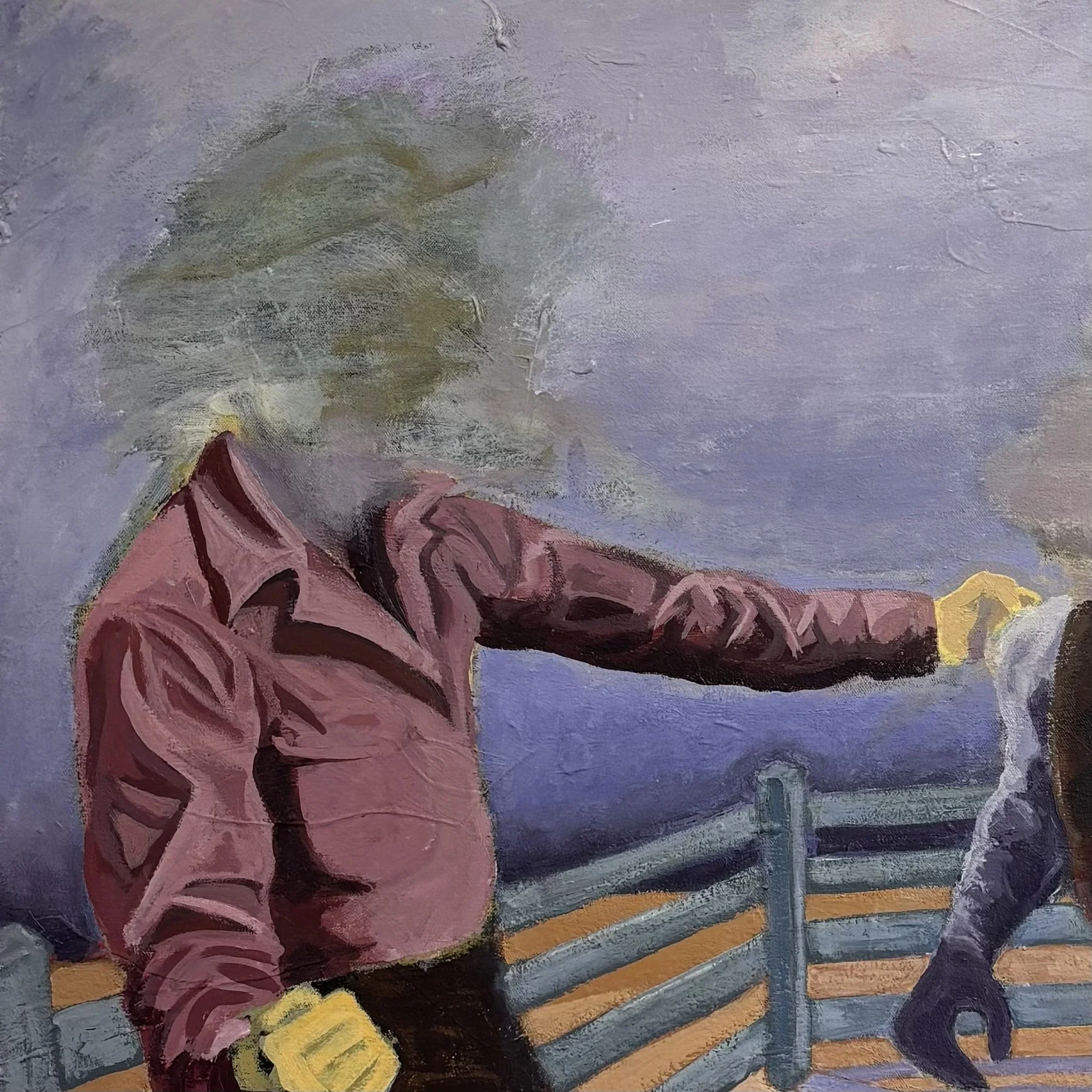
Scott T. Anderson, Detail of Dancing in the Midnight Corral, 2025, Acrylic on canvas
Coalescing into the visage of a single figure, the exhibition’s main character from whom the show takes its title looms over the surrounding works, a snarling avatar whose bared teeth shine beneath an obscured glare. Harkening back to the cowboy portraiture of Anderson’s previous exhibitions, this lone antagonist’s flushed countenance hovers somewhere between threat and terror. Ambiguity is reinforced through the figure’s aviator sunglasses, an iconic accessory with origins in the U.S. military, spanning the pop culture gamut from law enforcement to Raoul Duke.
Huddled beneath his refractory armor, this red-faced posturer stares out at us, yet we can never meet his gaze. Denied reciprocity, we are reminded of obfuscation as a necessary condition of power and control. Against this formidable antagonist, Anderson’s Untitled (2024), averts our attention back toward small moments of clarity. Here, a boy poses before a simple beach scene. Cap gun in hand, he dons a cowboy hat as he rides atop a mechanical dolphin. Restricted scale and gentle steed bear a palpable innocence. The child plays, unburdened by symbols hardening into decay.
The artist shares that the figure is drawn from a childhood photograph of himself, never intended to be part of the exhibition. The piece was originally made as a gift for his father, a reminder of a time he says, “when my world was so small.” There is no clear antidote to the formidable terrain of contemporary American collapse. We won’t find it in And Then The Wheels Fell Off, or likely anywhere else. Yet despite our fate in looping freefall, this image helps center our gaze back closer to home, to a time when the world remained strange and new, a limitless maze of childhood wonder. Where still nothing made sense, yet all was transparent with possibility.
