
THE OHIO VALLEY BIENNIAL’S AQUEOUS RHAPSODY
Louisville Visual Art’s 2026 Ohio Valley Biennial Exhibition, juried by relationship and community cultivator Dr. fari nzinga.
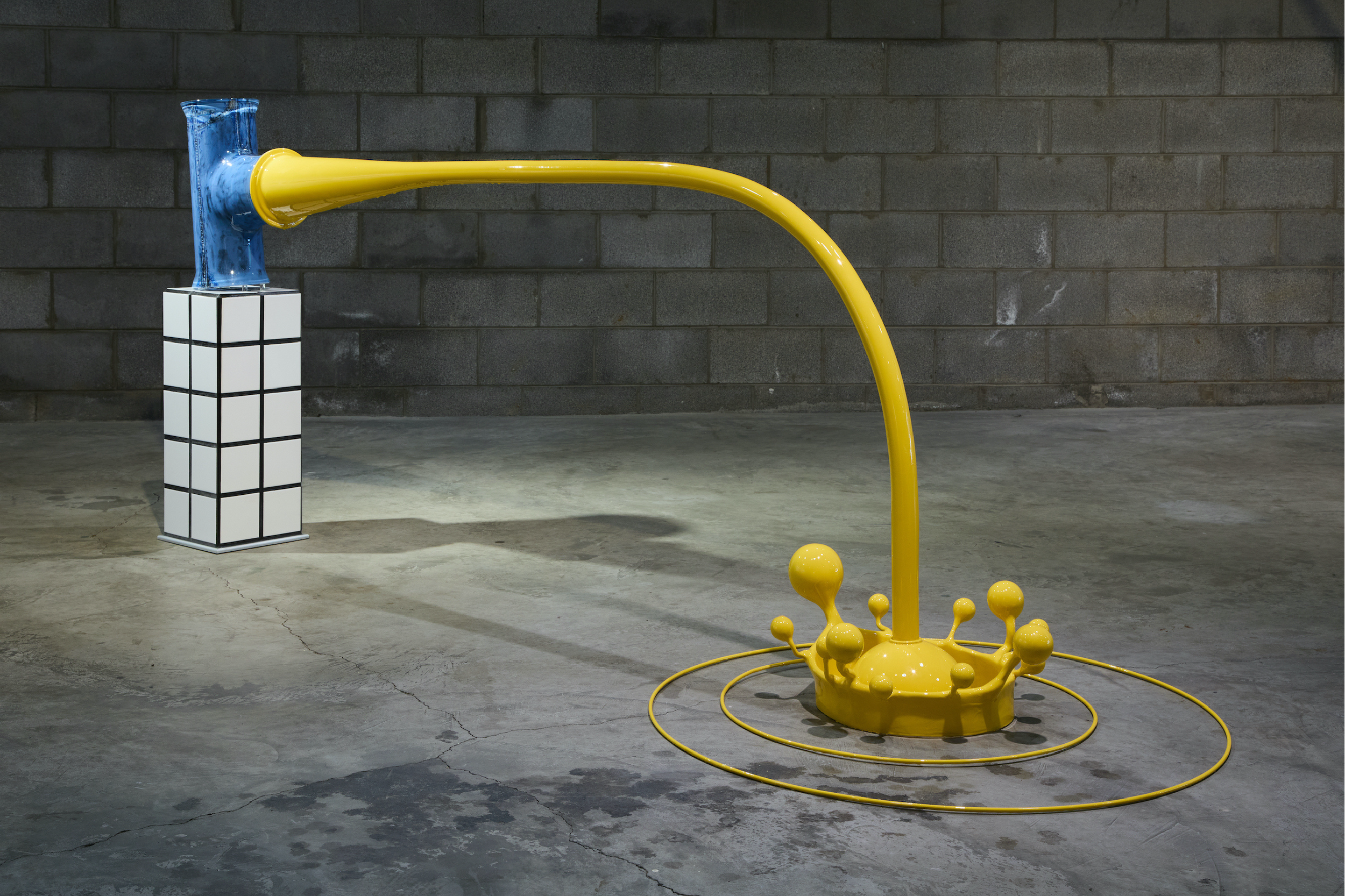
Photo via Louisville Visual Art.
By the time I get over to see this year’s Ohio Valley Biennial, the calendar is already at October’s doorstep. Those last stifling days of Virgo have given way to this crispness, the afternoon sun warm but dry, air and land both kind of toasted. The office staff of Louisville Visual Art have set up tables and brought their laptops to the open maw of the garage door at the gallery’s western wall, and I’m sure I’ve interrupted something for which I needed to RSVP. After generous assurances that they are not, in fact, taking tickets or checking names—just wanting to “feel this sun and breathe this air” (their words), “autumnal but still empty of death” (mine)—I begin my exploration of the exhibition.
I am mostly unprepared for anything I’m about to see. There are, however, faint ripples of preparedness emanating from a phone conversation I had yesterday with the exhibition’s guest juror, fari nzinga. Though a longtime Louisville resident, nzinga spoke to me from her mother’s home in Ohio over the sparkling sound carpet of her own daughter’s curiosity. A cultural anthropologist by training, she’s worked as a curator for many years, most recently at the Speed Art Museum. nzinga is currently a Project Ambassador for the Olmsted Parks Conservancy, working specifically to re-imagine Chickasaw Park through an artistic lens.
nzinga is warm and unassuming, and leaves me with some helpful insights in the description of her own selection process. She told me, for example, that the show did not have a theme and she did not consciously give it one. Given the daunting task of winnowing work from more than 150 gifted regional artists down to fewer than forty, nzinga says she gave the most weight to her own emotional responses to the pieces. She looked at each one “blindly,” completely removed from the names or biographies of the artists, following her gut’s response over conventional aesthetics or even what she “liked.” She dipped her toe into the stream of the subconscious, in other words.
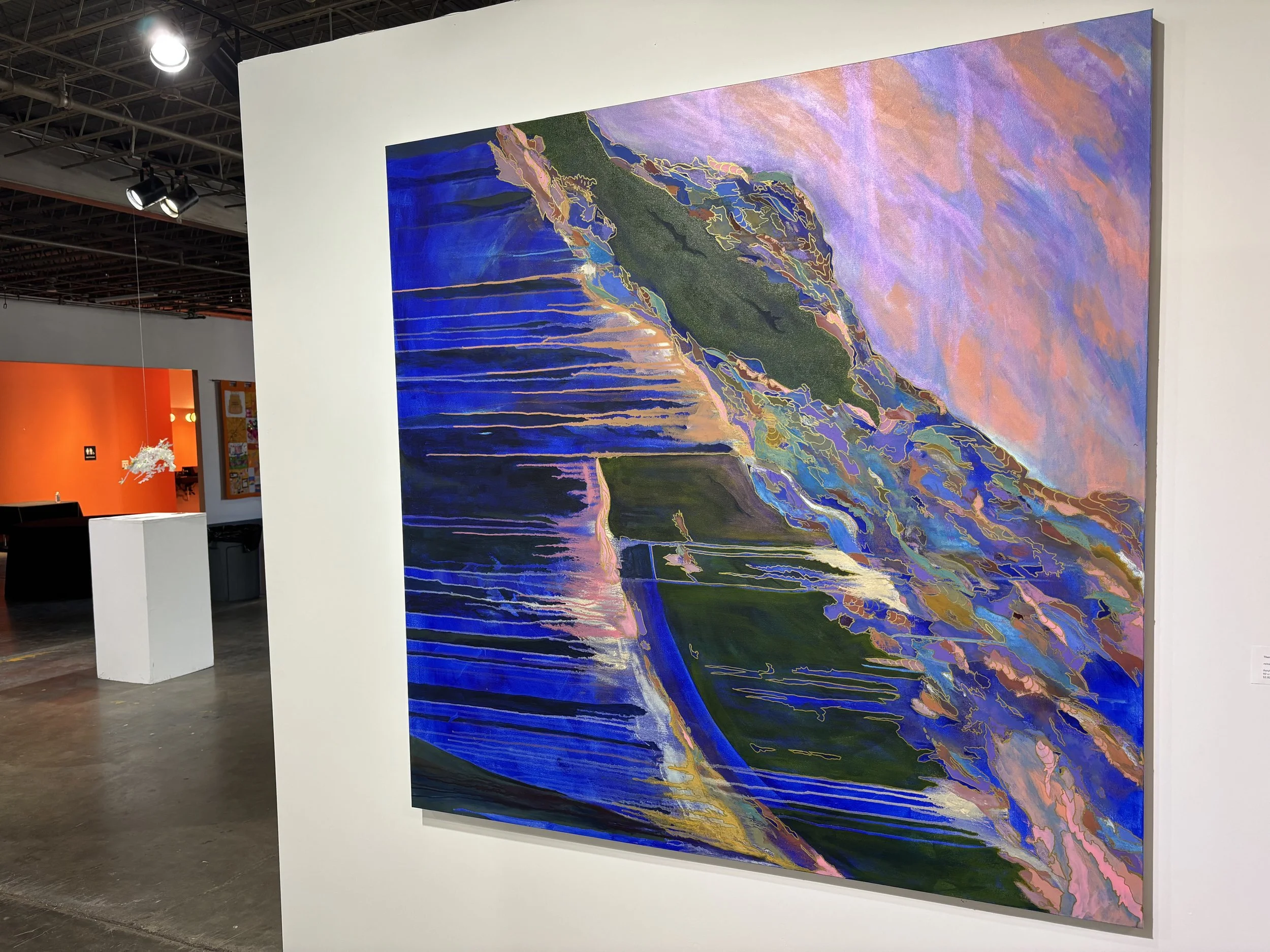
Photo via Caleb Brooks.
If we think of the converted warehouse of LVA’s gallery as a cavern, this exhibition is a Lascaux of vivid color on faux walls arranged into a labyrinth at the room’s center. The first piece that catches my eye happens to have won the award for Best Sculpture, Coral Plume by Edwin Ramirez. It hangs by fishing line above a waist-high white pillar and casts a shadow onto its surface that looks like sunlight through ferns. It is made of clear, delicate glass and seems to have drawn inspiration from the fascinator hats the Kentucky Derby has made so famous: a half-sphere adorned with golden feathers and yellow-green blooms and a pair of Hermetic wings at its fore. One of the listed materials, right there alongside glass and lacquer, is mica.
The painter Theresa Carpenter Beames has three pieces in the exhibition, all enormous and stunning. Release looks like a radioactive tidal basin. There are currents of lavender and drips of deep blue and archipelagos of pink and green framed in gold-leaf. The upper-right quadrant of the canvas has the iridescence of an abalone shell. Entire worlds are in its twenty-five square feet. Another piece, Expand, feels the way I imagine looking into an aquarium on psychedelics might. It is abstract and maximalist and layered with just enough oblong shapes to suggest bizarre creatures of the deep.
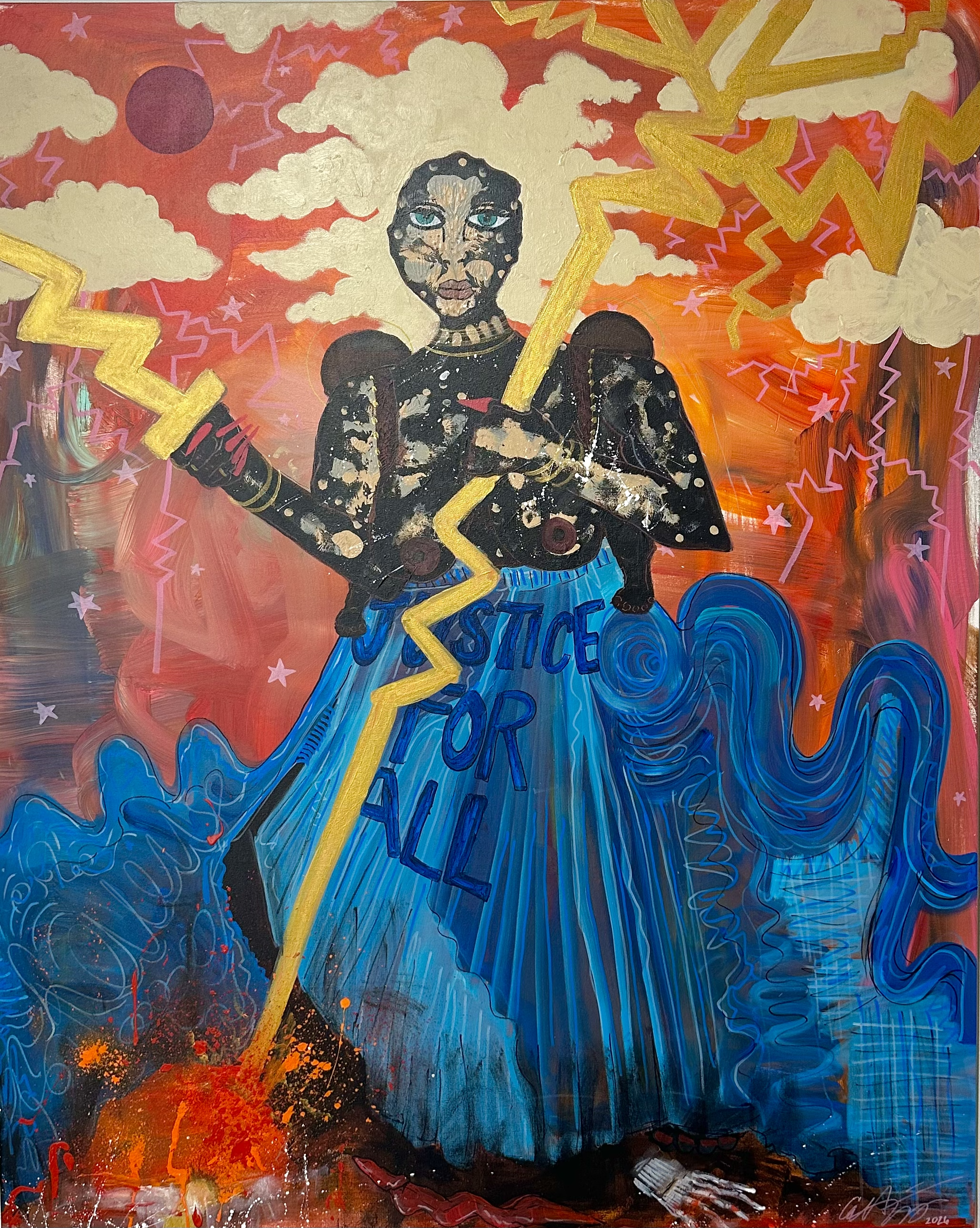
Photo via Louisville Visual Art.
Between them sits Second Amendment for Octopus, a sculpture by Craig Kaviar that poses the question, “What if a cephalopod was also John Wick?” It is made from forged iron that shines like polished coal and incorporates parts of real disposed firearms collected and dismantled by the Guns to Gardens Project at the business end of each tentacle. The animal looks up plaintively, a little ghost at the center of its undulating ribbons of violence, and what I understand about the alien physiology of octopi makes me wonder if the weapons have become part of their decentralized neural clusters, and if so, what they might ponder.
The winner of the biennials’s “Best 2-D Award” is Mary Rezny for her piece Clouds Illusion. Crafted from archival photographs of blue sky and feather canyons of cumulus woven at the piece’s center, Rezny’s work feels like a glitch that allows us to see the texture of space-time as a basket cradling our lives. The title, a clear reference to the opening stanza of Joni Mitchell’s “Both Sides Now,” invites us to ask if we really know clouds at all, and what else we might be misunderstanding.
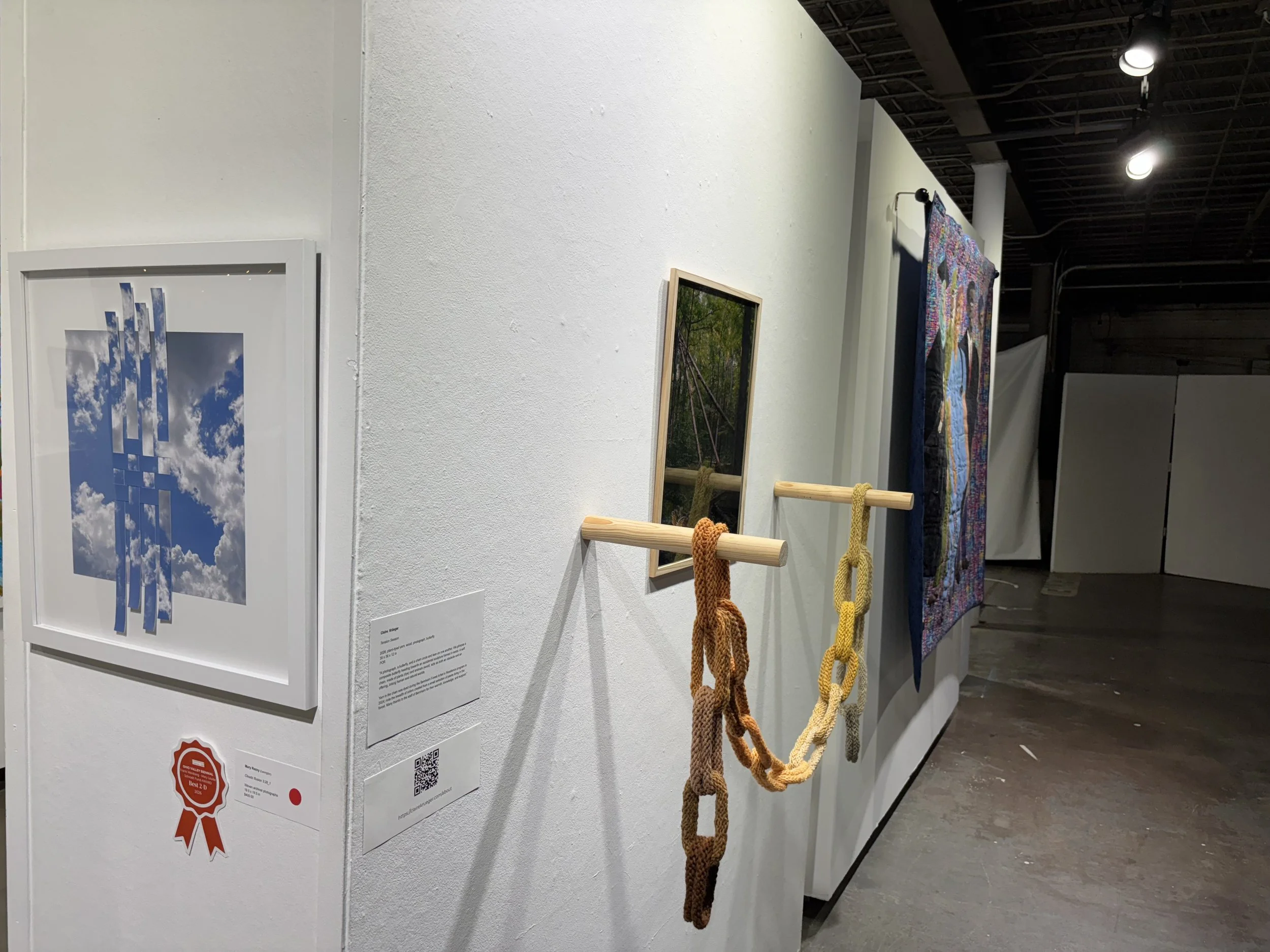
Photo via Caleb Brooks.
At the show’s far end hangs a mixed media piece that functions as its own gallery wall of dyed yarn. Polyester Estuary is more than just a highly palatable spoken phrase, it’s also the name of this delight by Claire Krueger. Ten tapestry panels hang from a wooden header that’s been painted with pixelated flowers in the fashion of those early, 8-bit video games. Each panel features its own woven member of a wetland ecosystem: there’s a turtle, heron, fish, muskrat, and cattails to name a few. Up close the yarn is ombre and striped and the pastels continue out over the driftwood frames.
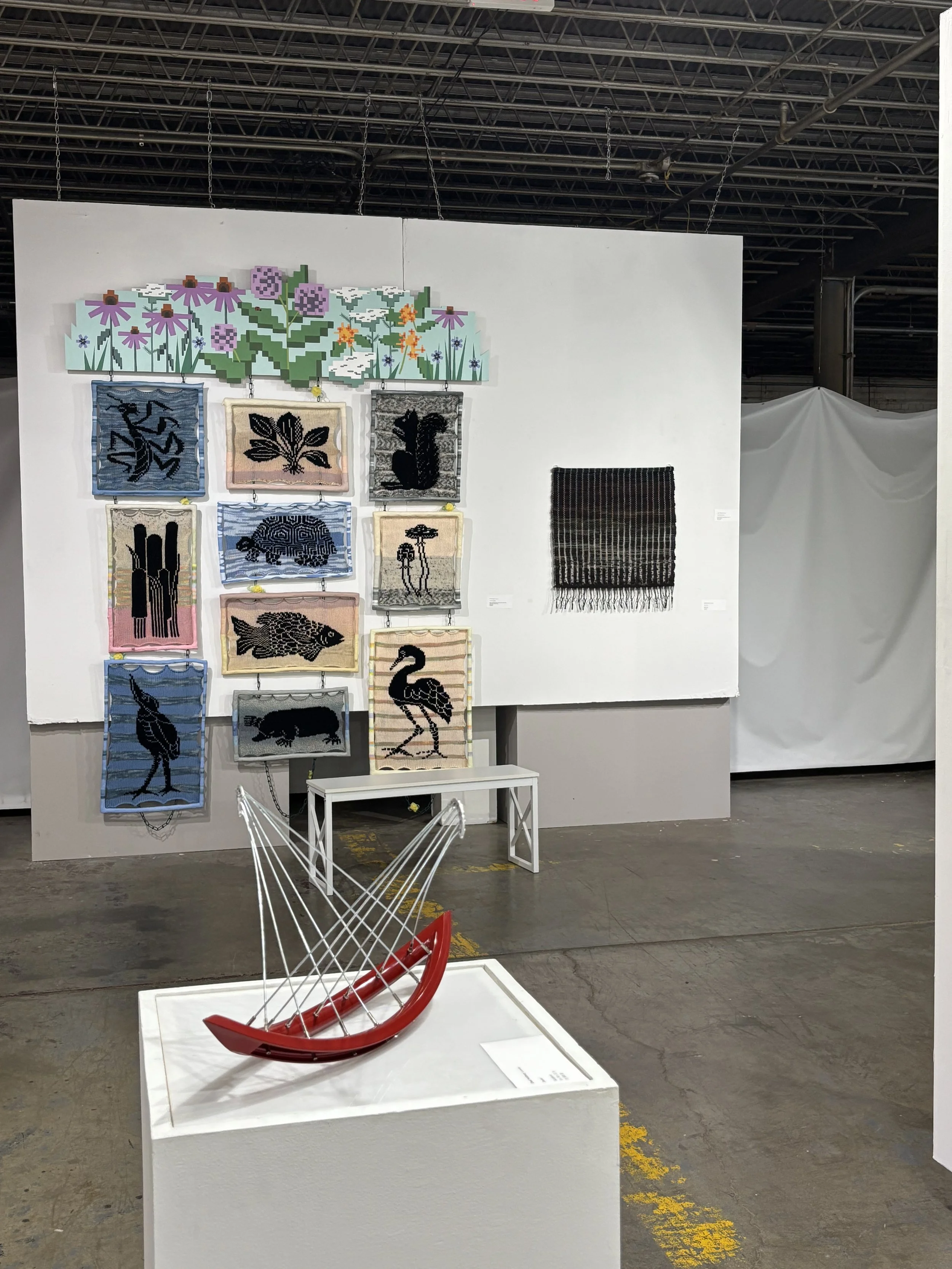
Photo via Caleb Brooks.
While nzinga couldn’t put her finger on a specific concept during our call, at one point she kind of laughed and said that if the exhibition had one it might be “ethereal, metaphysical, or woo woo.” After those remarks, I scribbled “the theme is woo woo, the theme is you,” in the margin of my legal pad, and that offhand note is beginning to feel some vindication. At this point you may notice that I’ve stumbled upon my own idea of a theme. The exhibition positively teems with water. The pieces flow with liquid intelligence and are sometimes just overtly referential to the world of the aquatic. I think this makes sense. This is, after all, the Ohio Valley Biennial and it’s being shown here in Portland, the most infamously riparian neighborhood in Louisville. LVA’s space is but a stone’s throw from the canal that bypasses the river’s roaring cataracts and limestone countertops that brim with tabulate coral fossils left in the wake of an ancient ocean.
Even further, I would make the case that nzinga’s current focus, Chickasaw Park, is our city’s park most defined by the Ohio. Chickasaw’s entire western border is riverbank, and there’s nowhere in its 61 acres that you can’t sense the absence it implies just beyond the treeline. Chickasaw is also the only Olmsted park designed specifically for Black residents during segregation, so it’s a place that cups the deep pools of those memories with both hands.
A sub-theme I begin to sense is that of the feminine. “Eve” appears in the titles of two pieces. Within the feminine, there’s a special emphasis on Black women of the US diaspora. There’s Debra Lott’s Black Swan, an oil-on-canvas depiction of a Black ballerina in three expressive poses while pairs of swans intertwine their necks in the background. The painting is treated with a cooling blue wash that makes it seem like you’re viewing the dancer and accompanying fowl through sheer curtains the color of an overcast dawn, but they could just as easily be underwater. There’s also Dr. Jabani Bennett’s mixed-media work Anansi’s Oak and Anansi’s Reeds, in which the artist has captured a Black woman at a moment of ecstatic joy, her braids a mosaic of buttons and jewels and fabric, her blouse a collage of exuberant wax print patches from the markets of West Africa. Lori Lamb’s Goddess Glance depicts another Black woman in portrait, her posture and the angle of her head identical to Rosie the Riveter. But this model has exchanged the trademark red bandana and flexed bicep for a crown of pink flowers and an expression that says, “WE can’t do anything right now, because I am not the one.”
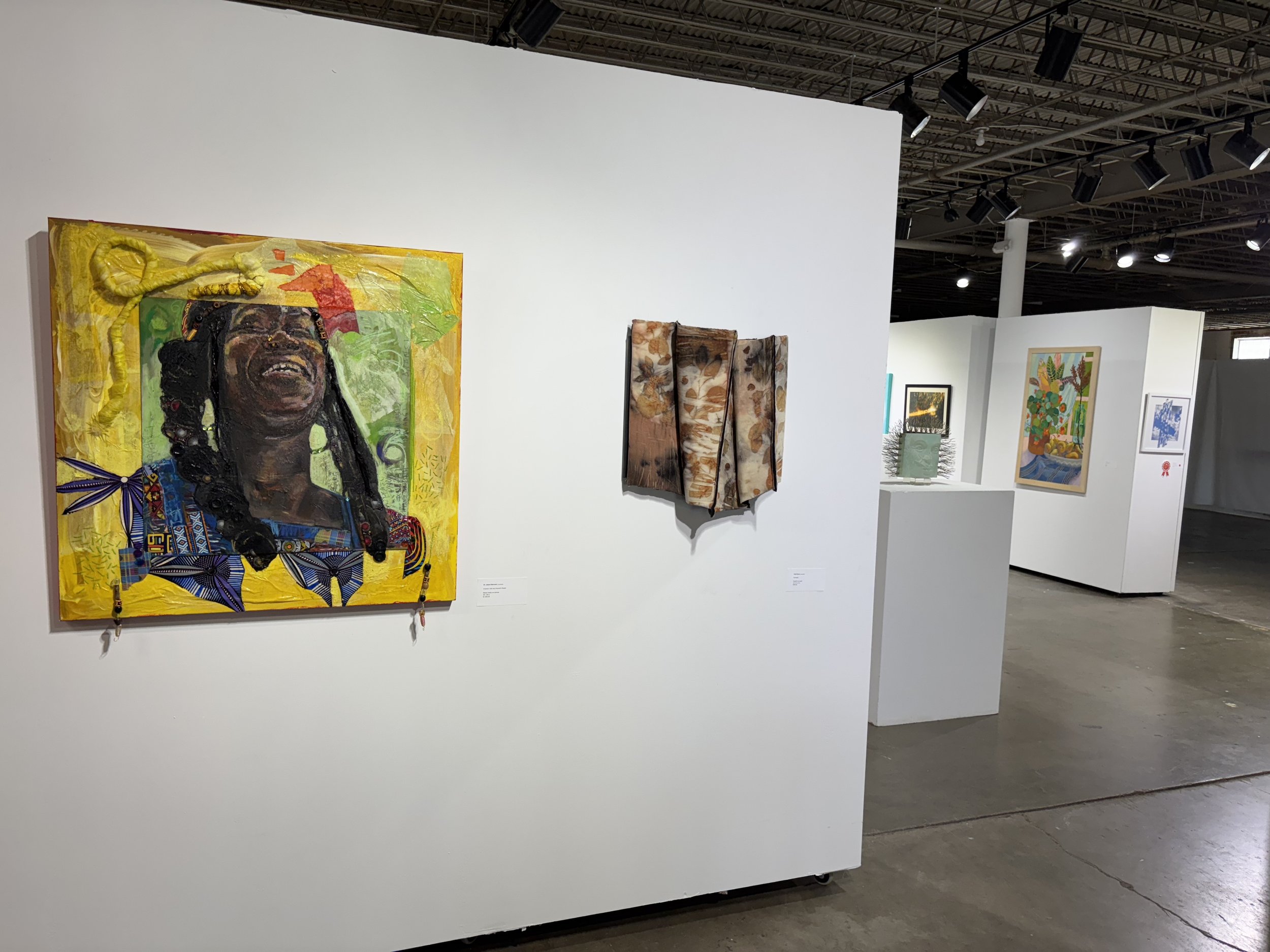
Photo via Caleb Brooks.
I, for one, think all this work is beautiful. Beautiful, too, is the way its inclusion seems to have bubbled up from the source of its juror, and what else could it have done? The exhibition is a peek into one of our city’s most-talented and inquisitive minds, an anthropologist who came of age on the campus of Oberlin College—the first college in the United States to admit either Black students or women, and both long before the first shots of the Civil War were fired. And someone raised, no less, by a mother who chaired the college’s Africana Studies department and was herself descended from Owen Brooks, a veteran of the Mississippi Freedom Movement. It’s dazzling what seeps into us and how, all these epigenetics and the unknowable hardware of our evolution shaping who and what we are now, both individually and societally. It is not always lovely, these depths. But there’s healing in charting and shaping them, forging them into something that can be seen and known.
Art is always an explication of our existence, and this Biennial succeeds uniquely in this role. The local artists it elevates are awash with talent and have plenty to say that, consciously or not, nzinga has gathered into a cohesive reservoir of expression. The exhibition is open through mid-November, and you owe it to yourself to make the journey down and see what’s been scrawled on these cave walls. The theme is always us. The subject is always you.