
Field notes from artist Aaron Raymer on his Great Meadows Foundation Artist Professional Development Grant trip to New York City
All photos via Aaron Raymer.
After landing at LaGuardia, I went with what I knew and grabbed an old-school union cab. I guess everyone takes Uber now because there was no line. As I got situated and moving along the BQE, I put on Ace Frehley’s version of “Back in the New York Groove,” as I have ritualistically done when coming over the Manhattan Bridge. The strobing sunlight filtering through the girders supporting the bridge, syncopated with the stomping bass drum, gave me a sense of familiarity and comfort. I’ve been here before. “And baby, you’d better believe, I’m back, back in the New York groove.”
Once I was dropped off at my hotel in the East Village, I wanted to get acclimated. I walked by my old apartment (my longest continuous address) then through Tompkins Square Park, where I used to take my son every day before and after school to run off his “extra” energy–which he obviously inherited from me–and stopped at Yuca Bar for “Tapa’s Tuesday.” It was the same, but everything was different. Some things had obviously changed, including the increased corporate influence, but all the old haunts were still there. I was the one who had changed.
Nostalgia can be a trap, but sometimes it’s good to check in on your experiences to gauge growth, stagnation, or regression. This was not the nostalgia trip I came for.
I was awarded the Great Meadows Foundation artist research travel grant to visit New York. The impetus for taking the trip was to see the Marcel Duchamp retrospective at MoMA. This was the most complete exhibition of his work in more than fifty years. When I discovered Duchamp in my twenties, it completely changed the way I understood art and what art could be. It helped me morph from an outsider artist drawing tattoos and band logos into someone considering the conceptual implications of what I create. This is the nostalgia I came for.
So, when I had the chance to see what was a once-in-a-lifetime opportunity, I jumped on it.
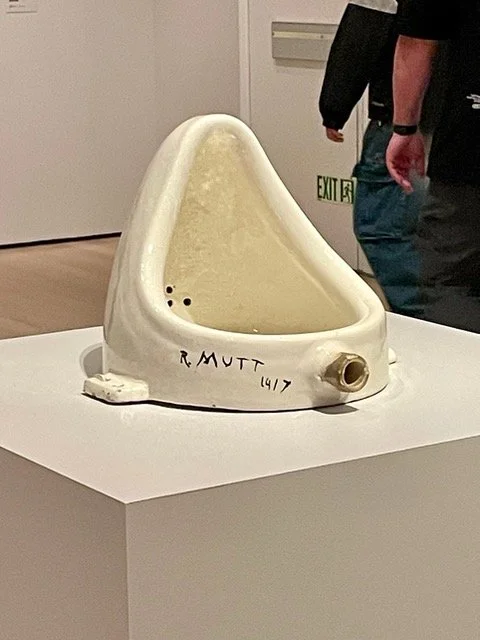
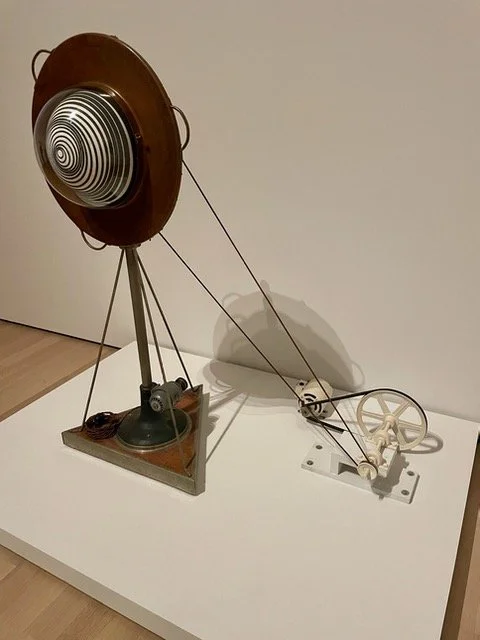
It was informative to see the progression of Duchamp’s career, from the early doodles, drawings, and paintings to the ready-mades and machines. What I saw seemed to be the evolution of a curious prankster who would grow bored with styles, methods, and conventions. Still, the playful absurdism born of the Dada movement was noticeably absent from the historical approach to the exhibition. It was informative but sterile and dry. Or, as Terrence Trouillot wrote in his review for Frieze, “This once-in-a-generation New York retrospective is built like a mausoleum when it should be a monument to the artist’s ungovernable wit and wonder.”
If MoMA was a mausoleum, then the urn containing Duchamp’s ashes was still smoldering, because the smoke stayed with me throughout the day.
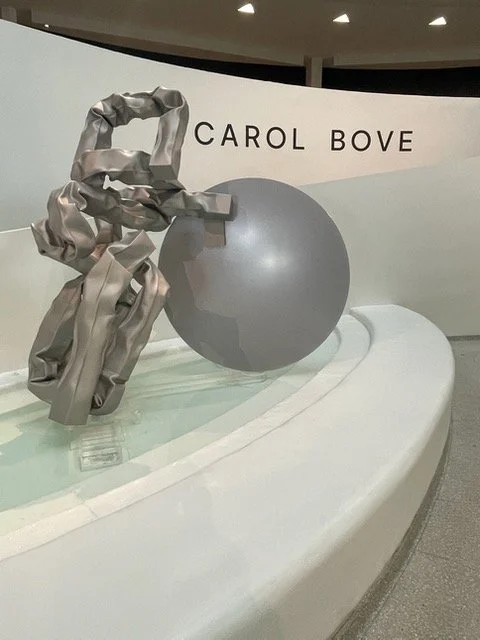
His influence weighed heavily on my next stop, the Guggenheim’s retrospective of Carol Bove. I had lost touch with her and hadn’t seen much of her work since I had her as a professor in grad school at NYU. She doesn’t do social media, so I was unaware of her latest work-or even that she was having this monumental show-when I proposed the trip for the grant. It was a pleasant surprise.
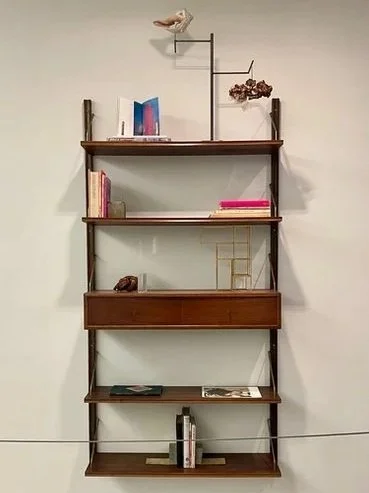
The exhibition moved through the stages of her work: the faint white-on-white drawings of ’60s and ’70s pop-culture icons, shelf assemblages consisting of books ranging from counterculture to philosophy alongside various objects, the peacock-feather “rug,” and many other works leading up to her large, crumpled metal forms.
What struck me was the variety of materials, methods, and lines of interrogation she employed. In true Duchampian fashion, she is not constrained by one technique or style. Like Duchamp, Bove’s work subverts expectation, though her cerebral concern with content removes some of the playful surface-level entry point.
This is very serious art, folks.
Following this, Duchamp’s smoke trail led me to White Cube to see work by David Hammons. Again, I did not know that this exhibition was going to be up when I applied for the trip—another lucky surprise.
I first heard about Hammons shortly after grad school, when I was making prints on large panes of glass by pressing my body or face against them and leaving my body oil behind. My studio mate saw them and said, “Are you making David Hammons pieces?” After looking, he was right, they were basically the same as his body prints that he made from the late 1960s through the late 1970s. The Door (Admissions Office) (1969) and Black Boy Window (1968) for example, were both body prints on glass and had inherent racial connotations that mine lacked. This made them more powerful and heavier than mine. The way I saw it, he closed the book that Yves Klein opened with body prints.
I ended up losing an entire series because it was way too close to Hammons’s work, even though I had been completely unaware of it. But in the process, I became a huge fan.
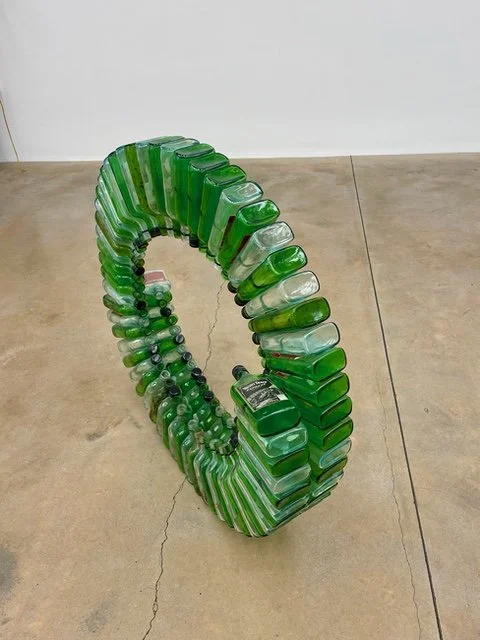
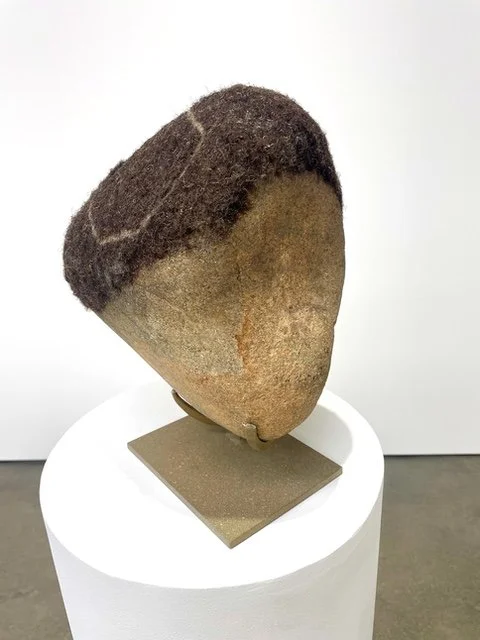
Beyond the body prints, I discovered that we were using similar materials as well. We were both using our own hair, as in his works Hair Relaxer (2007–08) and Rockhead (1998). His works felt closer to Duchamp because of the playfulness, providing an accessible entry point. With Untitled (Wine Bottles) (1989), I couldn’t help but think of Duchamp’s wine-rack ready-made. By arranging wine bottles in a circular spiral, Hammons takes the concept of the ready-made and extends it through repetition, giving the work connotations of consumption and alcoholism. Bliz-aard Ball Sale (1983), is another example, where Hammons sold perfectly packed snowballs in a variety of sizes on the streets of NYC. In the gallery, the piece is represented by a small bowl of water on a shelf accompanied by a description.
Hammons, being a massive Duchamp fan, deliberately utilizes light hearted silliness as an entry point to heavier subject matter. In a 2002 interview with critic Peter Schjeldahl, Hammons stated: “I am the C.E.O. of the D.O.C.—the Duchamp Outpatient Clinic. We have a vaccine for that smartness virus that's been in the art world for the last fifty years."
Like I said: back to the playful absurdity.
If the embers in the urn were still smoldering, Brock Enright threw gasoline on them in a downtown loft on the Bowery.
Pure combustion.
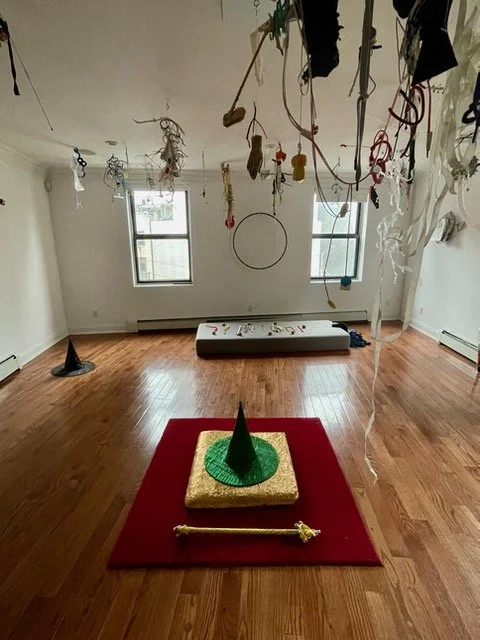
At Club Rhubarb, director Tony Cox, a Louisville native, secured a space directly across from the New Museum for Brock to install his mid-career retrospective. Every available inch of the loft was utilized: the entry stairs, closets, and even the bathroom, which was converted into a video-viewing room.
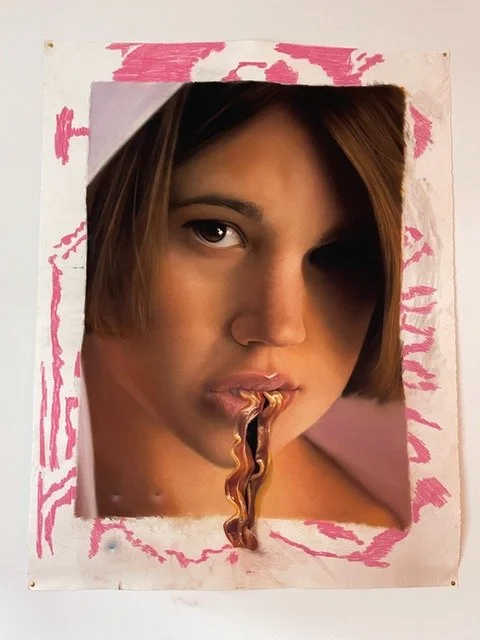
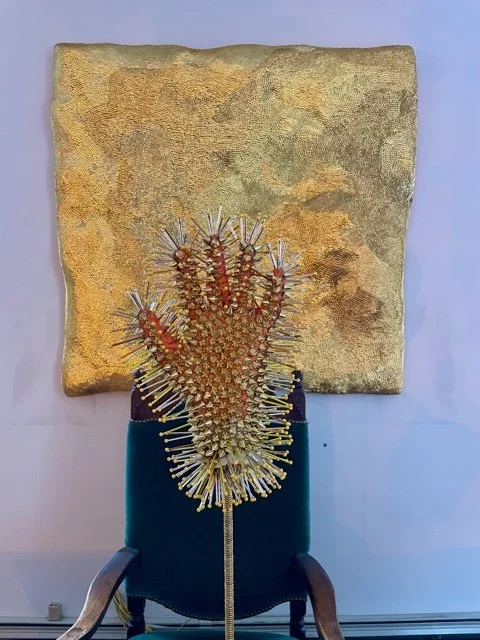
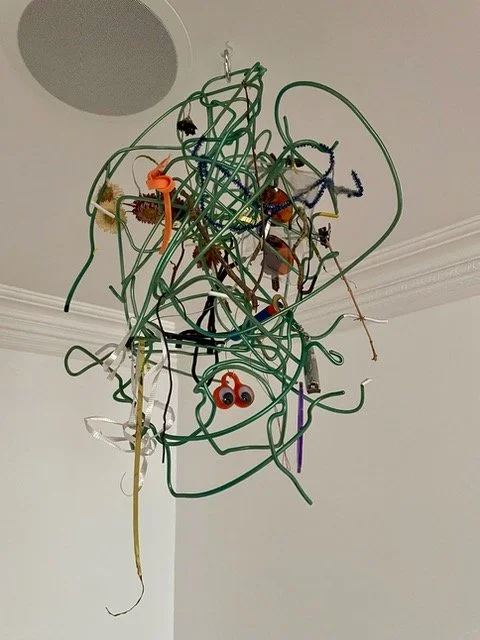
There were photorealistic drawings and collage sculptures made from just about anything you might have lying around. There were mystical and spiritual elements, but to me, the whole thing felt frenzied and energetic.
Since most interpretation is projection, if we are completely honest with ourselves, I couldn’t help but see the curiosity and the battle with boredom of ADHD in the show. The constant need to mess with things. To make things. A mind that will not stop, cannot be held, and is never satisfied with doing the same thing over and over. The rush of dopamine from something new was evident, even though some of the works loosely held to a “series,” like the Fascinators. These were a group of wiry mobiles, but that was about all they had in common. Each used different materials and compositions, seemingly trying to avoid repetition.
It has been a struggle to be an artist working in this vein. Constantly changing interests in materials and subject matter makes it difficult for curators, gallery owners, and the other gatekeepers to place you. They tend to gravitate toward artists who are easily defined.
This person paints flowers.
This one carves stone.
This one deals with politics.
It makes things simple. And believe me, I wish I were that simple.
I did not become an artist to find a “hook,” and regurgitate work like I did working in a factory. I became an artist to explore, discover, and evolve; not to tie myself to one thing.
Duchamp was partially responsible for me quitting my factory job as a plant manager in my twenties to devote my life to creating art. He opened the doors to a world that I was completely unaware existed. In this world, far away from where I grew up, in the blue-collar shadow of the LG&E smokestacks, you could make anything you wanted.
Being raised in the South End of Louisville, value was attached to labor, work, time spent, or technical skill. Those things were what validated anything, especially art.
No one gave a fuck what you thought. It was all about what you could do.
In fact, it seemed like thinking was frowned upon.
Being intelligent was pretentious.
Being clever was threatening.
It was great to see Duchamp, the artist who completely changed my life, and other artists in his lineage getting recognition and prominent exhibitions. It reaffirmed that this path was possible and somewhat viable.